
Feeds:
Posts
Comments

Posts Tagged ‘Warsaw’

Photo: Biblioteka Publiczna w Dzielnicy Targówek m.st. Warszawy.
A library has opened in a new metro station in Warsaw. 

Fans of libraries know that libraries have a way of popping up in all sorts of unlikely — even inimical — places. If you search on the word at this blog, you will find stories about libraries on horseback, in impoverished countries, in war zones, and wherever people find comfort from reading.

Jakub Krupa reported for the Guardian about a new library in a Polish subway station.

“An ‘express’ library has opened in a new metro station in Warsaw, aiming to provide an appealing cultural space to encourage residents and commuters to forgo smartphones in favor of books and, thanks to fresh herbs growing in a vertical garden, a dash of subterranean greenery too.

“The stylish Metroteka [in] the Kondratowicza M2 line metro station in the Polish capital’s Targówek district offers two reading areas for adults and children, as well as a space for public readings and events.

“About 16,000 books are on offer. … Readers can return them on site or through a street-level parcel locker for books, available 24/7.

“Visitors can study or work in a communal area, borrow a laptop to browse the internet, or simply sit down with a complimentary coffee or hot chocolate to unwind after rush hour travel on the metro. …

” ‘Our dream is for Metroteka to become an educational and cultural centre, and not just a place where you borrow your books from,’ says the deputy director of Targówek library, Grażyna Strzelczak-Batkowska. …

“She says the unique subterranean location brings the library closer to busy commuters, ‘both geographically and in terms of time you need to spend on getting the book.’ …

“More than 400 books were leased on the first day, mostly recommended school readings, as well as travel guides and ‘all sorts of how-to books.’

“The library’s innovative model aims to encourage Poles to read more. The annual survey by the National Library of Poland found that only 41% of respondents had read at least one book in 2024, down from the high 50s in the late 1990s and early 2000s, as people turn to TV, streaming services, and phones for entertainment instead.

“These numbers are higher than in southern Europe, but lower than in the Nordic countries, or even the neighboring Czech Republic, the National Library’s director, Tomasz Makowski, says.

“He says there are historical reasons for it – with Poland losing 70% of libraries in the second world war, ‘we had several generations that did not see their parents or grandparents in front of a wall of books’ – but also cultural as ‘reading is not something associated with adulthood,’ but with ‘schools, teachers, librarians, and usually mothers reading to children.’

“ ‘Opening a library in a metro station is like a dream for us,’ Makowski says, as it challenges that stereotype. ‘Libraries should be beautiful and open; inviting, not intimidating. It’s not a shrine, but a place where you can spend time freely, take part in discussions, public consultations, or meet people,’ he says.

“He says the National Library has also opened a ‘loud’ reading room, breaking with the tradition that such areas need to maintain silence, where ‘no one shushes you or tells you to keep quiet. To our surprise, it’s still pretty quiet, but they also talk, give tutoring, different kinds of lessons.’ ”

Good photos at the Guardian, a free paper, here.

What do you think of the library’s chances? I love the optimism behind this effort but can’t help picturing what the subways I know well are like. Has anyone else commuted to work this way?
Read Full Post »

Photo: The documentary Fat Kathy.
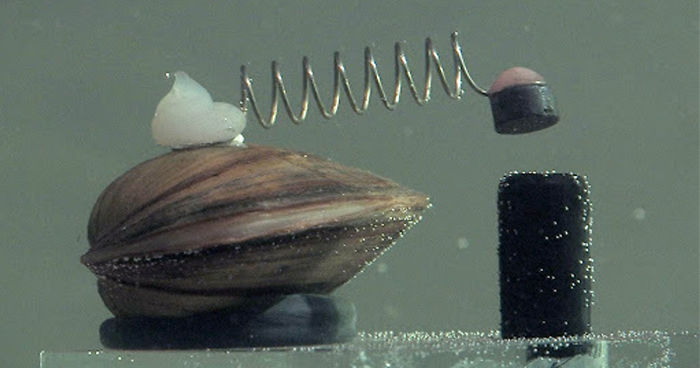
In Warsaw, clams are used to test for toxicity in the water supply.

I have blogged before about the role of oysters and oyster shells in cleaning up polluted water (for example, here and here), but today’s story suggests other mollusks are equally hard at work.

Judita K writes at Bored Panda, “Some manmade things are better left to nature. [That’s why parts of] the world have decided to trust clams and mussels to monitor the cleanness of their water. Despite most of us being used to seeing clams on a fancy dinner plate, some of them get a more important mission — monitoring the purity of drinking water. …

“The water quality in Warsaw, the capital city of Poland, is monitored by … well, yes, clams. A Polish Tumblr user who goes by nickname Ftgurdy explained that the city of Warsaw gets its water from a river and ‘the main water pump has 8 clams that have triggers attached to their shells. If the water gets too toxic, they close, and the triggers shut off the city’s water supply automatically.’

“There’s a whole documentary on that, called Fat Kathy, and you can check out its trailer here. It follows how the main scientist-malacologist watches over the system’s operation. …

“Municipal Water and Sewage Enterprise in the Capital City of Warsaw confirms the use of fish and mussels for biomonitoring. They explain that they use biomonitoring at Warsaw Waterworks to increase the safety of the water treatment process. …

“The mollusks first undergo an acclimatization process after being caught and brought to the laboratory. It takes about two weeks. During that time, scientists also determine the natural opening of their shell — clams leave a slight opening and feed by filtrating water. Within one hour, one clam can filter and thus analyze the quality of 1.5 liters of water.

They live only in completely clean waters and shut their shells immediately if they sense any impurity.

“After completing their acclimatization process, clams are placed in a specially designed flow tank. They are connected to the system controller that sends data to a computer which records the degree that the clams’ shells are open all the time. If the water quality deteriorates, the clams close their shells to isolate themselves from the contaminated environment. That automatically triggers an alarm and shuts down water supply while scientists perform laboratory tests.

“In order for the clams not to get used to the water that’s being tested, they only serve for three months. After their service is done, they are transported back to the same water they were taken from and are marked by the scientists so they don’t pick up the same clams again.

“This Polish Waterworks company claims that this biomonitoring method is one of the most effective proven technologies for water quality testing. According to them, mussels monitor water quality for over 8 million people in Poland. Turns out, Minneapolis is using this method as well. Minneapolis Water Treatment and Distribution Services credit 12 mussels for keeping the water clean and safe.

“ ‘They are filter feeders, so they are feeding off of the water that’s in there, pulling the nutrients down,’ said George Kraynick of Minneapolis Water Works. ‘They live for up to 50 years, they are there 24/7 and they are happy in the tank, just feeding. [After they’ve served their time] most likely, we will just set them free in the river. … Minneapolis is currently the only city in the US that uses clams for biomonitoring.”

The writer also includes great comments on this technology from Twitter and elsewhere on the internet.

More at Bored Panda, here. No firewall. If you prefer your sources to be less like Tumblr and more like the Economist, click here.

Hat tip: John.

PS. You might also like to read how Dr. Thabile Ndlovu in Eswatini (formerly Swaziland) is building a national bank of water data to ensure the water is safe to drink: here. She and her team are particularly focused on the danger of heavy metals.

Read Full Post »

Photo: Edward B. Silberstein/Cincinnati Art Museum/© 2018 Banco de México Diego Rivera Frida Kahlo Museums Trust, Mexico, D.F./Artists Rights Society (ARS), New York
Bernard Silberstein photographed the artist with “La Mesa Herida” in 1941, a year after she finished the work. Where is it now?

Here’s a real-life mystery that reads like a detective novel — my kind of thing.

Natalie Schachar writes at the Art Newspaper, “The hunt for Frida Kahlo’s long-lost painting ‘La Mesa Herida’ (‘The Wounded Table,’ 1940) has been revived in Mexico, where a researcher says he expects to track it down within five years. The work, a holy grail for Kahlo scholars, went missing after the artist donated it to the former Soviet Union. Last seen in an exhibition in Warsaw in 1955, it disappeared on its way to Moscow. …

“Raúl Cano Monroy, an investigator who organised an exhibition at Diego Rivera and Frida Kahlo’s Home-Study Museum in Mexico City last year, says he has uncovered new clues after working with the archive of the National Front of Plastic Arts, which promoted Mexican art abroad during the 1950s. …

” ‘La Mesa Herida’ is Kahlo’s largest painting, measuring around 1.2m by 2.4m, and was done in oil on wood rather than on canvas. The work is a surreal depiction of Kahlo and guests. … The work has been valued at more than $20m today.

“ ‘It’s important because it’s not only a self-portrait, it’s a statement,’ says Helga Prignitz-Poda, a curator and art historian who is working on an updated catalogue of Kahlo’s art. … Prignitz-Poda and the independent curator Katarina Lopatkina outlined their findings about the painting’s history in a recent essay for the International Foundation for Art Research (Ifar) Journal. The authors say that, although Kahlo, a dedicated Communist, sent the work to Moscow as ‘a gift of friendship.’ documents show that Soviet officials considered it to be an example of ‘decadent bourgeois formalist art’ and unsuitable for public display.

“In 1954, the same year Kahlo died, Rivera requested that the painting be shown in Poland in an exhibition with other works by Mexican artists. The show at Warsaw’s Zacheta National Gallery of Art proved so popular that it was sent on tour to other countries in the Soviet Union and even made it to China. However, ‘there was no trace’ of ‘La Mesa Herida’ after the Warsaw leg, Prignitz-Poda says.”

More at the Art Newspaper, here. Wish I could tell you why Mexican-art sleuth Raúl Cano Monroy thinks he will find Kahlo’s missing work in five years, but he’s playing it close to the vest. I mean, why five years?

Stay tuned.

Read Full Post »