Feeds:
Posts
Comments

Posts Tagged ‘weeds’

Photo: Lakshmi Rivera Amin/Hyperallergic.
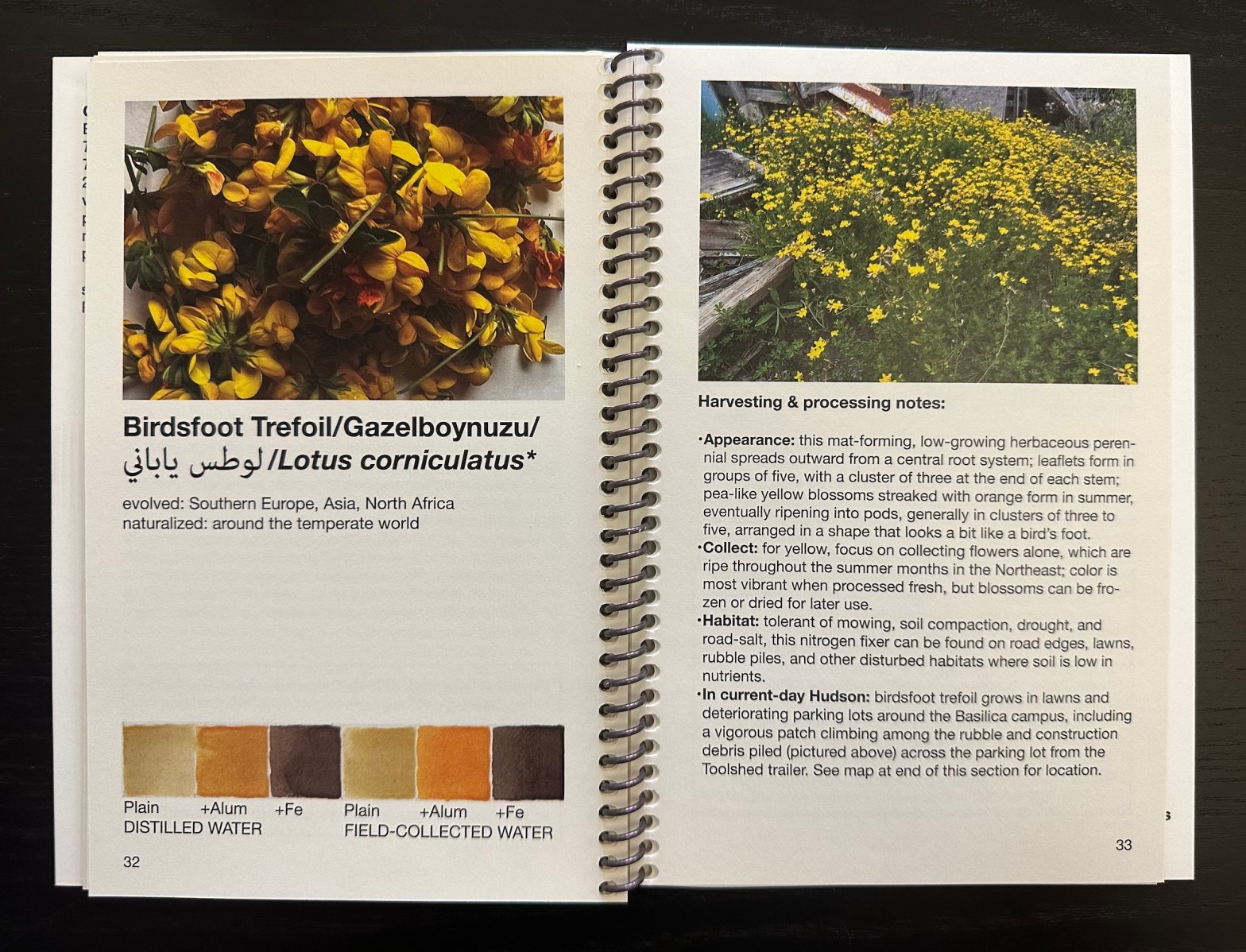
Page spread from Feral Hues, a book by Ellie Irons on making your own paints.

Artistic types are going back to nature for pigments these days. My friend Ann grows special weeds and flowers to make dyes for her beautiful textiles. In today’s Hyperallergic interview by Lakshmi Rivera Amin, we learn about an artist making her own paints.

“Taking the concept of a ‘green thumb’ several steps further, artist Ellie Irons approaches plants as a literal source of color: She creates her watery paintings with pigments tinted by organic hues found in the natural world. These works … record, honor, and reorient our relationship to the vegetation around us, specifically in current-day New York State’s Hudson area.

“I picked Irons’s brain about the process of creating her own paints through harvesting on the occasion of her recent book, Feral Hues: A guide to painting with weeds (Publication Studio Hudson). This interview has been lightly edited for clarity.

Hyperallergic: What is the most joyful part of making your own pigments?
Ellie Irons: There are many joys, which is why I’ve been entranced by the process for so many years: an ever-deepening and shifting connection to urban ecosystems and the land that supports them that emerges through careful, considered harvesting practices; the smells, colors, and textures that reveal themselves when plant parts are processed by hand in the studio; the joy of sharing the process with other humans who also become entranced by the relatively simple act of lovingly harvesting often overlooked weedy plants and creating paint with them; the process of attuning to the cycles of vegetal life sprouting, growing, blossoming, fruiting, [dying] across the seasons and years — there is always something to delight in and harvest, in any habitat, even in deep winter. …

H: How has your practice evolved over the past several years?
“Irons: I would say recently, since maybe 2019, my work has become more locally rooted and grounded. In the decade before that, I found myself investigating plants across urban habitats in a global sense — comparing pokeweed and honeysuckle growing in a parking lot in Taipei with the same species sprouting from a concrete river in current-day Los Angeles, for example.

“I’m still fascinated by those global connections, and find them resonant and relevant, but in recent years my focus and my daily practice have shifted to be more bioregional — I take the Mahicanituck/Hudson River Watershed as a salient range in which to work, connecting with human and plant populations up and down the river from New York City to the Adirondacks. …

“This shifting focus is based on a range of factors, from my increasing discomfort with energy-intensive travel to my new(ish) status as a mother to my day job with a community science and art organization that focuses on hyper-local environmental justice issues, to of course, the ongoing impacts of the pandemic. There are other ways it has changed, of course — writing has become increasingly important to me, as has enduring land-based work (a result of living in a shrinking upstate city where access to soil and open earth is simpler than in New York City, where I started working with plants more than a decade ago).

H: What are your favorite plants to work and be in relation with, and why?
Irons: Perhaps unsurprisingly, I have many favorites, and feel fortunate regularly meet plants who are new to me — my loves change by the season, and across contexts. Right now, in early August, each morning I’m greeted by innumerable, intensely blue Asiatic dayflower … blossoms lining the border of my neighbors’ chainlink fence where it meets the sidewalk.

“The blossoms only last until noon or so, depending on the weather and the intensity of the sun. I take 20 to 30 blossoms most mornings, and store them in a small cup in the freezer, accumulating them until I’m ready to process them into a range of shades of blue.

“I love dayflowers for the way they become unmissable once they catch your eye, and draw you in. They have an unassuming stature, foliage that’s easy to overlook, but when they burst into flower for several hours each morning, the proliferation of electric blue petals — almost sparkling if you look closely — can feel like tiny jewels sprinkled along the sidewalk. …

“Having migrated to the American continent, they live well in cities, where they are sometimes appreciated as a ‘wildflower,’ and are gaining notoriety as a super weed in round-up ready soybean fields, where they’ve demonstrated resistance to the herbicide glyphosate. And in their native China they are being studied as a hyperaccumulator due to their ability to thrive on the polluted soils of old copper mines, absorbing large amounts of heavy metals. …

H: What do you hope anyone interested in approaching plants as material sources for art will first consider and reflect upon?
Irons: I hope people will keep in mind processes of gratitude and respect — of mutual exchange, rather than of taking to satisfy a material need. This can look many ways. Maybe even just asking yourself a few questions before harvesting: Who else might be in relation with this plant, human or more-than-human? What is the plant doing here and why? How long has this plant been here, will they be here tomorrow, or in 100 years?” 

More at Hyperallergic, here. No paywall, but subscriptions are encouraged.

Photo: Ermell/Wikimedia Commons.
Asiatic Dayflower, or Commelina communis.

Read Full Post »

Goat vs. Wildfire

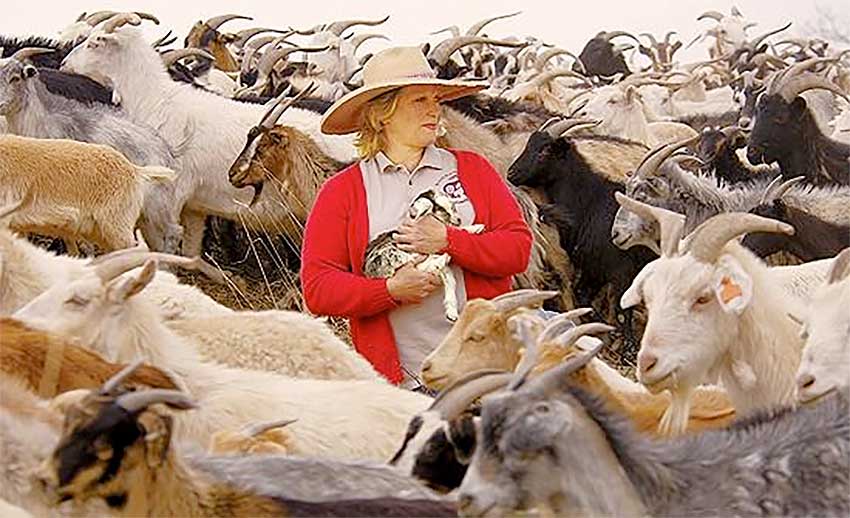
Photo: Goat Green LLC.
Lani Malmberg “contracts with federal, state, county, and city governments, homeowners associations, and private landowners for noxious weed control, fire fuel load abatement, re-seeding, watershed management, and land restoration.

While we’re on the subject of fungi and their role in improving soil, how about the work that goats are doing? Goats are not as ubiquitous as mushrooms, but they can really help restore damaged land and even prevent wildfires.

Coral Murphy Marcos reports at the New York Times, “When megafires burn in unison and harsh droughts parch the West, local governments, utilities and companies struggle with how to prevent outbreaks, especially as each year brings record destruction.

“Carrying an unconventional weapon, Ms. Malmberg travels the American West in an Arctic Fox camper, occupying a small but vital entrepreneurial niche.

“Ms. Malmberg, 64, is a goat herder and a pioneer in using the animals to restore fire-ravaged lands to greener pastures and make them less prone to the spread of blazes. She developed the fire-prevention technique in graduate school and is among a few individuals using grazing methods for fire mitigation. …

“Ms. Malmberg works with her son, Donny Benz; his fiancé, Kaiti Singley; and an occasional unpaid intern. The team runs on the goats’ time and have their dinner only when the day’s job is done. They arrive early and open the trailer. The goats jump out, ready to eat, as Ms. Malmberg watches that they don’t stray. The team sets up an electric fence to confine the goats and their meals to a specific area overnight.

After the goats digest the brush, their waste returns organic matter to the soil, increasing its potential to hold water.

“Goats are browsers that eat the grass, leaves and tall brush that cows and other grazers can’t reach. This type of vegetation is known as the fire fuel ladder and leads to wider spread when wildfires spark. More than quell a fire, Ms. Malmberg aims to prevent it from even starting. ‘By increasing soil organic matter by 1 percent, that soil can hold an additional 16,500 gallons of water per acre,’ said Ms. Malmberg. ‘If helicopters come and dump water on the fires, nothing is done for the soil.’ …

“ ‘Lani is a leading example of someone who has carved the pathway and is a trailblazer in this industry of prescribed grazing,’ said Brittany Cole-Bush, one of Ms. Malmberg’s mentees and the owner of Shepherdess Land and Livestock in Ojai Valley, Calif. ‘We want to support ecology as much as possible. We want to support the growth of native perennial grasses.’ Ms. Cole-Bush, who uses goats and sheep in her business, believes that fortifying perennial grasses, rather than planting grass annually, will make the land more tolerant of drought.

“Ms. Malmberg, who has a master’s degree in weed science from Colorado State University, spends most of the year traveling around the West on jobs. Last year, for the first time, the Bureau of Land Management contracted Ms. Malmberg and her goats for fire mitigation in Carbondale, Colo. …

“Ms. Malmberg’s assignments can take anywhere from a day to six months; she prices them after evaluating the site. In late August, she was hired to work on a property in Silverthorne that took six days and cost more than $9,000.

“At the beginning and end of every job, Ms. Malmberg asks the spirits in the area to protect her herd. She lights a ceremonial stick of tobacco and calls out to introduce herself, an intruder on the land, to the animals living there. …

“The work can take longer because of on-the-ground conditions. The Carbondale mitigation project was pushed back three weeks because mudslides caused by last year’s wildfires had closed Interstate 70, the state’s main highway

“Scientists say that wildfires have become hotter, more intense and more destructive in recent years.

“Experts attribute the longer and more ferocious fire seasons to climate change. Wildfires in the West are growing larger, spreading faster and reaching higher, scaling mountains that were once too wet and cool to support them. Studies have shown that wildfires are leading to skin damage and premature births.

“The cost of fire suppression has doubled since 1994 to over $400 million in 2018 — a cost, Ms. Malmberg notes, that doesn’t account for how people are affected by the loss of their land and homes.

“ ‘How do we value the nest that supports us?” Ms. Malmberg asked. ‘We’re just about out of time to change the ways of how we do things.’ ”

Amanda Lucier’s excellent photos of Malmberg’s work are at the New York Times, here. You can also search this blog on the word “goat” for related stories. I’m kind of a fan of goats.

Read Full Post »

Photo: Delaware Agriculture
Mark VanGessel, Professor of Weed/Crop Management at the University of Delaware, with an invasive palmer amaranth plant.

Agribusiness presents all sorts of challenges these days. For one, weeds are becoming resistant to Roundup, the herbicide that has received so much attention for causing cancer. And having a huge number of acres makes it hard to find a paying crop to plant on alternative years, which can help improve the soil.

A report at Civil Eats, rebroadcast by Public Radio International, got me interested in Australia’s superweed problem. In it, Virginia Gewin explained how near-desperation was causing to farmers to get creative.

“In December, C. Douglas ‘Bubba’ Simmons III left his corn and soybean farm in northwest Mississippi to visit the dryland wheat fields in Western Australia, a region considered to be the herbicide resistance capital of the world. Plagued with unwelcome intruders such as annual ryegrass and wild radish that have evolved resistance to several herbicides, Australian farmers have been forced to develop new approaches to manage weeds — and their seeds. It hasn’t been easy. Farmers there are paying roughly 27 percent more per acre due to increased management and yield loss, according to Bayer.

“Simmons visited several farms in the southern half of the state of Western Australia with three other U.S. farmers and a weed scientist. … Simmons, eager to learn from growers who have faced similar weed concerns, was inspired by Aussie ingenuity. It remains to be seen whether their mechanical and cultural solutions will work in the U.S., given Australia’s much drier landscape. …

” ‘I think Mississippi might even be considered ground zero for the number of herbicide-resistant weeds we have,’ he says. ‘It’s a constant battle from mid-March to mid-November.’

“The long growing season and warmer climates in some parts of the South allow noxious weeds to thrive. But ‘superweeds’ that refuse to die when sprayed with herbicides have been taking over crop land across the U.S. farm belt and beyond. Globally, 255 different weeds have developed resistance to 163 different herbicides, but the most concerning are the 43 that have developed resistance to glyphosate (the main chemical in the widely used weed killer Roundup). These weeds compete with crops for space, water, and nutrients in the soil — and they’re beginning to impact many farmers’ yields. …

“Palmer amaranth, an aggressive pigweed that has devastated crops in the South and Midwest, is one of the worst. Each plant can produce at least 100,000 seeds, and, when left unchecked, they can grow to be taller than some people. …

“ ‘We really need to think about other methods,’ says [Christy Sprague, a Michigan State University professor and weed extension specialist who also traveled to Australia]. It won’t be easy. Farms have gotten larger and larger, so it’s unclear what physical approaches can be incorporated into current farming systems. Cover crops also show promise in suppressing weeds, for example, University of Arkansas weed scientist Jason Norsworthy found that a cereal rye cover crop suppressed roughly 83 percent of palmer amaranth. But their use among farmers is only growing slowly. …

“ ‘Our mantra—keep the weed seed bank as low as possible,’ says Lisa Mayer, manager of the Australian Herbicide Resistance Initiative and WeedSmart at the University of Western Australia. In other words, control these seeds, and keep them from turning into new weeds. To that end, farmers have developed a number of approaches to catch and destroy the seeds. Some pile the wheat chaff into lines behind the combine, which can be collected or burned. They also use the Harrington Weed Seed Destructor, a device that pulverizes weed seeds as the grain is harvested.

“These methods have proven to kill 95-99 percent of the annual weed seed produced. In combination with some herbicides, weed populations have been reduced to around 1 plant per square meter, which lowers the potential for resistance. …

“Simmons says the big takeaway he learned from his Australian counterparts was the need for farmers to help develop new tools for the fight against weeds. Despite the often-intense pressure to continue buying herbicides, Simmons says growers can’t continue as if there’s only a single tool in the toolbox.” More here.

I can’t help thinking smaller farms are the answer, but can they feed a planet that already has too much hunger?

Photo: University of Delaware Carvel REC
The root structure of the invasive palmer amaranth weed makes it almost impossible to eradicate. And it produces a huge number of seeds.

Read Full Post »