Feeds:
Posts
Comments

Posts Tagged ‘whirling dervish’

Photo: Shirin Jaafari/The World.
Moayyed al-Kharrat, whose family has been performing the Sema in Syria for decades, described the dance as a sort of prayer.

As recently as June, when radio show The World filed this story about whirling dervishes, hope seemed to be the main emotion in Syria. The brutal Assad regime was gone, and victorious rebels were promising diversity and justice. Today sectarian violence has erupted.

But I think there are still reasons for hope — and for diverse groups to flourish. Like the Sufis.

This post shares what Shirin Jaafari wrote about the famous Sufi dance and the performers’ hopes.

“In the heart of Damascus, a group of men and boys dressed in long, white robes and tall headpieces stood in a semicircle. Their chants filled the courtyard of a traditional Damascene house that was turned into a hotel. …

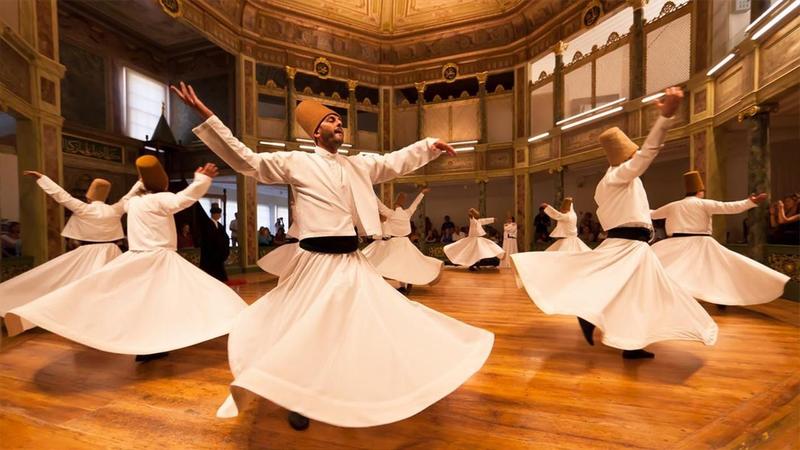
“As the melody built up momentum, several of the men and boys began to twirl, their white skirts flaring out like blooming flowers. The dancers’ synchronized rotations make them trance-like, seemingly detached from everything around them.

“The al-Kharrats say they are the only family in Syria who have continuously performed the Sema, as the dance is known. It was introduced to the country in the 14th century and first popularized by the Persian poet Rumi in Turkey.

“Through years of war, repression and threats from extremist groups like ISIS, the family has still been able to pass the ritual on to younger generations.

Now, they say they are hopeful about new opportunities under the new Syrian government.

“Moayyed al-Kharrat, one of the two brothers who oversee the dancers, said their great-uncle learned the Sufi dance and taught it to others in the family. …

“ ‘The spinning represents pilgrims moving around the Kaaba in Mecca,’ Kharrat said, referring to the ritual performed by Muslims. ‘It’s also reminiscent of the planets moving around the sun.’

‘During the ritual, one hand is extended upward, palm facing the sky, he went on to explain, which symbolizes receiving divine blessing. The other one is turned downward, palm facing the earth, to pass the blessings to the world.

“Mahmoud al-Kharrat learned the Sema when he was 4 years old. He said that keeping the tradition alive in Syria hasn’t been easy.

“Sufism is a mystical branch of Islam focused on spiritual closeness to God. It has long faced suspicion from extremists, who consider Sufis to be non-believers. ISIS fighters have attacked their shrines and killed and imprisoned the descendants of the saints and personalities they represent.

“The regime of ousted President Bashar al-Assad didn’t prohibit the Kharrat family from performing, the brothers said. But it did make it difficult for them to get the right permissions. The Assad regime used the arts to paint a more positive image of itself to the world, they explained. For example, when foreign dignitaries visited, they asked the family to perform for them.

“As the civil war ravaged Syria, countries stopped issuing visas for Syrians to travel. The family found it almost impossible to take its performances to international audiences as it had done before. One time, they managed to go to the US, but upon returning, Mahmoud was questioned by a border guard about why he hadn’t yet completed Syria’s mandatory military service, which all men had to complete at the time.

“Mahmoud estimated that he ended up paying around $7,000 in bribes so he wouldn’t get sent to the frontlines. …

“At the Damascene home-turned-hotel, the first part of the performance wrapped up, and the two brothers discussed with the younger members what they could improve on. …

“After some discussion, they got ready for the next part of the performance — their long, white skirts sweeping the ground as they moved around.

“ ‘The best way to keep this tradition alive,’ Moayad al-Kharrat explained, ‘is to pass it on to the younger generation [making] sure they learn the chants, and the full meaning of what this dance represents.’ …

“ ‘When I dance, I feel like I’m flying,’ Mahmoud added. ‘I feel like a child who has just been given a birthday present.’ ”

More at The World, here.
Read Full Post »

Photo: turkey.theglobepost.com via History Daily.
Turkey’s ‘whirling dervishes’ strive to keep the practice sacred amid tourist demand.

Each of us in our own way tries to maintain some sort of balance in our lives. It might be a balance between hours spent at a job and hours spent with family, a balance between work and play, between nutritious foods and sweets, between ideals and pragmatism. I myself would like to keep a balance between being well informed and getting depressed. Although it’s impossible to unsee what one has just read, there has to be a way to stop oneself when more information is just going to be upsetting.

At the radio show The World, Durrie Bouscaren reported recently on Turkey’s whirling dervishes and the challenge they face keeping a balance between a wish to share their culture and respecting their religion.

Bouscaren writes, “On a recent Friday evening, spectators gathered around a circular, wooden stage at a cultural center in Konya, Turkey. A single beam of light shined down on a man who placed a red sheepskin cloth on the floor. 

‘A procession of semazen appeared wearing tall headpieces and long, white robes covered by dark cloaks. They ranged widely in age, but are all were men who enact the sema, a ritual meditation known in popular culture as actions of the ‘whirling dervishes.’ 

“ ‘The acts of the sema represent the other world,’ said 32-year-old Osman Sariyer, a semazen and tour guide with the Irfan Civilization Research and Community Center in Konya, where the ritual demonstration took place. ‘Remembering the other world, remembering the creator, all the time.’ 

“Countless semazen — those who do the sema — live in the modern Turkish city of Konya, the final resting place of Jalalluddin Rumi, the 13th-century Persian poet, Islamic philosopher, and Sufi mystic who first popularized the sema. 

Today, semazen must grapple with the push and pull between the promise of tourism income for the community and the nagging feeling that the sema should be a private affair.

“In December, Konya hotels sell out for weeks as tourists arrive from around the world to pay their respects on the anniversary of Rumi’s death. In 2008, UNESCO inscribed the sema as one of the ‘masterpieces of the oral and intangible heritage of humanity.’

“In this hubbub — where busloads of tourists arrive to buy tickets to sold-out ‘dervish shows,’ and flock to the shops where they sell tiny figures of semazen souvenirs — it can start to feel overwhelmingly commercialized. 

“But performing the sema for tourists is a way to share this ritual, Sariyer said. At the cultural center, the tickets are free, according to a long-held tradition that prohibits the exchange of money or engagement with politics when it comes to this practice. 

“As semazens, we believe in the brotherhood of other religions, and we do not exclude anyone. Anyone coming here from any religious energy will feel that energy, and that’s what we’re trying to do here,” he said.

“As the music begins, a solo from a type of flute known as the ney symbolizes the breath of God, blowing life into human forms. The semazen shed the outer layer of their clothing — an act of shedding the ego. They bow and begin to spin. …

“It’s a slow, controlled spin. One foot stays planted on the floor. At times, one hand reaches up to the sky, while the other points downward — a position meant to bring love from God down to Earth and its people. 

“But outside the ritual, Sariyer explained, most semazens live regular lives. They get married, have kids and work desk jobs. …

“Historically, semazens were organized in orders throughout the Ottoman Empire and beyond. The orders were banned in 1925, as Turkey became a secular republic. So, they went underground.

“The semazens grew and learned about the practice within these orders, explained Nadir Karnıbüyükler Dede, a leader at the International Mevlana Foundation. When they were abolished, it became harder to pass on the traditions to the new generation. …

“In his office at a construction firm, Adnan Küçük keeps a small square board on the floor — just 3-feet tall and 3-feet wide — to practice the turns of the sema. 

“ ‘It gives you this excitement, this feeling of being overjoyed,’ … Küçük said.  He’s been practicing sema for over 20 years.

“Küçük’s father was one of those who upheld the tradition in those difficult decades, from the 1920s through the 1990s. …

“By the 1990s, when Küçük was a teenager, there were very few young semazens in Konya. But one day, a Polish official called Konya’s tourism office to ask if they had any whirling dervishes they could send to participate in a youth festival. …

“ ‘They’d take us to a hotel, people would be eating — and as we’re preparing the sema they’re serving alcohol,’ he said. ‘Which completely contradicts the ritual.’ Alcohol is forbidden in Islam. …

“Now he only gathers with a small group of friends to do the sema privately, meeting at least once a week before the pandemic began.”

More at PRI’s The World, here.

Read Full Post »