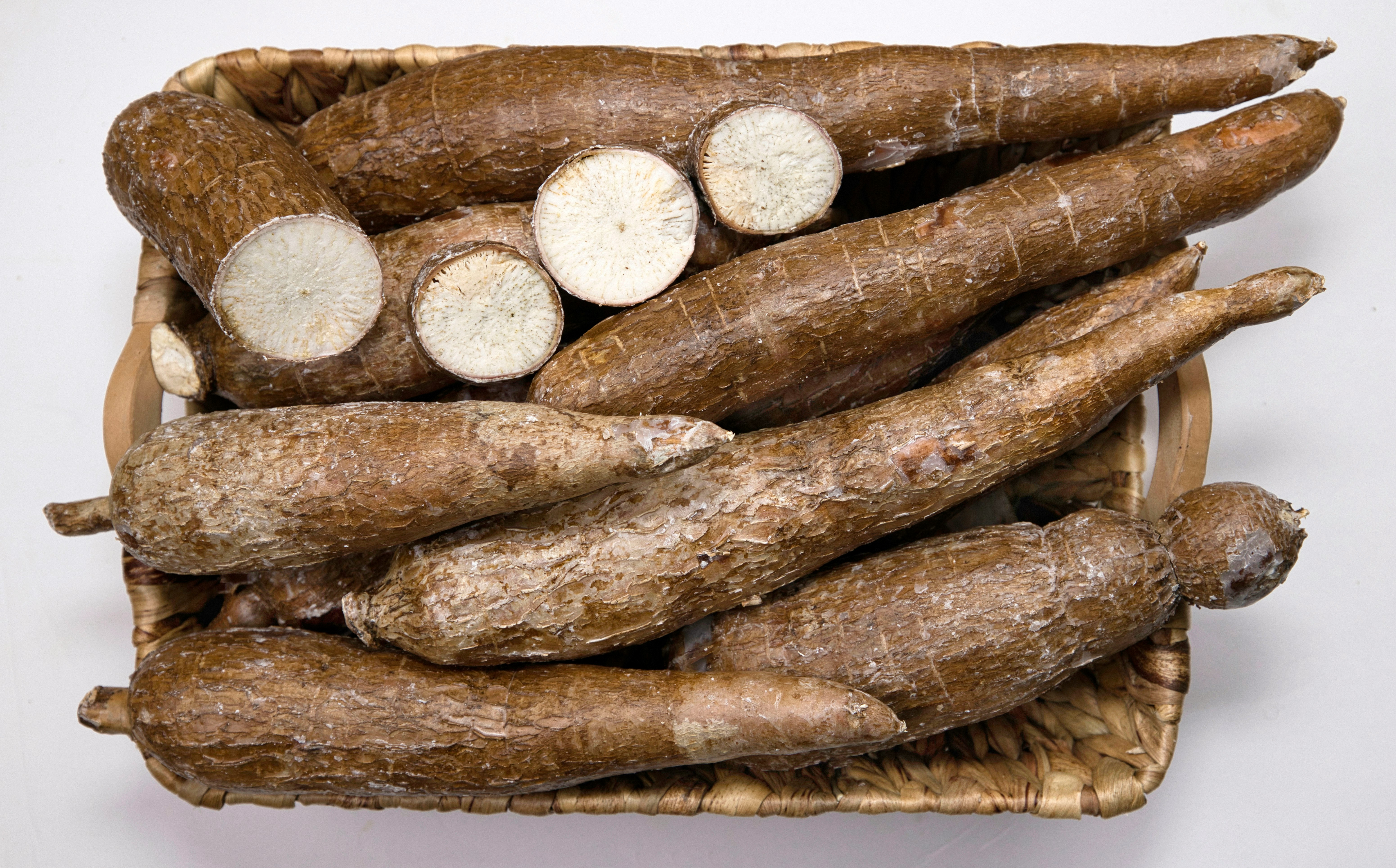
Photo: Loren Biser/Unsplash.
“Cassava’s humble appearance belies an impressive combination of productivity, toughness and diversity,” says the Washington Post. But it has to be detoxified.
As Planet Earth keeps adding more people, many of the crops to feed them are suffering from climate change. What is the answer? Are there foods that are both nourishing and relatively easy to produce?
Stephen Wooding, an assistant professor of anthropology and heritage studies at the University of California at Merced, writes at the Washington Post about a food that is both. It just has a little toxicity problem.
“The three staple crops dominating modern diets — corn, rice and wheat — are familiar to Americans. However, another top crop is something of a dark horse: cassava.
“While nearly unknown in temperate climates, cassava is a key source of nutrition in the Southern Hemisphere. It was domesticated 10,000 years ago, on the southern margin of the Amazon basin in Brazil, and spread from there throughout the region. … There’s just one problem, however: Cassava is also highly poisonous.
“So, how can cassava be toxic, yet still dominate diets in Amazonia? It’s all down to Indigenous ingenuity. For the past 10 years, my collaborator, César Rubén Peña, who is of Cucuna heritage and grew up on the rivers of Amazonia, and I have been studying cassava gardens on the Amazon River and its myriad tributaries in Peru. We have discovered scores of cassava varieties, growers using sophisticated breeding strategies to manage its toxicity and elaborate methods for processing its dangerous yet nutritious products. …
“A little more than 10,000 years ago, [hunter-gatherers] cleared the hurdle with one of the most transformative innovations in history: plant and animal domestication. … Today, almost every rural family across the Amazon has a garden. Visit any household and you will find cassava roasting on the fire, being toasted into a chewy flatbread called casabe, fermenting into the beer called masato, and steaming in soups and stews. Before adopting cassava in these roles, though, people had to figure out how to deal with its toxicity.
“One of cassava’s most important strengths, its pest resistance, is provided by a powerful defense system. The system relies on two chemicals produced by the plant, linamarin and linamarase. These defensive chemicals are found inside cells throughout the cassava plant’s leaves, stem and tubers, where they usually sit idle. However, when cassava’s cells are damaged, by chewing or crushing, for instance, the linamarin and linamarase react, releasing a burst of noxious chemicals.
“One of them [is] cyanide gas. The burst contains other nasty substances as well, including compounds called nitriles and cyanohydrins. Large doses of them are lethal, and chronic exposures permanently damage the nervous system. …
“Ancient Amazonians devised a complex, multistep process of detoxification that transforms cassava from inedible to delicious. It begins with grinding cassava’s starchy roots on shredding boards studded with fish teeth, chips of rock or, most often today, a rough sheet of tin. Shredding mimics the chewing of pests, causing the release of the root’s cyanide and cyanohydrins. …
“Next, the shredded cassava is placed in baskets where it is rinsed, squeezed by hand and drained repeatedly. The action of the water releases more cyanide, nitriles and cyanohydrins, and squeezing rinses them away. Finally, the resulting pulp can be dried — which detoxifies it even further — or cooked, which finishes the process using heat. …
“The Amazonians pushed their efforts even further, taming it into a true domesticated crop. In addition to inventing new methods for processing cassava, they began keeping track and selectively growing varieties with desirable characteristics, gradually producing a constellation of types used for different purposes.
“In our travels, we have found more than 70 distinct cassava varieties that are highly diverse, physically and nutritionally. They include types ranging in toxicity, some of which need laborious shredding and rinsing and others that can be cooked as is, though none can be eaten raw. …
“While cassava has been ensconced in South and Central America for millennia, its story is far from over. In the age of climate change and mounting efforts toward sustainability, cassava is emerging as a possible world crop.
“Its durability and resilience make it easy to grow in variable environments, even when soils are poor, and its natural pest resistance reduces the need to protect it with industrial pesticides. …
“While cassava isn’t a familiar name in the United States just yet, it’s well on its way. It has long flown under the radar in the form of tapioca, a cassava starch used in pudding and boba tea. It’s also hitting the shelves in the snack aisle in the form of cassava chips and the baking aisle in naturally gluten-free flour. Raw cassava is an emerging presence, too, showing up under the names ‘yuca’ and ‘manioc’ in stores catering to Latin American, African and Asian populations. Track some down and give it a try. Supermarket cassava is perfectly safe, and recipes abound.”
More at the Post, here.

 Suzanne's Mom's Blog