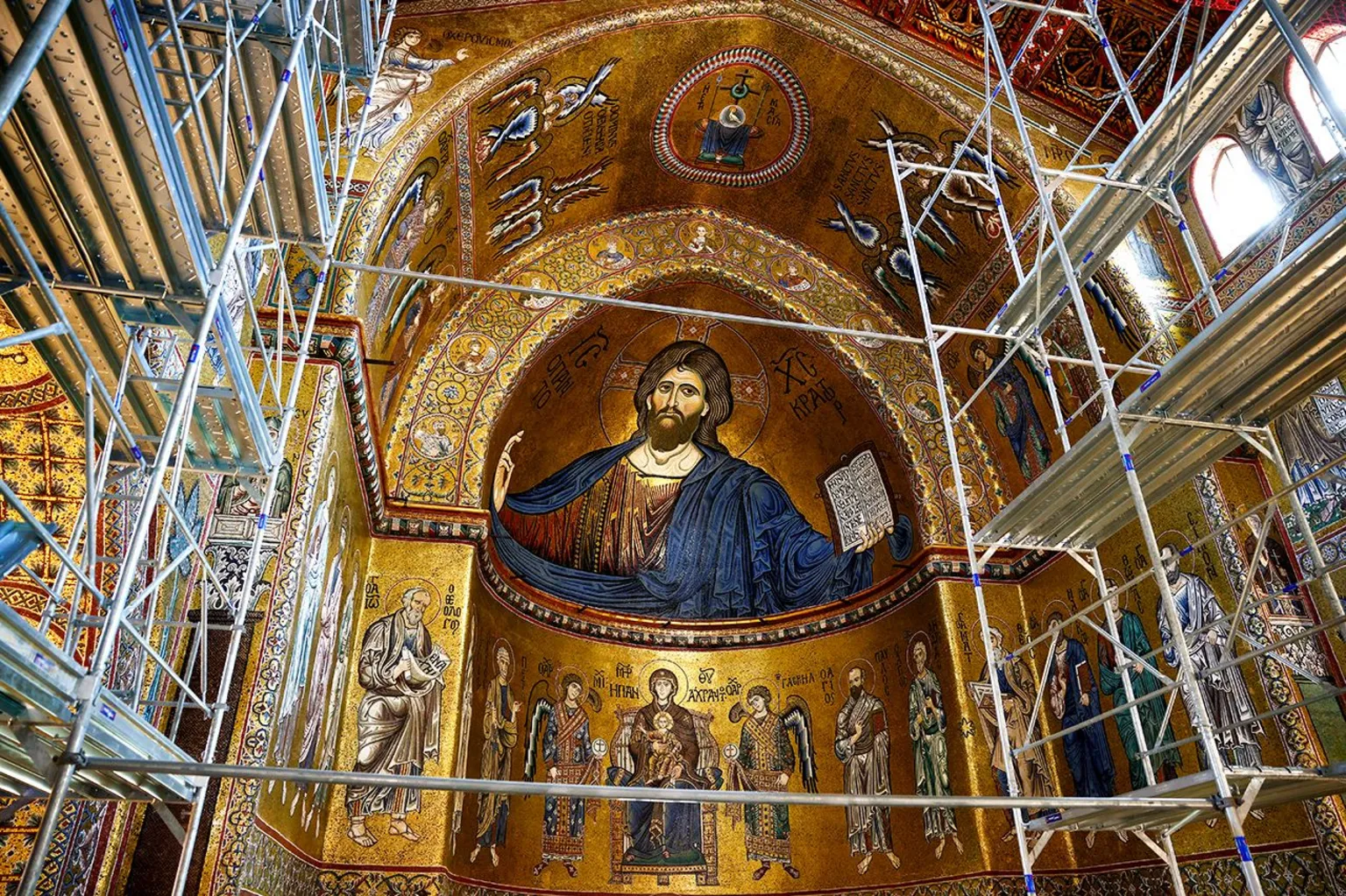
Photo: Reuters.
The Monreale cathedral was declared a Unesco World Heritage Site in 2015, and has recently undergone extensive restoration.
Some organized religions eschew signs of wealth and pomp. For others, such things emphasize the value they put on their faith. I always like hearing about the individual stonemasons who gave their heart and soul to carving small corners of the great cathedrals, but I have mixed feelings about covering churches in gold, however beautiful. I was not part of the fundraising for my church’s dome, which one member paid to gild, covering the sky-blue paint.
All to say that an extraordinary amount of gold is now drawing tourists to a cathedral in Sicily, a UNESCO World Heritage site.
The BBC’s Sara Monetta writes, “On a hill overlooking the city of Palermo, in Sicily, sits a lesser-known gem of Italian art: the cathedral of Monreale. Built in the 12th century under Norman rule, it boasts Italy’s largest Byzantine-style mosaics, second in the world only to those of Hagia Sophia in Istanbul.
“Now, this Unesco World Heritage site has undergone an extensive restoration to bring it back to its former glory. The Monreale mosaics were meant to impress, humble and inspire the visitor who walked down the central nave, following the fashion of Constantinople, the capital of the surviving Roman empire in the east.
“They span over [69,000 square feet] and contain about [4.6 pounds] of solid gold. …
“Local experts from the Italian Ministry of Culture led a series of interventions, starting with the removal of a thick layer of dust that had accumulated on the mosaics over the years. Then they repaired some of the tiles that had lost their enamel and gold leaf, making them look like black spots from down below. Finally, they intervened in the areas where the tiles were peeling off the wall and secured them.
“Working on the mosaics was a challenge and a big responsibility, says Father Nicola Gaglio. He has been a priest here for 17 years and has followed the restoration closely, not unlike an apprehensive dad.
” ‘The team approached this work almost on their tiptoes,’ he tells me. ‘At times, there were some unforeseen issues and they had to pause the operations while they found a solution. For example, when they got to the ceiling, they realized that in the past it had been covered with a layer of varnish that had turned yellowish. They had to peel it off, quite literally, like cling film.’
“The mosaics were last partly restored in 1978 , but this time the intervention had a much wider scope and it included replacing the old lighting system.
” ‘There was a very old system. The light was low, the energy costs were through the roof and in no way it made justice to the beauty of the mosaics,’ says Matteo Cundari. He’s the Country Manager of Zumtobel, the firm that was tasked with installing the new lights. …
“I ask Fr Gaglio what it was like to see the scaffolding finally come off and the mosaics shine in their new light. He laughs and shrugs.
” ‘When you see it, you’re overwhelmed with awe and you can’t really think of anything. It’s pure beauty,’ he says. ‘It’s a responsibility to be the keeper of such world heritage. This world needs beauty, because it reminds us of what’s good in humanity, of what it means to be men and women.’ “
More at the BBC, here. No firewall.

 Suzanne's Mom's Blog