Feeds:
Posts
Comments

Posts Tagged ‘world's largest’

Photo: J Zapell/Wikimedia.
The world’s oldest organism, a grove of Populus tremuloides (Quaking Aspen) sharing one root system. From Fish Lake National Forest website.

Here’s something that’s a little hard to believe. Unless you live in Utah, I suppose. It’s a forest with one root system, so it’s technically one tree, and its “genetic integrity has been sustained over a long period time (between 9,000 and 12,000 years),” according to Wikipedia.

I first got interested thanks to Kayleen Devlin’s story “Can Trees Really Live Forever?” at BBC Earth, which focused on ancient gingko trees, mostly in China. But Pando in Utah is said to be the world’s largest tree. And it’s really old.

Wikipedia says, “Pando (Latin for ‘I spread’), the world’s largest tree, is a quaking aspen tree (Populus tremuloides) located in Sevier CountyUtah in the Fishlake National Forest. A male clonal organism, Pando has an estimated 47,000 stems (ramets) that appear as individual trees, but are connected by a root system that spans 106 acres.

“Pando is the largest tree by weight and landmass and, is the largest known aspen clone. Pando was identified as a single living organism because each of its stems possesses identical genetic markers. The massive interconnected root system coordinates energy production, defense and regeneration across its expanse. Pando spans 0.63 miles by 0.43 miles of the southwestern edge of the Fishlake Basin in the Fremont River Ranger District of the Fishlake National Forest and lies 0.43 miles to the west of Fish Lake, the largest natural mountain freshwater lake in Utah. Pando is located at an elevation of 2,700 m (8,900 ft) above sea level.

“Pando occupies approximately 106 acres (43 ha) and is estimated to weigh collectively 6,000 tonnes (6,000,000 kg), or 13.2 million pounds, making it the heaviest known organism. Systems of classification used to define large trees vary considerably, leading to some confusion about Pando’s status. In contrast to the General Sherman Tree, the largest single stem tree, Pando is often characterized as an ‘organism’ or ‘plant.’ Pando, however, is a tree and commonly known as the ‘Pando Tree.’

“Within the United States, the Official Register of Champion Trees defines the largest trees in a species specific way, in this case, Pando is the largest aspen tree (Populus tremuloides). In forestry, the largest trees are measured by the greatest volume of a single stem, regardless of species. While many emphasize that Pando is the largest clonal organism, other large trees, including Redwoods can also reproduce via cloning. This leaves Pando in a class of its own being the largest aspen tree, largest tree by weight and, the largest by land mass, combined.

More at Friends of Pando, here, BBC Earth, here, and Wikipedia, here.
Read Full Post »

Photo: Richard Vogel via New York Post.
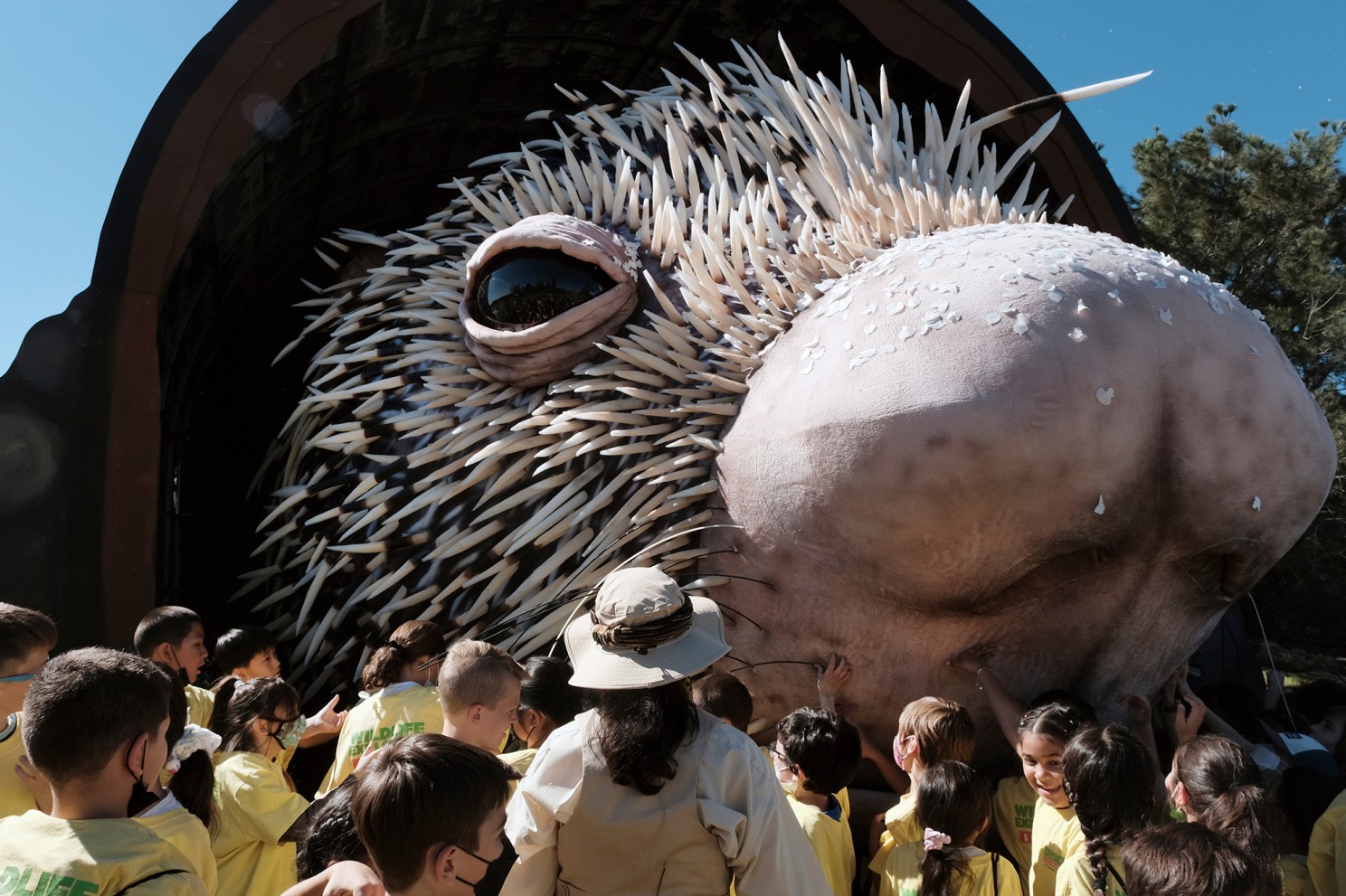
Percy the porcupine is two stories tall and has 2,000 foam quills.

I finally got it through my head that wild animals want to be in the wild — not in a zoo. But I have lingering ambivalence. The better zoos can keep animals pretty happy while also protecting those that are endangered; they collaborate with other organizations to improve the habitat of animals’ endangered families back home; and they teach delighted children about the importance of conservation.

So you be the judge of today’s story about delighting children at a zoo. No animals were harmed.

Jessica Gelt has the story at the Los Angeles Times. “Boris is not shy, but he is a bit prickly. He enjoys being the center of attention and squeals with indignation if anyone tries to remove him from the limelight. He loves bananas and his large, porcine nose wriggles with contentment as he bites into one.

“A group of artists, designers and fabricators surround Boris [at] Jim Henson’s Creature Shop in Burbank.

“ ‘What color is his tongue?’ one asks, leaning in to observe the lithe muscle as it darts out of his diminutive mouth for a taste of fruit.

“Another studies his whiskers, marveling at the way they cover his velvety muzzle.

“Boris … is a 21-year-old Brazilian porcupine — a visiting ambassador to the legendary puppet-making shop as it works to build what might be the world’s largest animal puppet, most certainly the largest porcupine puppet. …

“Named Percy the Porcupine, the two-story creation is covered in 2,000 foam quills and has an articulated nose the size of a 2-ton Volkswagen. And that’s just the arboreal animal’s head. The five fabricators who spent more than 1,000 hours meticulously constructing the fantastical creature decided to leave the body out of the equation. …

“The San Diego Zoo commissioned Percy over the holidays in celebration of the grand opening of a new 3.2-acre attraction called Wildlife Explorers Basecamp, which will welcome families beginning March 11. …

“ ‘Our goal is to inspire the youth of the world,’ says San Diego Zoo wildlife ambassador Marco Wendt, who stands in a conference room beside a small 3-D-printed foam model of Percy’s head that was made to ensure the patterns created for the giant puppet were accurate. ‘Jim Henson’s Creature Shop does the same. So it’s the perfect collaboration.’

“Wendt shares that his parents are from Mexico, and that as a first-generation American, he learned English in part from cartoons and Jim Henson movies.

“Peter Brooke, creative supervisor for the Creature Shop, smiles broadly beneath his face mask as Wendt talks. ‘The reason we said ‘yes’ is that we’ve never had such a challenge,’ says Brooke. …

“Fabricators, including Tina Roland, labor on Percy’s 2,000 quills, which are hand carved out of pool-noodle-like foam using a variety of sharp knives, box cutters and razors. It will take more than 10 gallons of paint to give all of the quills their signature brown stripes.

“ ‘I did get the process down to a minute-and-a-half for each quill,’ says Roland, who uses barge glue (the kind you’d find at a cobbler shop for repairing soles) to attach the quills to Percy’s head. ‘But that was after a lot of practice, and it doesn’t include painting.’ …

“Fabrication supervisor and lead designer Scott Johnson first created the patterns for Percy using a stock photo and a computer program for digital sculpting called ZBrush. The patterns were sent off to a company that turned them into sewing patterns for Percy’s giant head, which was stitched together from inflatable canvas (the kind you’d find on a hot air balloon).

Percy is made large using air blown by a loud generator through a seam at the back of his head. Creators realized this was the only reasonable solution to the problem of the puppet’s portability. …

“Percy’s whiskers are made from a thick monofilament, like fishing line, says Brooke. Those are punched into the muzzle and pulled through. The tongue, which fabricators have identified as pink thanks to Boris, ends up being made from a piece of foam, as do the two beaver-esque front teeth. …

“A few hectic weeks later, Percy is ready for his coming-out party. Dozens of eager elementary kids from schools around the city sit on the grass in Elysian Fields with a stunning view of downtown L.A. behind them. …

“After some inspirational words from San Diego Zoo reps, the kids count backward from five and Percy zooms out from inside the log, his giant head bouncing and bobbing, his liquid-brown eyes blinking beneficently. Rice paper confetti shoots from two air rockets on either side, strains of ‘Going to the Zoo’ by children’s folk singer Raffi blast from speakers, and the kids swarm the massive puppet. They scream, squeal and cheer, petting his super-soft snout and pulling on his fabulous quills.

“ ‘It’s a success; we’re happy,’ says Brooke, proudly observing the kid chaos. ‘It really worked!’ “

More at the Los Angeles Times, here.

Read Full Post »