I volunteer with English Language Learners at two agencies in Providence and one in Boston. The classroom teachers are all quite different in their approach, and I learn from them all. JVS in Boston has a rapid-employment model, so all the English learning is geared toward what you need for a job.
At one Providence agency, I work with a teacher who has brand-new refugees, some of whom, because of war or poverty, have never been to school in their native countries. She keeps the atmosphere friendly and light, but there is an understandable level of seriousness, given how new everything is to the participants.
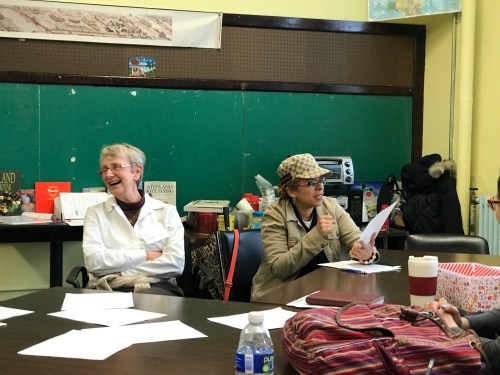
The teacher I assist at the Genesis Center has a class of immigrants whose language skills are a bit further along and who mostly come from Spanish-speaking countries and are not refugees. I believe the woman in the hat, above, is from Puerto Rico — so, born a US citizen. She wants to improve her English and loves to write.
On Monday, the teacher was following up on the previous week’s discussion of periodic tables, the instability of hydrogen, and the 1937 crash of the German pleasure blimp the Hindenburg in New Jersey. He showed the crash film to the class, one that I’ve seen often enough to know I really can’t take it. I look away.
I said, “What’s interesting is that when Orson Welles did his radio play at Halloween the following year about Martians landing in New Jersey, many listeners were so sensitized to disaster they thought the radio play, presented as real news, was true.
I said, “It might be fun sometime for the class to practice their English by reading the script.”
The next thing I knew the teacher had found the radio play on the web and was passing around copies.
When we were halfway through it, we discussed the ways Orson Welles had adapted the H.G. Wells sci-fi classic to New Jersey, with an authentic-sounding ballroom broadcast that was frequently interrupted by a studio announcer switching to reports of an unusual light burst on Mars and (after some more of the big band concert) a shiny cylinder falling on a farm in Grovers Mills. Details like the boom heard as far as 100 miles away in Elizabeth, New Jersey, added to the verisimilitude. So did the on-the-ground reporter conducting interviews with the farmer and a scientist who didn’t believe in life on Mars, as police sirens wailed in the background. We talked about how panicked some listeners were and how they jammed the lines at the radio station.
The teacher next had people write their own endings to the story. It was a lot of fun. The students don’t speak much English, but they certainly got the point about the panic. One woman, remembering how in her hometown some individuals thought the turn of the millennium was the end of the world and did away with themselves, put that into her story. Others envisioned panicked parents rushing to schools to pick up their children.
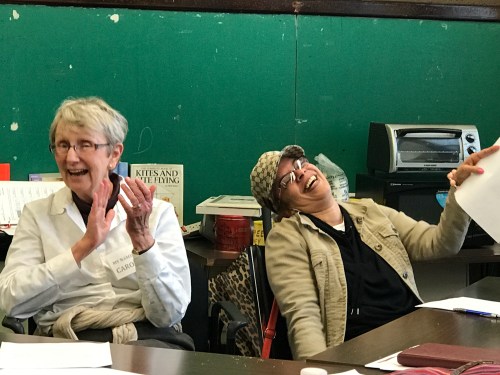
It was serious in a way, but we laughed a lot. I felt grateful to work with a teacher who is able to make up a good lesson on the spur of the moment like that.
Photos: David Buchalter

 Suzanne's Mom's Blog
It sounds like you’re still enjoying this. That is great. Im currently working with some students not literate in their first language. It is a challenge and slow going but like you, we have lots of smiles. Cheers
LikeLike
We have one such student who never moves up when the others do. He seems to be learning disabled, and what is sad is that we ave no teachers trained to help him. So he just keeps repeating the same class.
LikeLiked by 1 person
We have a couple of people who are in a similar situation. It’s difficult but you have to admire them for sticking with it.
LikeLike
yes!
LikeLiked by 1 person
Love this post ^_^ Today in Springfield a bus went by with an advertisement, in Spanish, for a bilingual local show on PBS, and I was able to read it all (!) And I saw that it said that the show was airing on Thursdays. “Hey, today is Thursday!” I said. It felt like a sign. I really want to get some Spanish under my belt–not to *teach* in it, but just because having it really does help get closer to the kids in Holyoke.
LikeLike
So great that you stick with your language learning. I’m using Duolingo for Swedish right now — we hope to go visit Erik’s folks in May — but I doubt I’ll be able to read a TV ad by then.
LikeLike
What a great story! Using War of the Worlds is a brilliant strategy and engaging on so many levels–I need to go back and listen to that again myself! And cute pictures!
LikeLike
I had forgotten how brilliant it was. The students were surprised that Welles got away with what was really fake news.
LikeLike
Thanks for sharing. Love this post.
LikeLike
I really think students learn better with this creative, opportunistic way of teaching than with a focus on standardized tests.
LikeLike