Photo: Andrea Pasquali
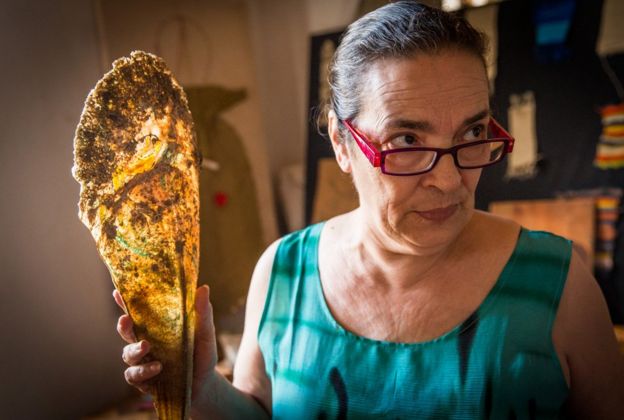
Chiara Vigo harvests byssus without harming the clam and uses the sea silk to weave special fabric “for outcasts, the poor, people in need.” She keeps this clam for educational purposes.
Have you heard of “sea silk”? I hadn’t either, until I saw this on Facebook. It’s stories like this (and friends’ photos) that keep me from throwing in the towel on Facebook.
Max Paradiso wrote for the BBC, “Silk is usually made from the cocoons spun by silkworms — but there is another, much rarer, cloth known as sea silk or byssus, which comes from a clam. Chiara Vigo is thought to be the only person left who can harvest it, spin it and make it shine like gold.
“Villagers stare as I knock on the door of Chiara Vigo’s studio, otherwise known as the Museum of Byssus, on the Sardinian island of Sant’Antioco. …
“Vigo is sitting in a far corner of the room surrounded by yarns and canvasses, holding hands with a young woman …
“Then she hums a song with her eyes closed and fixes the bracelet on the girl’s wrist. She reaches for the window and opens the shades to let the sunlight in and instantly the dark brown bracelet starts to gleam. …
“The bracelet is made of an ancient thread, known as byssus, which is mentioned on the Rosetta stone and said to have been found in the tombs of pharaohs.
“Some believe it was the cloth God told Moses to lay on the first altar. … It is extraordinarily light. …
“Every spring Vigo goes diving to cut the solidified saliva of a large clam, known in Latin as Pinna Nobilis.
“She does it early in the morning, to avoid attracting too much attention, and is accompanied by members of the Italian coastguard — this is a protected species. It takes 300 or 400 dives to gather 200g of material.
“Then she starts weaving it, but as the sign on the door says, it is not for sale.
” ‘It would be like commercialising the flight of an eagle,’ Vigo says. ‘The byssus is the soul of the sea. It is sacred.’
“She gives the fabric to people who come to her for help. …
” ‘I weave for outcasts, the poor, people in need.’
“A steady stream of [them] arrive throughout the day. If they bring a child’s christening dress, she will embroider it. …
“According to Gabriel Hagai, professor of Hebrew Codicology at the Ecole Pratique des Haute Etudes in Paris, Vigo is ‘the last remnant’ of a combination of Jewish and Phoenician religious practices that was once far more widespread in the Mediterranean.” More here.
Perhaps this is silly comment to make, given the religious associations of Viga’s silk, but I can’t help thinking about the magic thread in the Little Lulu comics of my childhood. One thread could make tubby Little Lulu a glamorous little girl, but it took a bolt of the magic cloth to turn Witch Hazel into a pretty woman.
Photo: Andrea Pasquali
The loom belonging to the last weaver of sea silk.

 Suzanne's Mom's Blog
I have never heard of this! How interesting,and I hope the art is never lost.
LikeLike
And I hope the search for her successor is expanded beyond her daughter. I don’t know about Sardinia, but most American daughters would not want to pursue their mother’s vocation, especially if there was an assumption that they would!
LikeLiked by 1 person
I heard of this a few years ago–amazing that such a thing is possible. What a story, huh? Beautiful.
LikeLike
I’m guessing you were researching your lovely book “Penpals” at the time. Sea silk weaving is a skill that seems perfect for the community of Mermaid’s Hands.
LikeLiked by 1 person
I had seen this on Facebook, too–I’d love to see the weaving in person and be able to handle it.
LikeLike
And I’d like to see what you yourself could weave with it.
LikeLike