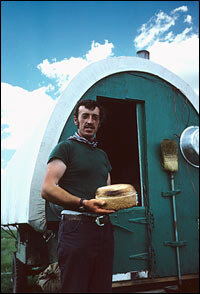
Photo: Richard Lane/Basque Library, University of Nevada, Reno
A herder holds freshly baked bread. His sheep wagon was a camp on wheels with beds, a table, and a wood stove. In the early days, a team of horses pulled the wagons.
I was driving to Providence and listening to the radio when I heard a story about Basque men who emigrated to the American West years ago because they needed jobs and because Idaho, Nevada, and other states needed shepherds.
Although the Basques actually knew nothing about being shepherds, they persisted, and today significant Basque communities remain.
Kimberlee Kruesi writes at the Associated Press, “Idaho is home to one of the biggest concentrations of Basques in the United States. … Basques began settling in southwestern Idaho as early as the late 1800s, with many coming from the Basque region on the border of Spain and France to work as sheepherders in Idaho. Nearly 8,000 residents of the Gem State identify as Basque today. …
“The Basque Museum and Cultural Center is packed with exhibits that explore the lives of the first Basque sheepherders, including a sheep wagon and full-size sheepherder’s tent. …
“The Basque Market … has become famous for preparing large portions of paella, served with homemade baked bread every Wednesday and Friday right on the patio. …
At National Public Radio, the Kitchen Sisters reported on the life of Basques in Nevada.
“Francisco and Joaquin Lasarte came to America in 1964 from Basque country in northern Spain. Francisco Franco, the Spanish dictator who repressively ruled the country for nearly 40 years, made life miserable for the Basque people, suppressing their language, culture and possibilities.
“The result was a massive exodus, and the only way to come to the United States for many Basque was to contract as sheepherders. There was a shortage of shepherds in the American West. …
“Neither Lasarte brother had any sheepherding experience when they arrived in America.
” ‘You lonely, you by yourself,’ Francisco Lasarte said. ‘My God, you with 2,000 sheep and two dogs and you don’t know what to do, where to go.’
“The brothers were contracted for five years to this life. It was a sentence.
“Each brother had his own flock, and they rarely saw each other or anyone else for months on end. Mostly they ate lamb and bread cooked in a Dutch oven in a hole they dug in the ground. You can still find these holes up in the mountains of Idaho, Montana, Nevada and California.
” ‘You say Basque to a Westerner and you think sheepherder,’ said Mark Kurlansky, author of The Basque History of the World. “In Basque country very few people were shepherds.’ …
“William Douglass, former director of the Center for Basque Studies at the University of Nevada, Reno, describes this solitary life.
” ‘Teenagers were ripped up out of their communities back home, brought to a foreign land, with a foreign language, put up on top of a mountain … crying themselves to sleep at night during the first year on the range.’
“The Basques have a family-oriented, communal culture, gathering around big tables to eat, drink and sing. This solitary life in remote mountains ran against the grain.” More at NPR, here.
Photo: Kimberlee Kruesi/The Associated Press
The Basque Center displays both the United States flag and Basque flag in Boise, Idaho.

 Suzanne's Mom's Blog
Hard to imagine what it would be like to be by yourself with dog,sheep for months! Be interesting to try the bread though.
LikeLike
LOL. Do you suppose they made beer bread? I’ve been thinking lately about the beer bread fad I got swept up in years ago.
I also kept a sourdough culture going for years.
LikeLiked by 1 person
Maybe, be easier to do then sourdough. 😄
LikeLiked by 1 person
I had no idea! But the thought of those poor boys and men, alone in a foreign land . . . so sad.
LikeLike
I suppose some people can handle solitude for long stretches — may even like it. But not from that culture, I gather.
LikeLike
I remember encountering Basque sheepherders and their wagons while camping with my parents in the wilds of central and eastern Idaho back in the 1960’s and 1970’s. They were always very much alone and eager for company. Fortunately, both of my parents spoke Spanish, so they got along famously with the shepherds. I still remember having savory sheep/lamb stew and fresh bread with them.
If you ever have an opportunity, stop by The Star Hotel in Elko, Nevada, for a traditional Basque meal and hospitality.
LikeLike
Thank you so much for letting us all know about the Star Hotel and for sharing your delightful memories. Very interesting.
LikeLiked by 1 person
You’re very welcome. If you travel throughout the states that they used to shepherd within, you can still find their shepherding wagons — though they are becoming a rare sight.
LikeLiked by 1 person