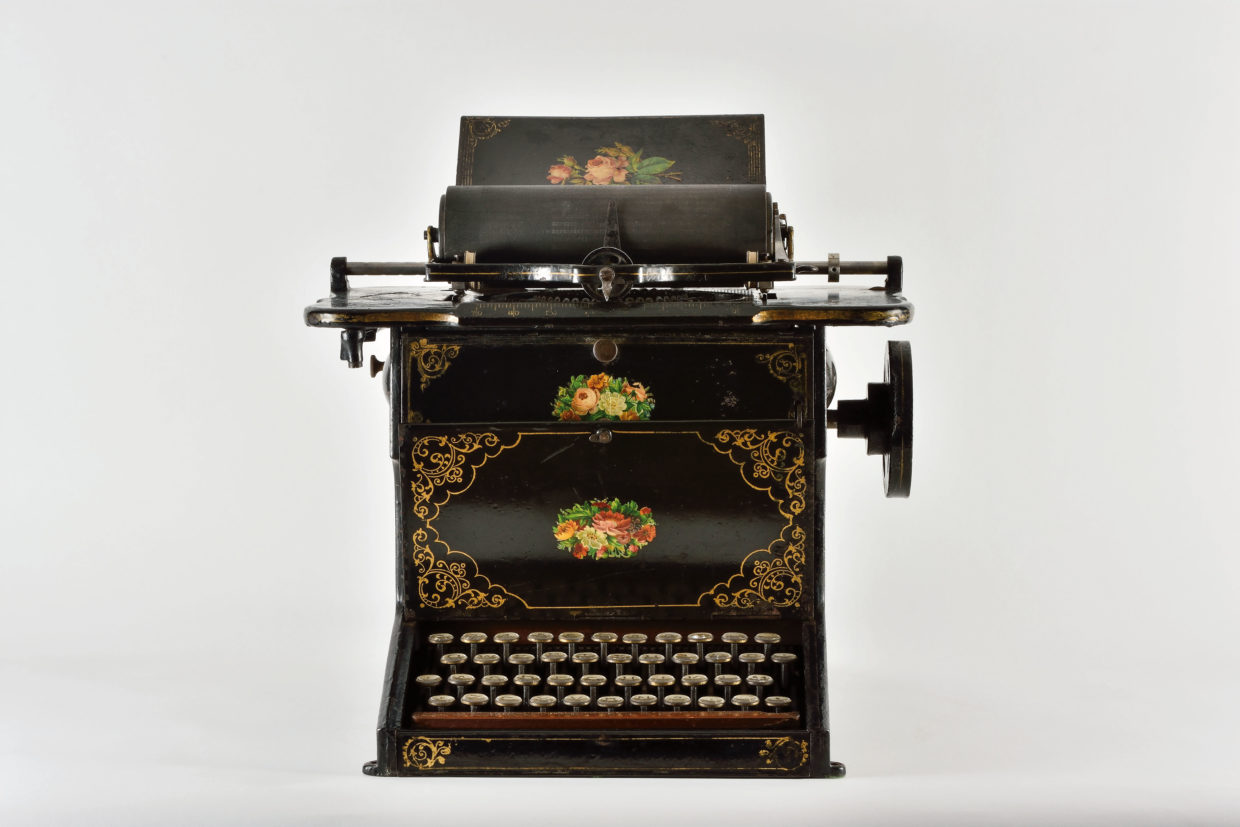
 Photo: Anthony Casillo
The Sholes & Glidden Type Writer, 1874.
Personally, I never liked using a typewriter. Part of the problem was I didn’t learn to touch-type until I was over 50. But I also find typewriters are too limited. Word processors let you search for a word, fix mistakes fast, cut and paste — they also let you see if you accidentally hit the space bar an extra time. (Well, some features are more important than others.) I don’t love spellcheck because it uses a different dictionary from my favorite, and I hate the distracting grammar check. I turn it off.
We all value different things. Some people, for example, still value typewriters.
Anthony Casillo writes at LitHub, “In the late 1970s, I stumbled upon an old, long abandoned, Oliver typewriter stored away in the back room of a typewriter repair shop where I worked in New York City.
“The Oliver was unlike anything I had ever seen. … It was old and deserving of greater appreciation than it was receiving there. It begged me to rescue it from that dark room — and potentially the trash heap. So, I packed up the 30-pound orphan and carried it home on the subway during my standing-room-only rush-hour commute.
“Once home, I began to explore this beauty a little further. The Oliver opened a door to a new world for me, one that ignited my curiosity about the early history of the typewriter. …
“Shortly after the Oliver discovery, I was leafing through the classified section of a monthly typewriter trade magazine when another vintage machine caught my eye: a Blickensderfer typewriter from the 1890s was being offered for sale. The Blickensderfer was a small manual typewriter that used a type element similar to the modern IBM Selectric typewriters that were popular in the 1970s. …
“I took a road trip across two states to purchase and pick up my prize. After all, I thought to myself, when would I ever see another one? On my return trip, a voice inside kept telling me that not only had I just acquired something special, but also, on that day, I had become a collector. …
“Some remained faithful to their typewriters during a period of technological change that began in the 1980s with the introduction of the personal computer. They were the holdouts who refused to part with their trusted friend as technology marched forward, always keeping a place on their desks for tasks that a typewriter could perform more efficiently than their computer. For these people, the filling in of forms, addressing of envelopes, and other small tasks always seemed to get done more quickly on a typewriter, giving the machines an extended life as a secondary writing instrument in many offices.
“And then there are the collectors who see beauty in old, twisted, and often rusted metal. It is not uncommon for a dedicated collector to travel great distances to procure an ancient typewriter for his or her collection. …
“Many of us have a typewriter story to tell — whether we used the machines for papers in high school and college, or watched our grandparents type out letters on their cherished machines — stories that evoke fond memories of a much simpler time.” Hmm. My memory is of paying Harriet to type my college papers. That’s how hopeless I was then.
Read more at LitHub, here. And at National Public Radio, here, you can read about actor Tom Hanks and how his love of typewriters led him to write a book about them.

 Suzanne's Mom's Blog
I never learned to type so typewriters were mostly my enemy. But this passion for them makes me think of the ways some people still love records and record players . . .
LikeLiked by 1 person
Funny you should mention record players. We got one recently, and now I can listen to all our old LPs. I do find it takes a little more effort than turning on the radio, though.
LikeLiked by 1 person
That typewriter in the photo is so beautiful! Never mastered the typewriter myself.
LikeLike
I never mastered the typewriter either. It took me six months to type 20 pages. So happy I learned touch typing for word processors even if I was late to the party.
LikeLiked by 1 person