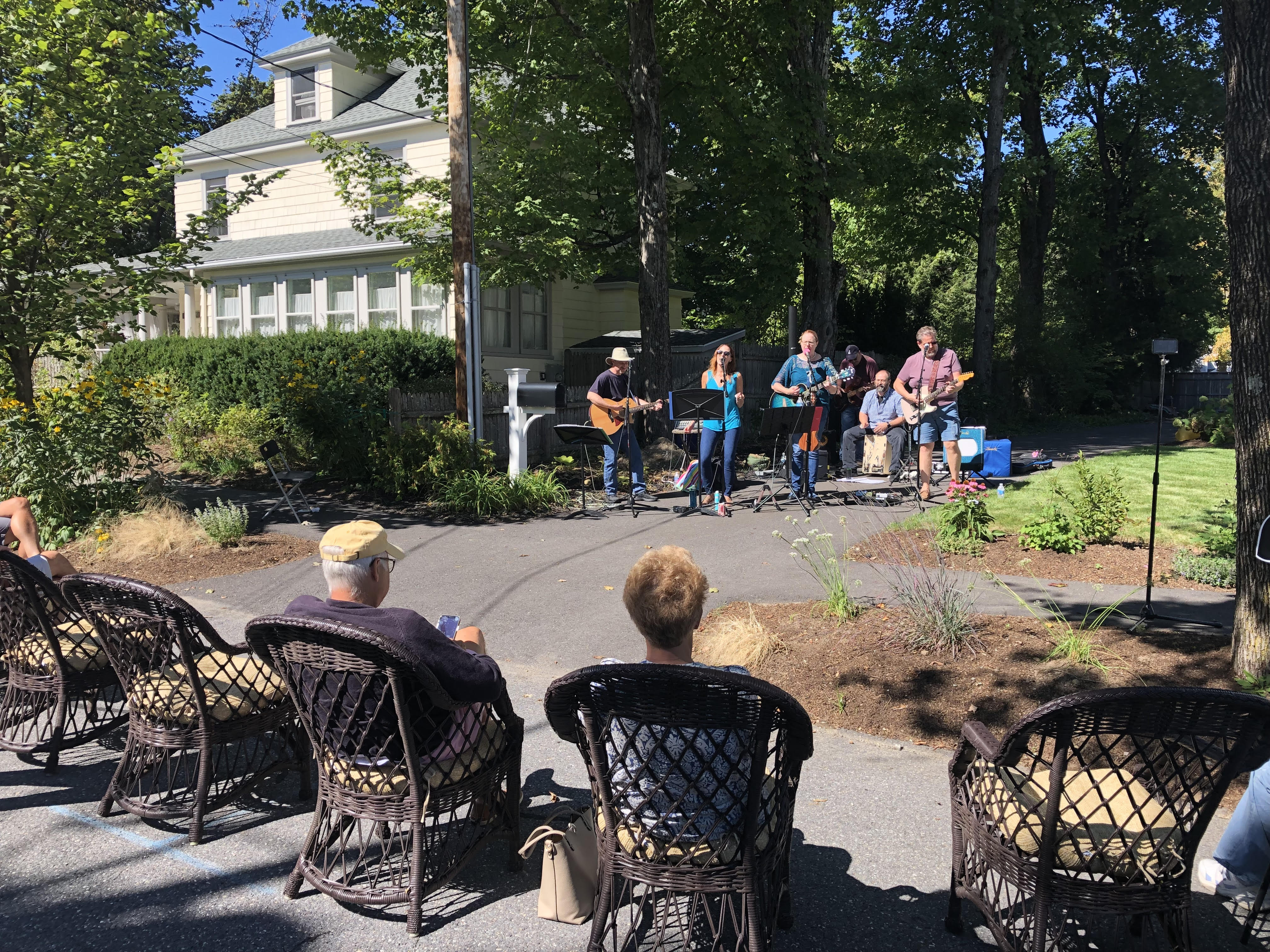
Photo: Suzanne and John’s Mom.
Porchfest events in Massachusetts towns promote neighborliness.
When Sara and I traveled together at age 16, one of the many things I learned from her was that it was perfectly fine to be friendly to strangers under some circumstances. You know, for example, how women who don’t know each other may strike up a conversation in a restaurant ladies room? That’s the kind of thing that was a revelation to me.
Nowadays, some folks have gotten more wary. Too wary. It is one factor in an epidemic of loneliness.
Sophie Hills writes at the Christian Science Monitor, “Lida and Mark Simpson sit on the steps of their porch with friends while the blues rock band Red Medicine plays in a yard across the street. People crowd all four corners of the intersection, dancing and chatting. It’s PorchFest in Petworth, a neighborhood of Washington, D.C. Some 100 performers will play on porches and yards throughout the day. A new group of people walks up, searching for space with a view of the band. ‘Sit, sit,’ says Ms. Simpson with a big smile, gesturing toward the wall at the edge of the yard.
“The Simpsons, who have a 4-year-old and a 6-year-old, chose Petworth because it’s walkable, close to restaurants and playgrounds and public transit, and still has a neighborhood feeling. When they first moved in eight years ago, Ms. Simpson says she hoped for an active front porch culture. But it didn’t quite coalesce until people began socializing from their yards in 2020. Happily, says Ms. Simpson, ‘porch and stoop culture restarted during the pandemic, and it’s stayed around.’
“[This spring], the U.S. surgeon general declared an epidemic of loneliness and isolation, saying that 1 in 2 adults reported experiencing loneliness even before the pandemic. At a time when neighborliness is decreasing and Americans are growing further apart, some, like the Simpsons, are intentionally building relationships within their communities. And events like porch fests are growing in popularity. Central to a culture of neighborliness, many say, are front porches. …
“ ‘As it has built for decades, the epidemic of loneliness and isolation has fueled other problems that are killing us and threaten to rip our country apart,’ wrote Surgeon General Vivek Murthy in the New York Times on April 30, announcing a framework to rebuild community. …
“A front porch is a liminal space, says Michael Dolan, a writer and editor in Washington. ‘It’s the outside of the inside and the inside of the outside. … When people who have [porches and stoops] don’t use them, they’re missing out on the opportunity to interact with the environment. [And] the environment includes humans and includes passersby, includes somebody coming up to ask directions, includes somebody coming by to say hello.’
“The type of neighborliness embodied by Mister Rogers is no longer the norm. Over half of Americans say they only know some of their neighbors. … Over half of Americans who say they know some of their neighbors say they never get together socially, according to a Pew study from 2019.
“It takes curious and open people to build the kind of community that has block parties, borrows ingredients, and watches each other’s kids, but social spaces like front yards and porches are important too, says [Campbell McCool, founder of a Mississippi development that centers community life]. ‘A front porch is central to the whole personality of a neighborhood,’ he says. …
“Historically, Mr. McCool says, three things sped the decline of the front porch in suburbia in the 1950s: air conditioning, television, and the car. Air conditioning and TV coaxed people indoors. Cars meant more people lived further apart from each other.
“When sociologists began studying differences between residents in neighborhoods with and without porches, they found that in the latter there was little to no interaction. People drove straight into their garages, and private backyard decks grew in popularity. …
“Today, polls show that older Americans are more likely to have neighborly connections. Just 4% of Americans over 65 say they don’t know any of their neighbors, compared with 23% of adults under 30. …
“Karen Goddard, who prefers porches to private decks, calls herself a ‘professional porch sitter’ in her attempt to make neighborliness popular again. …
“The point, Ms. Goddard says, is to meet on front porches without agendas, minutes, or formality – ‘just meeting and conversation.’
“It resonated with Ms. Goddard as something she was already doing. ‘My friends in my neighborhood in New Hampshire knew that they could come to my house any Friday night and hang out on the porch,’ she says. …
“ ‘I like to smile and make eye contact and say “hello” if possible, because I just think that’s important for human connection and for neighbors.’
“The porch has always been a place of social interaction, says Mr. Dolan. That’s been his experience for the four decades he’s lived in the Palisades neighborhood of Washington, where he says neighborliness shines. …
” ‘I like to answer my door and say hello to the people who come to my house,’ he says. ‘[One gains] the feeling of trust in the neighborly compact, the ability to rely on one’s neighbors and call one’s neighbors. … Or even if your neighbors bother you, … you tolerate them because they’re neighbors. So it’s a sense of place that reinforces your feeling of being part of something.’ ”
More at the Monitor, here. No firewall. Subscriptions welcome.

 Suzanne's Mom's Blog
[…] Porch Culture […]
LikeLike
Porch culture is my kind living!
LikeLike
I can picture that, Deb!
LikeLiked by 1 person