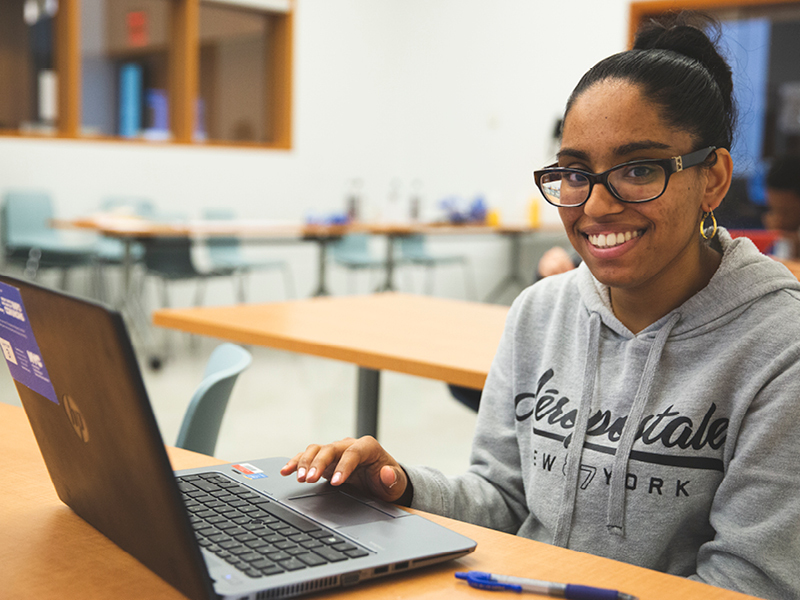
Photo: Brooklyn Public Library.
Teens in towns where some books are banned were given access to a card from the Brooklyn Public Library, just like one the New Yorker above enjoys.
It’s hard to imagine, but this is where we are. We don’t ban websites that tell you how to make a lethal weapon, but there are apparently ideas in books young people shouldn’t think about.
In one small step for humankind, the Brooklyn Public Library decided not to be passive about the situation.
I’m sorry to be late with this story, but I only just learned about the initiative and believe you might be interested. On April 13 last year, the library posted the following release on its website.
“Brooklyn Public Library (BPL) is launching a new campaign today, titled Books Unbanned, to help teens combat the negative impact of increased censorship and book bans in libraries across the country. For a limited time, young adults ages 13 to 21 nationwide, will be able to apply for a free eCard from BPL, unlocking access to the library’s extensive collection of eBooks.
“ ‘Access to information is the great promise upon which public libraries were founded,’ said Linda E. Johnson, President and CEO, Brooklyn Public Library. ‘We cannot sit idly by while books rejected by a few are removed from the library shelves for all.’ …
“The card will be good for one year and is designed to complement access to resources for teens in their local communities. The Brooklyn Public Library eCard provides access to 350,00 eBooks; 200,000 audiobooks and over 100 databases. Teens will also be connected to their peers in Brooklyn, including members of BPL’s Intellectual Freedom Teen Council, to help one another with information and resources to fight censorship. …
“To apply for the card, teens can send a note to BooksUnbanned@bklynlibrary.org, or via the Library’s s teen-run Instagram account, @bklynfuture. The $50 fee normally associated with out-of-state cards will be waived. Teens are encouraged to share videos, essays, and stories on the importance of intellectual freedom and the impact that book challenges and bans have had on their lives.
“The Library will also make a selection of frequently challenged books available with no holds or wait times for all BPL cardholders, available through the library’s online catalog or Libby app. The titles include: The Black Flamingo by Dean Atta, Tomboy by Liz Prince, The Bluest Eye by Toni Morrison, The 1619 Project by Nikole Hannah-Jones, Juliet Takes a Breath by Gabby Rivera, On Earth We’re Briefly Gorgeous by Ocean Vuong, and Lawn Boy by Jonathan Evison.
“While challenges to books and ideas are nothing new, the initiative was conceived in response to an increasingly coordinated and effective effort to remove books tackling a wide range of topics from library shelves. The American Library Association’s Office of Intellectual Freedom counted more than 700 complaints last year, the most since it began keeping records more than 20 years ago.
“In Texas, Matt Krause, chairman of the Texas House of Representatives General Investigating Committee, has called for public school libraries to ‘account’ for 850 sexually explicit or racially preferential books. The list includes a wide range of titles from National Book Award winner How to be an Antiracist by Ibram Kendi to John Irving’s bestselling Cider House Rules. Books which feature LBGQT characters; advice for dealing with bullies; and tips for teens on relationships are all included on the list, along with titles on historical events including the rise of the KKK, the Indian Removal Act and the election of Harvey Milk. …
“Locally, the New York State Education Department (NYSED) removed a tweet by the New York State Librarian after she recommended the book Gender Queer: A Memoir. NYSED said it was not aware of the graphic contents in the book. …
“Said Nick Higgins, Chief Librarian, ‘Limiting access or providing one-sided information is a threat to democracy itself.’ ”
The only one of the books mentioned that I have read is The Bluest Eye, by Toni Morrison, a Nobel winner. There is no doubt it is heavy-duty stuff, but that doesn’t mean people should be bliocked from reading it. The ideas are serious, and, I think, important, and even if they weren’t, I don’t see that any group of people should make decisions about what to read for any other group.
More at the Brooklyn Public Library, here.

 Suzanne's Mom's Blog
Hurrah for folks at the BPL taking this initiative. I agree that it’s hard to believe/understand/make any sense out of the fact that “we don’t ban websites that tell you how to make a lethal weapon, but there are apparently ideas in books young people shouldn’t think about.”
A good blurb or online review can tell a reader whether they want to read it, or read it at that moment. I often see a book I want to read someday but tealize I probably can’t handle it right now. Young people can do that. It should be their decision.
Great initiative! So glad to hear it.
Maybe other libraries will try it. There are so many innovative ones. I’ve been following the Ferguson one since the Brown shooting. It was a sanctuary during the rioting. And the Milwaukee library is so creative and funny!
Thanks for sharing this idea.Anita
I hope it catches on.
“In one small step for humankind, the Brooklyn Public Library decided not to be passive about the situation.” It is beyond comprehension how a group of vocal, aggressive people want to control what other people read. It really is evil. (Sorry if this sounds too over the top.)
The author of the wonderful Great Library fantasies has a right to feel strongly about libraries. And evil does often take a form of ignorant people who believe that scapegoating and controlling others can work to their advantage. It can’t, not for long anyway.