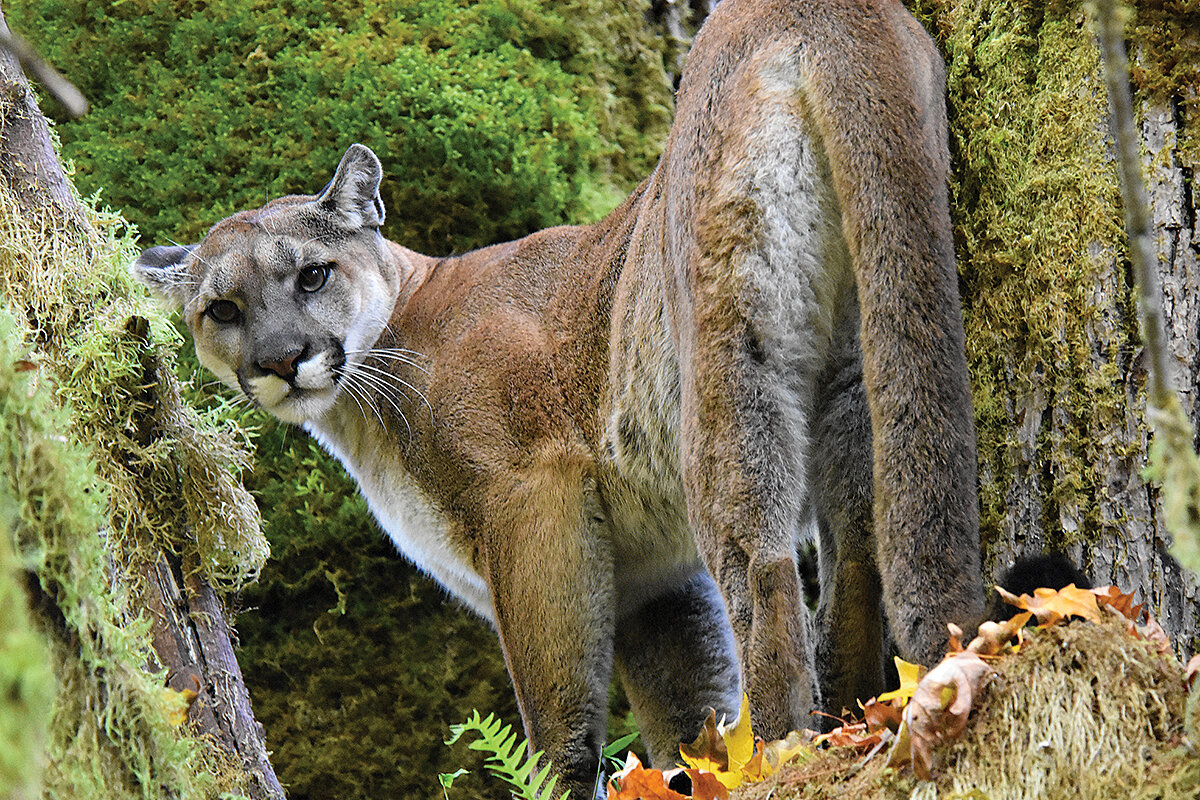
Photo: Mark Elbroch.
Since 2018, the collaborative Olympic Cougar Project has tagged 111 individual pumas, including Charlotte, above.
How many names do you know for the animal in the picture above? I learned four from today’s article.
Stephen Humphries writes at the Christian Science Monitor, “If Kim Sager-Fradkin didn’t have to write a grant proposal, she’d be spending her afternoon on the trail of a killer.
“The biologist leads a team that’s researching cougars in Washington’s Olympic Peninsula. (The big cat is also referred to as a puma or a mountain lion. Not to mention wild cat, or panthera.]) Today, the team is tracking a cougar named James. It suspects he recently hunted an animal in a nearby forest.
“ ‘Visiting cougar kill sites is really fun and like being sort of a forensic scientist,’ says Ms. Sager-Fradkin … wildlife program manager for the Lower Elwha Klallam Tribe. She’s overseeing the Olympic Cougar Project in partnership with Panthera … and five other Native American tribes. They’ve pooled their talents and resources to help an apex predator that has become effectively imprisoned in the westernmost part of Washington.
“The region’s cougars are penned inside a geographical island roughly shaped like a square. Three sides are bordered by the ocean and bays. To the south there’s the expansive Columbia River as well as Interstate 5. The barriers on all four sides collectively form a de facto fence. Unable to easily connect with other big cats in the Pacific Northwest, cougars in the Olympic Peninsula are inbreeding. The lack of genetic diversity poses health challenges for them, scientists say. By collecting data on the big cats, the Olympic Cougar Project is bolstering the case for constructing a wildlife overpass over I-5 so that the species is less confined.
“ ‘Humans love wildlife stories, and humans love wildlife movements,’ says biologist Jim Williams, author of Path of the Puma: The Remarkable Resilience of the Mountain Lion. ‘What’s really neat about this project is it’s going to create information that will be translated through story that will keep humans excited and caring about the species.’ …
“When Ms. Sager-Fradkin began working for the tribe in 2007, her primary role was to plan sustainable subsistence hunting and fishing for current and future generations. A year later, she initiated a small-scale study of cougars in the region. She called in cougar expert Mark Elbroch. In 2018, they expanded the scope and scale, incorporating the five other tribes in the region and adopting the Olympic Cougar Project name.
“ ‘The tribes on the peninsula aren’t always working together on a lot of things,’ says Ms. Sager-Fradkin, adding that there are sometimes disagreements over issues such as hunting jurisdictions. ‘So it’s really amazing that we’ve all come together and are working on a big project like this.’ To get all the partners on board, she had to get them to see the big picture. …
“The cougars are considered an ‘umbrella species’ because so many other creatures in the ecosystem depend on them. ‘Where there are frequent kills, the grass is literally more nutrient rich,’ explains Ms. Sager-Fradkin. …
“It was this fact that helped her persuade the region’s tribes that it was in their common interest to study the feline carnivore.
“For his part, Dr. Elbroch, director of the puma program at Panthera, adds that Ms. Sager-Fradkin used her natural skill of engaging with people. …
“Working in concert, the Skokomish, Makah, Quinault, Jamestown S’Klallam, and Lower Elwha Klallam tribes have created a grid consisting of 550 cameras. Artificial intelligence catalogs animals photographed in the peninsula – including bobcats, bears, coyotes, deer, and elk – and helps estimate their populations. Research technicians, such as Lower Elwha Klallam tribe member Vanessa Castle, analyze the patterns of 127 individual cougars. There’s also the less glamorous task of analyzing animal scat.
“ ‘A lot of our ancestral knowledge was lost,’ says Ms. Castle, who praises how Ms. Sager-Fradkin has mentored her and other employees in the project. ‘So we’re having to relearn those things. Like how wildlife all is intertwined with each other. … I had no idea the role that mountain lions played in the system as a whole.’ …
“ ‘The first thing that is needed is to protect the habitat on either side, because you can’t spend all the money on a wildlife bridge and then end up with a Walmart parking lot right on one side,’ says Ms. Sager-Fradkin.
“The Olympic Cougar Project is not just liberating the big cats, she adds, but also creating a sustainable ecosystem for the tribes for the next seven generations.”
More at the Monitor, here. No paywall. Subscriptions encouraged.

 Suzanne's Mom's Blog
Beautiful animals, but I wouldn’t want to see one in the woods behind my house. 😉
LikeLike
Even a coyote would worry me up close.
LikeLiked by 1 person
Yup.
LikeLike
Mountain lions are so beautiful. Glad their habitat is protected and their genetics monitored.
LikeLike