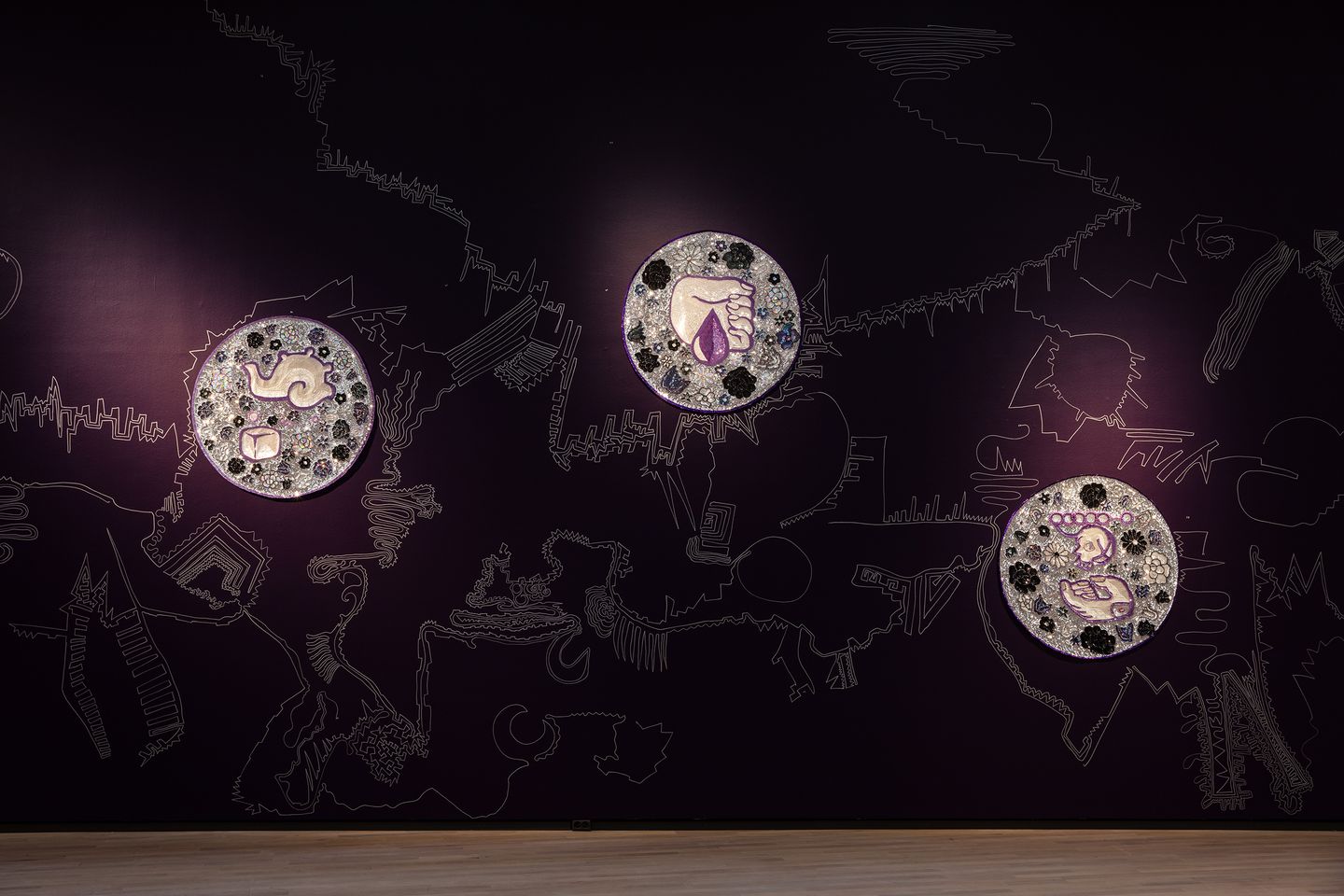
Photo: Christian Tunge via Henie Onstad Kunstsenter Museum in Norway.
Art by Guadalupe Maravilla: “Embroideries” (2019).
Today’s post is about the artist Guadalupe Maravilla, who has found his own way of using art-making as a healing practice. He is interviewed by Jareh Das at Ocula magazine.
“At the age of eight in 1984, Maravilla fled civil war in El Salvador and arrived in the U.S. undocumented. As an adult, he overcame colon cancer, which led him to learn about global healing practices from cultures as far-reaching as Mayan and Tibetan, alongside standard medical treatments like radiation and chemotherapy.
“Accordingly, his practice brings together often separate knowledge systems, from Western Cartesianism, which sees the mind and the body as separate entities, to non-Western and non-hierarchical approaches that look to nature and natural remedies for healing and tend to view humans as part of a wider cosmological system of equal parts.
“For Maravilla’s first exhibition in Europe, and most comprehensive to date, Sound Botánica at Henie Onstad Kunstsenter (18 March–7 August 2022), over 30 works comprising monumental sculptures, drawings, a large-scale mural, and instances of activated sound baths fill the institute, including four major bodies of work: ‘Tripa Chuca’ (2016–2020), ‘Embroideries’ (2019), ‘Disease Throwers’ (2019–ongoing), and ‘Retablos’ (2021), which are devotional [votive] paintings.
“Speaking to the ethics of artistic creation, both the retablos and embroideries were made with collaborators specialized in such forms, co-authored, and fairly compensated — all of which are important to Maravilla and his wider way of working.
“Sound Botánica unfolds over two main gallery spaces with the most captivating and monumental works on view being Disease Thrower #4, #6, #7, #8, #9 (all 2019)—totem-like sculptures that each incorporate a sound gong, assembled from plaster of Paris made by microwaving tissues and plastic that hold together objects collected during the artist’s travels.
“The most recent Disease Thrower #13 (2021) is an astounding work measuring over two meters high made from cast aluminum, moulding vegetation and nature into a constellation of organic forms, some related to the healing and nutrition during Maravilla’s cancer treatment, with notable vegetable forms like squash placed besides real squash at the base of the sculpture.
“In the conversation that follows, Maravilla speaks about forced migration, how trauma manifests in the body and the collective, and disrupting boundaries between art and life, with a practice led by a personal commitment to create a more equal and equitable world.
“Jareh Das: Some of your artworks, such as the series of monumental sculptures ‘Disease Throwers’, are activated through performative gestures. I notice they are made of materials like luffa sponges, anatomical models, gongs, glass bottles, and the invented plaster you create by melting tissues and plastic in a microwave.
“These are hybrid, totem-like sculptures that draw from your experience as a child who migrated undocumented to the U.S. They also bridge Indigenous cultures with ritual, and speak to your cancer treatments, which have included modern medical techniques alongside healing practices.
“How did you bring together these intersecting knowledge systems and develop an art practice centered on collective healing experiences, as the exhibition Sound Botánica at Henie Onstad Kunstsenter demonstrates?
“Guadalupe Maravilla: I am interested in collective healing and the intersections between the Indigenous and the medical, and dismantling systems. My daily experiences are the core of my work. People often wonder how I can be so open about having cancer, being undocumented, and being a child of war.
“I escaped the civil war in the south of El Salvador in 1984 and migrated to the United States, which separated me from my family; this is very common with migration. Somehow, I made it to the United States — I feel very blessed to be in this position, as an artist now exhibiting all over the world.
“I have a teaching position as a professor and all these great things, so I think of how lucky I am, but I also think back to the kids who did not make it, particularly those who crossed with me. On the other hand, because I’m a cancer survivor too, I can make a direct connection between the trauma of the civil war and seeing violence as a kid and the illness that came to inhabit my body.”
More at Ocula, here. No paywall. You can also listen to an interview at PRI’s the World, here.

 Suzanne's Mom's Blog
I love that he is reminding us of our interconnectedness with his art practice…
LikeLike
We can never have too many reminders.
LikeLiked by 1 person
An exhibit I would like to see.
LikeLike