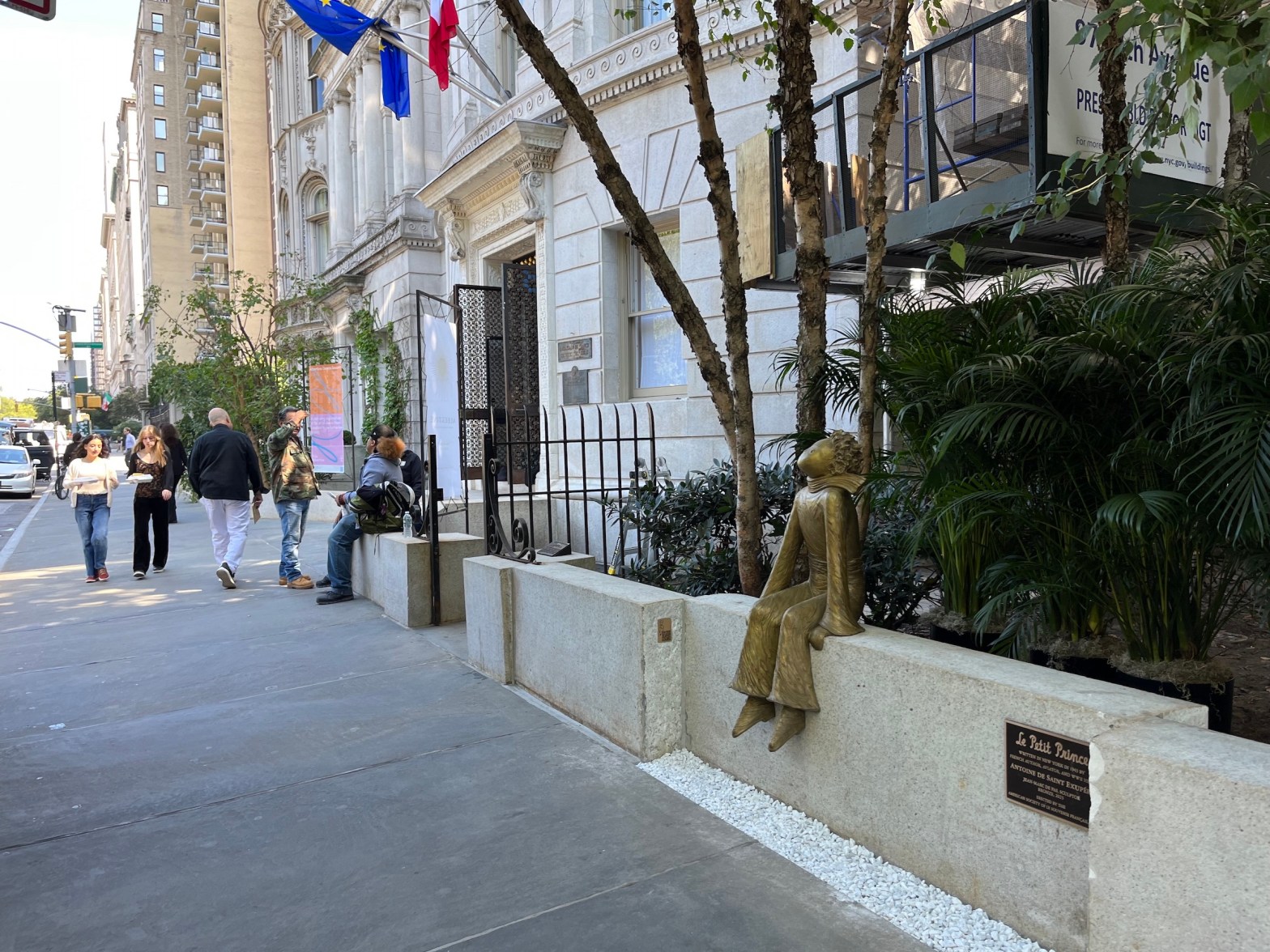
Photo: Hyperallergic.
The Little Prince gazes toward the sky from his seat on Villa-Albertine’s garden wall in New York City (972 Fifth Avenue), probably looking for his beloved rose on another planet.
My rose, all on her own, is more important than all of you together, since she’s the one I’ve watered. Since she’s the one I put under glass. Since she’s the one I sheltered behind a screen. Since she’s the one for whom I killed the caterpillars (except the two or three for butterflies.) Since she’s the one I listened to when she complained, or when she boasted, or even sometimes when she said nothing at all. Since she’s my rose.”
How many generations of people, young and old, have been fascinated by the peace-loving, philosophical Little Prince of Antoine de Saint-Exupéry’s lyrical imagining? I remember there was even a movie in which two intellectuals discussed the story at length, My Dinner with André. The André of the title, André Gregory, even presented a wild idea that the innocent little book was some kind of conspiracy.
Elaine Velie writes at Hyperallergic, “A bronze statue of the Little Prince now gazes wistfully toward the trees of Central Park in Manhattan’s Upper East Side. The titular subject of Antoine de Saint-Exupéry’s 1943 children’s novel is celebrating his 80th birthday, and sculptor Jean-Marc de Pas’s four-foot-tall version arrived yesterday, September 21, in front of Villa-Albertine, the French Embassy’s bookshop and cultural center in New York. …
“Saint-Exupéry wrote Le Petit Prince (The Little Prince) while living in New York after escaping the Nazi invasion of his native France. The book tells the story of a young boy who lands in the Sahara desert from a faraway planet. A pilot crashes and meets him, jumpstarting a winding tale of friendship filled with insightful commentary on the human condition. As the pair wanders through the barren landscape, the Little Prince tells the man about his travels to six planets. He met a different person at each location, each of whom was entangled in his own habitual folly. Saint-Exupéry’s tale offers meditations on how to live a worthwhile life — and how not to fall into the trappings of cynicism and adulthood. …
“The new sculpture sits on a low stone wall in front of the gilded-age Payne Whitney House that hosts Villa-Albertine. A row of small palm trees blow in the wind behind the prince as he gazes skyward.
“One passerby, self-proclaimed arts lover and hobbyist photographer Timothy Arena, stopped to look at the sculpture on his way from the Frick’s Breuer location to the Metropolitan Museum of Art a few blocks north of Villa-Albertine.
“ ‘I’ve walked by here dozens of times,’ he said, noting that the shiny bronze of the sculpture and plaque had caught his attention. He was familiar with the subject, especially after visiting an exhibition on The Little Prince at the Morgan Library and Museum last winter. Seeing the sculpture, he said, made him want to read the book.
“Film stylist Meghan Kleinheinz strolled along Fifth Avenue and paused to examine the work and take a photograph. ‘The texture of the bronze really gives it a lot of movement,’ Kleinheinz told Hyperallergic. ‘It looks perfect — with the breeze coming through.’
“Gaëtan Bruel, the director of Villa-Albertine and cultural counselor for the French Embassy, said in an interview with Hyperallergic that the Little Prince is perhaps the most universal character in French literature. Bruel spoke to the importance of the lessons in the story, among them kindness, wisdom, dialogue, and the acceptance of differences. ‘He’s a quite political figure — not a partisan one — but someone who can inspire a generation of minds,’ Bruel said. …
“The statue was sponsored by the American Society of Le Souvenir Français nonprofit and the children’s advocacy group Antoine de Saint Exupéry Youth Foundation. Bruel discussed the statue’s connection to Villa-Albertine, which hosts an artist residency program. Like the Little Prince, he said, these artists are travelers who have much to learn and share.
“Bruel recalled the first time he read the story. His mother was a preschool teacher, and when he was the same age as her students, she read him the book while they were traveling on their sailboat. … ‘I felt a connection. I remember that the sky in the book reminded me of the sky above the sea.’ ”
More at Hyperallergic, here. No firewall. There’s also a lot of information about the book on Wikipedia, here.
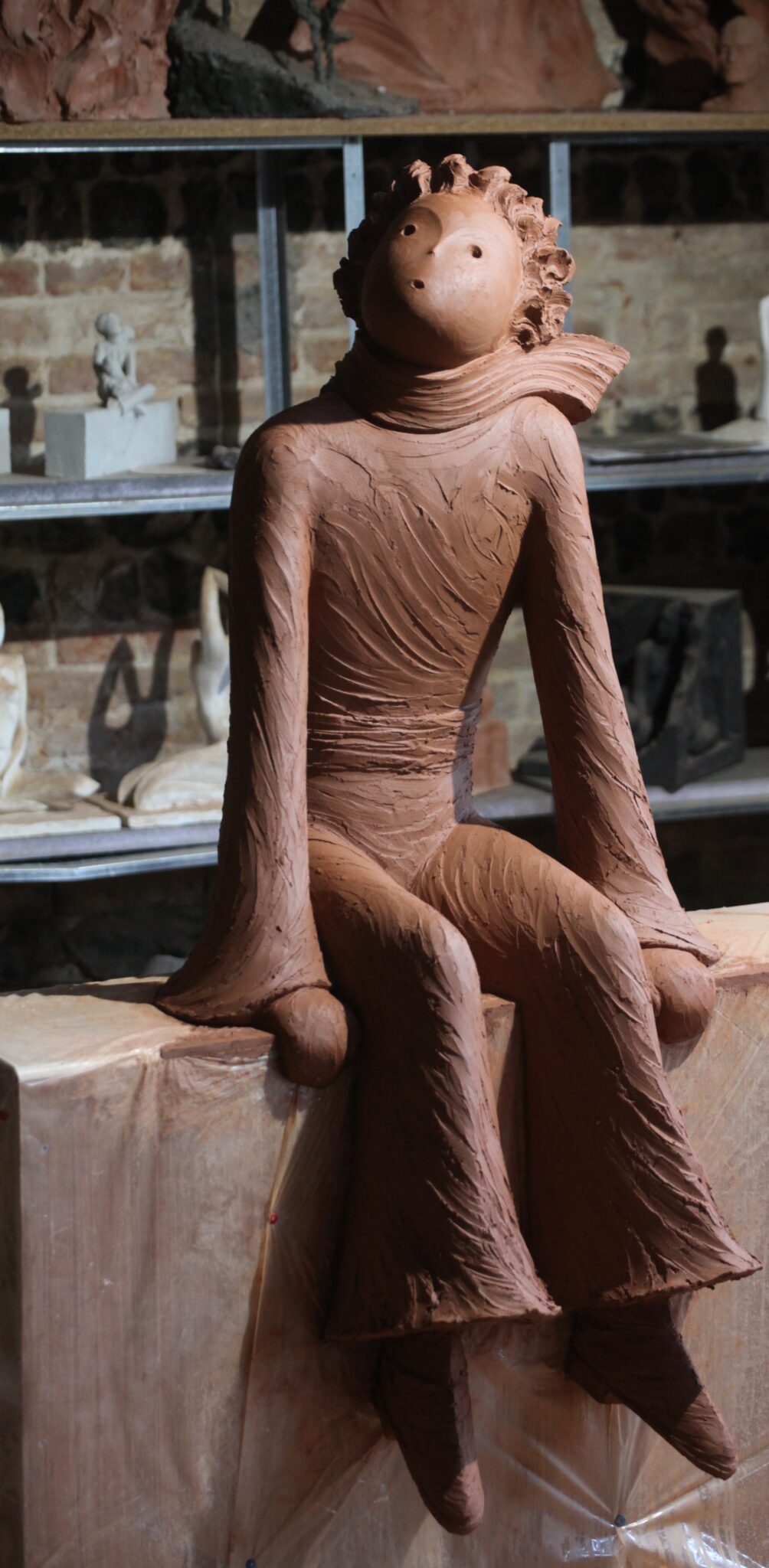
Photo: Jean-Marc de Pas via Villa-Albertine.
A model of the Little Prince sculpture by Jean-Marc de Pas before casting in Normandy, France.

 Suzanne's Mom's Blog
This is one book I can read over and over. It has such a universal message. I enjoyed your post so much.
LikeLike
And I am thrilled that you are back doing your wonderful reports from Paris!
LikeLiked by 1 person
Oh, thank you. The Covid years left my inner-writer dying on the vine but being in Paris always inspires. Nice to hear from you as always.
LikeLike