Photo: Sophie Hills/The Christian Science Monitor.
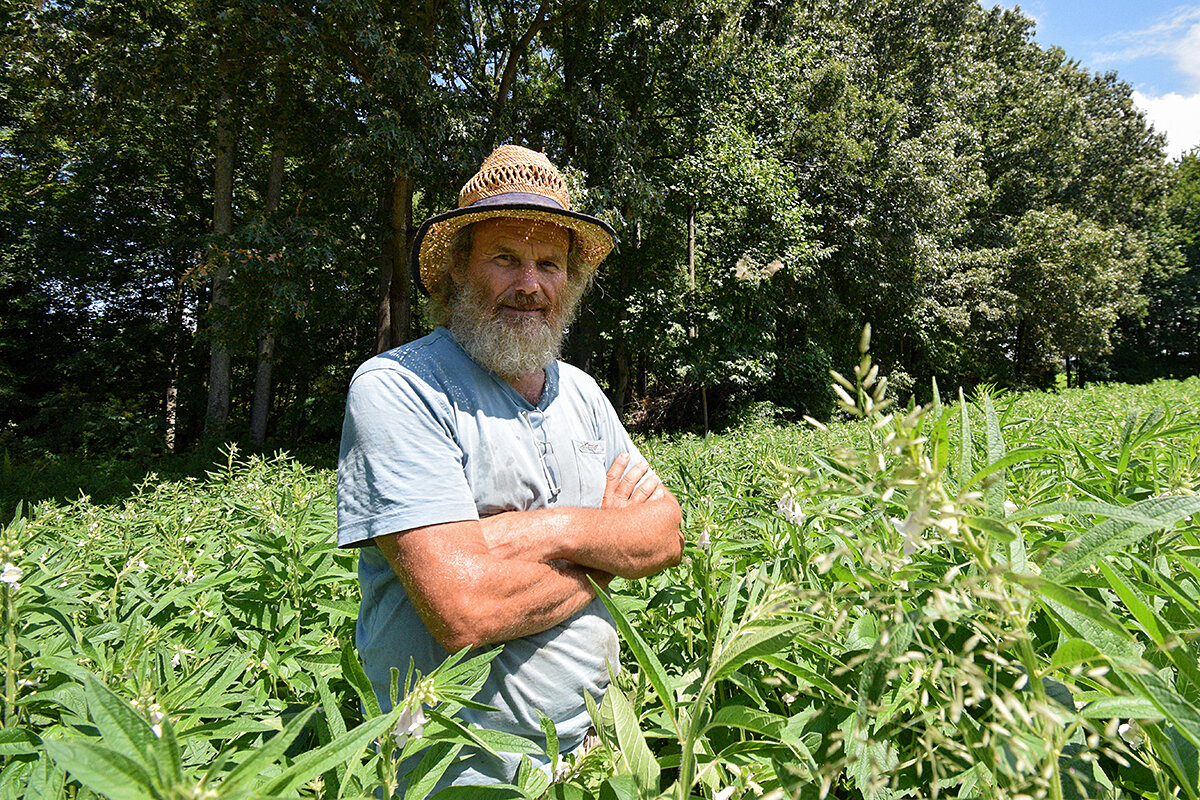
Heinz Thomet stands in a field of sesame on his farm in Newburg, Maryland, Aug. 17. Mr. Thomet tries to grow nearly everything he eats.
I love the first line of today’s story about “one of only two commercial rice farmers in Maryland.” Because who knew there were rice farmers anywhere in the US? Don’t you think of rice farmers as being almost entirely in places like Japan and Vietnam?
Sophie Hills writes at the Christian Science Monitor, “Heinz Thomet is one of only two commercial rice farmers in Maryland. The other is Nazirahk Amen of Purple Mountain Organics. Not one to accept the status quo, Mr. Thomet grows six varieties of rice on his farm in southern Maryland, where most fields are planted with soybeans and corn. Mr. Thomet didn’t start growing rice until sometime during the past decade. His explanation for why he added the crop is simple: ‘I eat rice.’ …
He is the sort of person who has utter faith in natural processes but none in institutions.
“He’s always been a farmer, from growing up on a farm in Switzerland to working on a famed biodynamic farm in the United States as a young man. Since 2000, he’s farmed in Newburg, Maryland. There, in addition to the rice, he grows barley, Sichuan peppers, bananas, grapes, bitter lemons, oats, kiwis, sesame seeds, figs, and more, depending on the season.
“It’s difficult to make a profit on rice in Maryland. Farm-to-table was a natural concept for Mr. Thomet even before the movement expanded out of California in the early 2000s.
And though small-scale, direct-to-consumer farming is difficult to justify commercially, Mr. Thomet’s main concern remains the quality of the food he grows and stewardship of his land.
“In this case, that means successfully producing rice – a crop grown by few others on the East Coast. ‘Nothing of what I do makes sense for a cheap food system, but if you recognize a decentralized food system as food security, then I start to make sense,’ says Mr. Thomet. ‘If you look at diversified farms as part of the resilience towards a global weather pattern change, then I start to make change.’
“In an era of climate disruptions that are changing where everything from coffee and cacao to mustard and olives can be successfully grown, a decentralized food supply – like the one Mr. Thomet espouses – is getting a second look.
“After decades of factory farming and reliance on a global food chain that sends bananas, grapes, mangoes, and avocados thousands of miles to stores, returning to the idea that food should be grown where it is eaten is no easy task. And rice-growing is a useful case study.
“It’s unusual to find rice farmers anywhere on the East Coast, says Raghupathy Karthikeyan, Newman endowed chair of natural resources engineering at Clemson University in South Carolina. Rice production in the U.S. now takes place mainly on commercial farms in the Midwest and the South. But Mr. Thomet and fellow farmer Mr. Amen are holding on, despite the tight profit margin for small-scale, organic farmers.
“Both Mr. Thomet and Mr. Amen grow upland rice, a method that doesn’t use water for weed control, instead requiring labor-intensive weeding. While both sell their rice, neither grows enough to register on the U.S. Department of Agriculture census. Historically, Maryland farms mainly grew tobacco, and South Carolina was rice country. But the end of slavery and changing weather patterns made rice-farming less profitable. At one time, about 225,000 acres in South Carolina were planted with rice. Today, it’s somewhere between 25 and 50 acres. In Maryland, it’s 2.
“Agriculture in Maryland, as in most of the U.S., doesn’t supply much of the produce purchased in the state. Maryland farms produce more grain than other crops, and most of that is used for livestock feed and seed.
“Mr. Thomet’s interest is in locally grown crops for food, and he has a loyal base of customers, including restaurants.
“For Mr. Thomet, it’s not just about protecting the locavore movement. It’s also about stewardship. He quotes the motto of his family’s farm, Next Step Produce: ‘Committed to growing nourishing food in harmony with nature.’ …
“He eats what he grows and tries to grow whatever he wants to eat. In fact, Mr. Thomet has a nearly complete food system growing on the 30 acres he cultivates. The one thing he can’t grow is sugar cane, so he grows sweet sorghum instead, which is made into molasses.
“Day length, sun exposure, and night temperature in Maryland are all sufficient for rice to thrive, he says. Next Step Produce starts the rice in a greenhouse and then transplants it, allowing for more growing days so the farm can grow higher-yield varieties.
“Whether upland or lowland, rice is no longer profitable to grow in South Carolina – the historical center of U.S. rice-farming – unless it’s grown as a hobby, says Dr. Karthikeyan, who’s leading a study on climate-resilient rice production. The remaining commercial rice farms he’s aware of in the U.S. all grow lowland rice in paddy fields.
“Rice is a labor-intensive crop, even if you flood it, says Dr. Karthikeyan. The yield gap between upland and lowland rice is large, making it hard to turn a profit growing commercial varieties upland. That extra labor limits how many acres of rice Mr. Thomet plants, since they’re weeded by hand. It’s also reflected in the price, he says.
“Still, in his eyes, everything comes down to priorities and societal values. There’s no good reason everyone shouldn’t have access to nutritious, locally grown food, he says. Next Step Produce, which he runs with his wife and daughters, was certified organic for two decades until last year, when a red-tape snarl was the last straw for Mr. Thomet. But his customers don’t care about the label at this point, he says. They know his growing practices. …
“Benjamin Lambert, the executive chef at Modena, a restaurant in Washington, D.C., has bought from Mr. Thomet since 2007, when he met him at a local farmers market. ‘As a chef, you look for good ingredients,’ he says, standing in the restaurant, a James Beard Award hanging just behind him.”
More at the Monitor, here. No firewall. Subscriptions solicited.

 Suzanne's Mom's Blog
What a deeply reassuring story. Hurrah for this man and his family! We definitely are going to need more diversified, locally-run farms as climate change/catastrophe increases in our lives. That’s why I love the non-profit farm right over the border in Lexington next to the Arlington reservoir. Thanks for finding and sharing this article!
LikeLike
What is the name of the nonprofit farm you mention? I want to try it.
LikeLike
The Lexington Community Farm (https://lexfarm.org/).
LikeLiked by 1 person
This post struck a chord with me. My father told me that there was a man who used to grow rice, in the ravine behind his childhood home.
LikeLike
Wow! As far north as Canada?
LikeLiked by 1 person
I was surprised too!
LikeLiked by 1 person