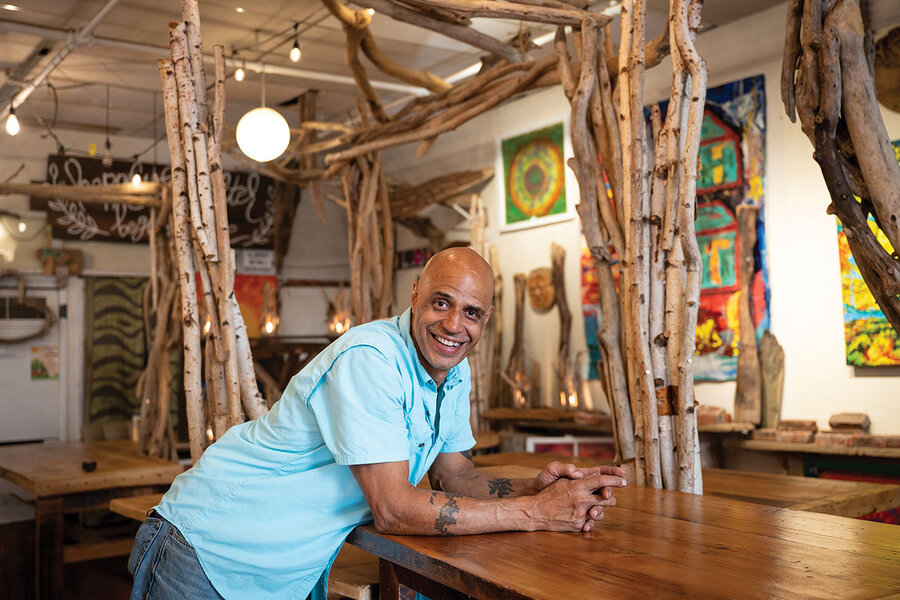
Photo: Riley Robinson/Monitor Staff.
Artist Danny Killion poses in his gallery, Weathered Wood, in Troy, New York. He is one of many who have benefited from the Prison Arts Program.
Some folks have no sympathy for people in prison and would begrudge any type of cultural program that might help them. “If they wanted to do [art, music, a GED …], they shouldn’t have committed the crime.”
But many of us know that life circumstances and not always conscious decisions can accumulate until someone is in big trouble. I like the Norwegian approach to corrections, here, and the often small but meaningful work that is done in the US.
Troy Aidan Sambajon wrote about an example at the Christian Science Monitor.
“On a long table, Jeffrey Greene prepares bundles of colored pencils for delivery to Connecticut state prisons. …
“Finished artwork lines the shelves of this airy warehouse, home to the permanent collection of the Prison Arts Program. Mr. Greene reaches up to a high shelf and retrieves a model RV, rendered in detail down to the windowsills. The shingles were cut from cardboard with a nail clipper and glued with a mixture of floor wax and nondairy creamer. Another artist unraveled a prison blanket and crocheted the threads into a 3D horse. …
“[Mr. Greene] has known his students for years, even decades. He can describe the medium they use and the metaphors their pieces convey, and has seen how the artistic process helps students deal with issues like depression, anxiety, and post-traumatic stress disorder.
‘Art unsettles habitual modes of thought and gives you the opportunity to think differently,’ says Robin Greeley, professor of art history at the University of Connecticut.
” ‘It can disrupt your whole routine and can create a sense of wonder.’
“The Prison Arts Program is one of the oldest correctional arts programs in the United States. It’s the longest-running program of Community Partners in Action, a criminal justice nonprofit based in Hartford. …
“Mr. Greene never intended to work in the prison system. After graduating from Hamilton College in New York, he volunteered to teach art workshops in prison on a whim. But he’s never forgotten the impression left by his first day on the job.
“ ‘Everyone’s developing in this artificial, man-made, absurd, adversarial environment. It’s ridiculous,’ recalls Mr. Greene. …
“ ‘What drives Jeff really is the ability to show the humanity of the prison, of the people that are incarcerated,’ says Beth Hines, director of Community Partners in Action. ‘They know they can count on him when they get out.’
“In each prison he visits, Mr. Greene instructs his students to create art that only exists because they exist. He says it’s about more than finding a hobby while behind bars: ‘They are people that are coming out into the world with this incredible empathy and curiosity.’ Even if they never leave the prison system, he adds, that mindset can have a positive effect on others. …
“For years, Natasha Kinion felt like she’d been swallowed alive in prison. ‘I was guilt-ridden. I was shameful. I was really broken,’ she says in a phone interview.
“A mother of four who has experienced domestic abuse and substance addiction, Ms. Kinion spent 13 years at York Correctional Institution in Connecticut. There she started making abstract art.
“ ‘It took me at least the first six years of my incarceration to really open up and allow the healing process to start,’ says Ms. Kinion. …
“Mr. Greene helped Ms. Kinion send her artwork to her children. Her daughter Mayonashia Jones once received a drawing of a butterfly trying to fly with broken wings. She remembers thinking of her mom and wondering, ‘Has she always felt like that?’ …
“Since her release in 2019, Ms. Kinion has published a book about her journey, titled Stand Up You’ve Been Down for Too Long, and has opened her own digital art company, Dezigning Deztiny.
“ ‘I never told him this … but Jeff is really my hero,’ says Ms. Kinion.
“Danny Killion had little interest in art when he was robbing banks in Connecticut. Then he was caught and sentenced to 12 years in prison. ‘Prison can be a very cold, hard environment,’ says Mr. Killion. …
“He spent 10 years in the Prison Arts Program, learning to concentrate on the artistic process and find solace in a concrete cell.
“ ‘I’ve never met anyone who’s a more profound teacher,’ says Mr. Killion, who finished his sentence in 2007. As he found his feet in society, Mr. Greene would drop by, offering art materials and a listening ear.
“After working in construction, Mr. Killion began creating furniture using driftwood from the Hudson River. In 2013, he opened his own art studio and gallery, Weathered Wood, in Troy, New York. He traces his transformation back to those first classes with Mr. Greene. …
“This year, Mr. Killion unveiled his first public commission, a sculpture of twisted scrap metal depicting a man breaking through chains, installed at Old New-Gate Prison, a historical site in East Granby, Connecticut. Mr. Greene was there too, both men now standing outside prison gates.”
More at the Monitor, here.

 Suzanne's Mom's Blog
Leave a comment. Website address isn't required.