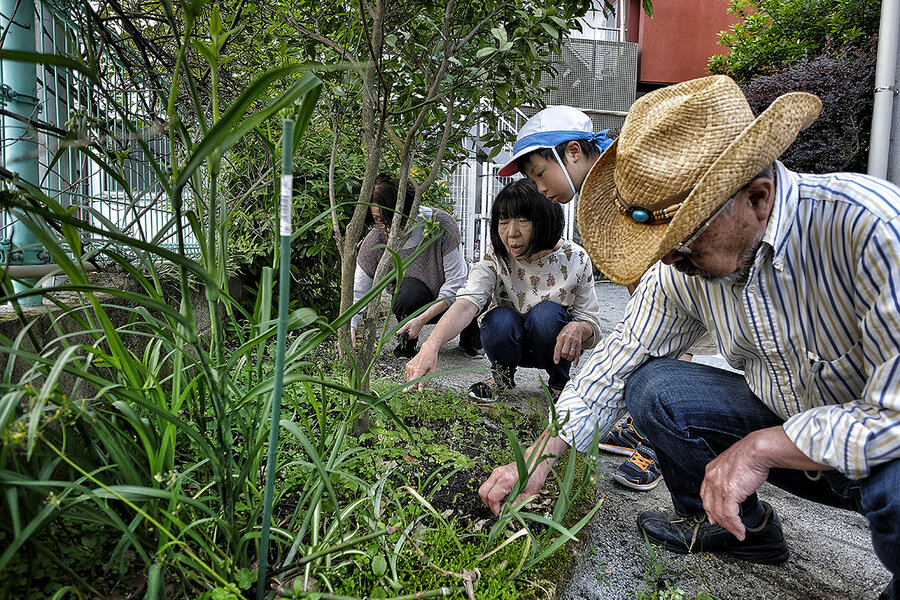
Photo: Oscar Espinosa.
Residents of a Japanese apartment building designed to combat loneliness in seniors are seen weeding with a boy from the child development center on the first floor.
Social media, working at home, and lack of face-to-face interaction are among the reasons for the increased isolation of all ages in our world. Isolation is not good for individuals or for society.
At the Christian Science Monitor, Oscar Espinosa describes an apartment building in Japan specially designed to bring people together more.
“A message on a small whiteboard near the elevator,” he writes, “is a reminder that dinner in this apartment building is tonight at 7 p.m., as it is once every month. Many of the residents are likely to attend, since being together is the point.
“Nagaya Tower, in the peaceful city of Kagoshima on the Japanese island of Kyushu, houses 43 people, ages 8 to 92, including a family with five children. With shared community spaces, the tower was built so that different generations could meet and interact. The staff is dedicated to supporting residents and connecting them with each other to generate that community life so important to combating the loneliness of older people, which has become a significant problem in Japan’s increasingly aging society.
“ ‘This community is inspired by the ancient nagayas of the Japanese Edo period,’ says Nomura Yasunori, who moved here five years ago with his wife. ‘From children to the elderly, families, singles, from different occupations, all lived together in the same long compartmentalized house.’
The building was designed in a V shape so that everyone could see each other when they enter or leave their homes.
“[In 2021], the Japanese Cabinet Office appointed a minister for loneliness and social isolation. … According to a survey conducted in 2017 by Japan’s National Institute of Population and Social Security Research, 15% of older men who live alone talk with one person or no one every two weeks, while 30% feel they have no reliable people they can turn to for help in their day-to-day lives.
“Dozono Haruhiko, founder of one of Japan’s first palliative care clinics, saw how his patients could suffer from social isolation. He believed that what these patients needed was human interaction, and so, in 2011, he applied for a government grant with his idea for Nagaya Tower, which was completed in 2013.
“By 6 p.m. on this evening, residents are starting to arrive with food for the communal dinner. Some of them rearrange tables to form a single one that takes up almost the entire room; others go to the kitchen to lend a hand.
“ ‘After coming to Nagaya Tower I feel rejuvenated,’ smiles Kukita, who arrived three years ago with his wife. … ‘Here you stay young because you are surrounded by children and young people.’ Kukita says he walks every day in the park, swims in the pool, participates in the art workshop once a month, and, above all, takes every opportunity to talk and spend time with the children.
“ ‘I can learn a lot from the elderly people through the exchange,’ says Takai, who is in his 30s and is one of the younger residents. ‘We help each other from time to time if we have a problem.’
“The building was designed in a V shape so that everyone could see each other when they enter or leave their homes, allowing them to greet each other, which is not common practice in other places, according to Moemu Nagano, age 27, who has lived here for two years. …
“After dinner, Kawasaki Masatoshi sings Bob Dylan’s ‘Blowin’ in the Wind’ to a standing ovation, making it clear that Nagaya Tower’s motto, ‘Life is happy when you have someone to smile with,’ is more than just a phrase on a piece of paper. He loves community life and boasts of being resident zero, when he moved in 10 years ago.
“ ‘I signed up before the construction of the building was finished, and I will stay here for the rest of my life,’ Mr. Kawasaki says.
More at the Monitor, here. No firewall. Charming photos. And for more insights on communal or supported living, read the blog Making Home Home, here.

 Suzanne's Mom's Blog
My 95-year-old neighbor lost her husband roughly 18 months ago and she is so isolated. The woman was an icon in her day who did so much for so many people. She’d happily allow a young family to live with her rent free in the home where she and her husband raised 6 kids and took in many people over the decades. But nowadays, things seem so complicated. Everyone is busy and most people are uncomfortable with unconventional living arrangements, even if they are economical. We desperately need more facilities like the one in this article!
Indeed. In Cambridge, MA, there’s a system whereby, a college student can share a house with an elderly person in exchange for some chores.
What you’ve shared here has really got my mind going. It’s elicited a lot of discussion in our home.
I am learning that the design and the culture of a place can really give people the nudge they need to socialize. People who are lonely often get depressed and then may withdraw more.
Living with people of various ages is important. The US could take note of this model. I’m sure loneliness is endemic here as well.
I see it where I live now. Especially in the independent part of the retirement community, where people have to make more of an effort.
My parents in their 80s chose a building with many ages living there and enjoy it.
Excellent!