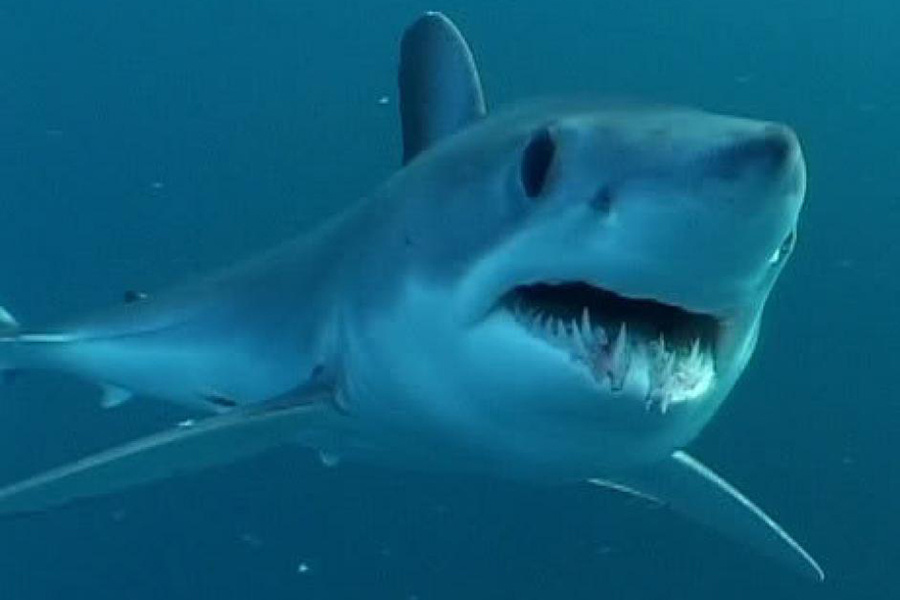
Photo: NOAA Fisheries.
Mako sharks are part of a study involving acoustic tags.
You have to move fast to get a tag on a shark, and you have to throw the shark back, even if you’re not done, if it starts showing any sign of weakness. Frank Carini has the story at ecoRI News.
“A South Kingstown-based nonprofit co-founded by a lifelong Rhode Islander [attaches tags to sharks].
“Jon Dodd, the Atlantic Shark Institute’s executive director, said getting an acoustic tag, or any tag, for that matter, onto a shark works like a ‘NASCAR pit stop.’ A crew of four, sometimes six, has a maximum of 12 minutes to get a tag attached and take a blood sample and measurements. If a sharks begins to look lethargic, Dodd said the animal is immediately placed back in the sea, even if all the data hasn’t been collected or the tag fastened.
“A hose is put in the shark’s mouth to flush salt water through its gills, and a towel is often placed over the eyes to keep the animal calm.
“The Atlantic Shark Institute, an all-volunteer nonprofit, partners with other shark scientists and researchers, which allows collaboration to play a critical role in the research, management, and conservation of large predatory sharks in the northwest Atlantic Ocean, according to Dodd.
“ ‘We have to spend wisely to advance science,’ he said. The institute’s budget gets a helping hand from 20 local boat captains who provide their vessels and fuel free of charge for tagging research.
“Dodd noted tagging allows researchers and scientists to track where sharks go and when. … Given the vulnerability of most of the shark species they are tagging, studying, and tracking, Dodd said, they abide by strict protocols regarding the way the sharks are handled when they are being caught, tagged, and measured. He noted that traditional J hooks, which can fatally puncture an organ, have been replaced by circle hooks, which are more likely to lodge in the corner of a shark’s jaw, making removal easier. Fishery regulations also require hooks to be composed of corrodible metals which, unlike stainless steel, degrade faster and increase the chance of a shark’s survival if a hook can’t be removed.
“The type of tag used is determined by the species caught and the study being conducted, according to Dodd.
“The least expensive are national fisheries tags — an index card in a plastic tube attached to the base of the dorsal fin. These cards are provided by NOAA Fisheries for free. A shark swims around and ‘if somebody caught it someday, they say please unscrew the cap and the card rolls out and it says please call the National Fishery Service and tell us where you caught this shark, what size it was, et cetera.’ …
“Acoustic tags, which cost $425 and last about a decade, track a shark’s movement via signals picked up by acoustic receivers, which cost $2,500 each, that have been placed up and down the East Coast. Both the Atlantic Shark Institute and the Rhode Island Department of Environmental Management have placed receivers in local waters.
“Pop-up satellite archival tags — each with a price tag of up to $4,000 — provide even more detailed data beyond location, such as water depth and temperature. They last about two years before the battery dies and the tag corrodes and falls off the shark. …
“The Atlantic Shark Institute’s … mission, and that of its science partners, is ‘to do the highest quality shark research to help manage and conserve these magnificent animals.’ …
“During a recent conversation with ecoRI News, Dodd often used the words ‘beautiful’ or ‘awesome’ to describe a shark species — well, maybe not spiny dogfish.
“Dodd has spent much of the past 45 years, even while working full-time in a totally different field, thinking about, learning about, and studying sharks. He has caught, released, and tagged some 1,000 sharks for various research projects during the past four-plus decades. …
“ ‘When I saw my first shark, I was fascinated, and it just kept rolling,’ Dodd said. ‘But it quickly went from fascination to concern. It was just this realization that Man will take a lot of things out of an ecosystem, and it didn’t feel right.’
“His concern about the species grew during the 1980s and ’90s, especially as he watched the popularity of shark tournaments grow, the number massacred for their fins increase, and the amount killed in bycatch rise.
“ ‘We take over 100 million out of the ocean every year. It’s just too many,’ said the 62-year-old Dodd. ‘And the big problem is that a lot of these sharks are very slow growing and slow maturing. I’ll give you a perfect example. … It takes the female great white 33 years before she’s sexually mature. So we’re talking right now and it’s March 21, 2024, so if a white shark is born while we’re chatting that shark will finally reproduce when I’m 95 years old.
“ ‘For the first time she can finally replace herself, but what’s the chance that her pup [litter sizes range from 4-12 individuals] survives? A lot of things can eat you, you can bite the wrong hook, you can sit on a longline and die because you’ll basically suffocate. You can get dragged up somewhere. You can get caught by a recreational guy that poses with it too long and kills it. What’s the chance that you survived 33 years so you can reproduce?’ …
“Since 1975 the world’s shark populations have declined by 71%, according to the Save Our Seas Foundation. It’s a disturbing trend that Dodd said has major implications beyond the marine environment.
“He likes to tell people, ‘Shark health is ocean health and ocean health is our health. Sharks are the apex predator, and they regulate everything underneath them.’ “
More at ecoRI News, here. No firewall.


Oh my goodness, we remove 100 MILLION sharks from the ocean a year. That’s really terrible. We must take fewer out and let them reproduce.
LikeLiked by 1 person
I just read that shark meat is popular in Brazil and also that many people don’t know when they are eating it.
LikeLiked by 1 person
Well, time to put information about sharks in the famous Brazilian soap operas. It worked for getting the word out about birth control…
LikeLike
LOL. You always have something new to tell us!
LikeLiked by 1 person
Thanks, I took a media for development and social change class that was fascinating.
LikeLiked by 1 person
Let the sharks be…I agree with Dodd ,a shark healthy ocean is a very important!
LikeLike
What was surprising to me: my husband said he had been supporting the shark-monitoring program in Rhode Island for a couple years! I hadn’t even remembered that when I saw the article!
LikeLiked by 1 person
Bless the folks who devote their lives to helping other species whom ignorant, greedy and otherwise disrespectful human beings have taken advantage of!!! I did not know that “it takes the female great white 33 years before she’s sexually mature….” We gotta start thinking seven generations into the future when we make our daily choices about what to eat (or not eat), what to buy (or not buy), what to drive (or not drive), etc.
LikeLike
We need to be more “thinking” about everything.
LikeLiked by 1 person
The world needs more people like Dodd and more organizations like the Atlantic Shark Institute see sharks as wonderful creatures that need to be protected instead of destroyed. I made a blog post about one such organization called Shark Allies, different methods, same goal. https://exemplarsofchange.wordpress.com/2024/07/14/shark-allies-protecting-the-presumed-man-eating-sharks-from-true-monsters/
LikeLike
Thank you. We are losing sharks too fast.
LikeLiked by 1 person