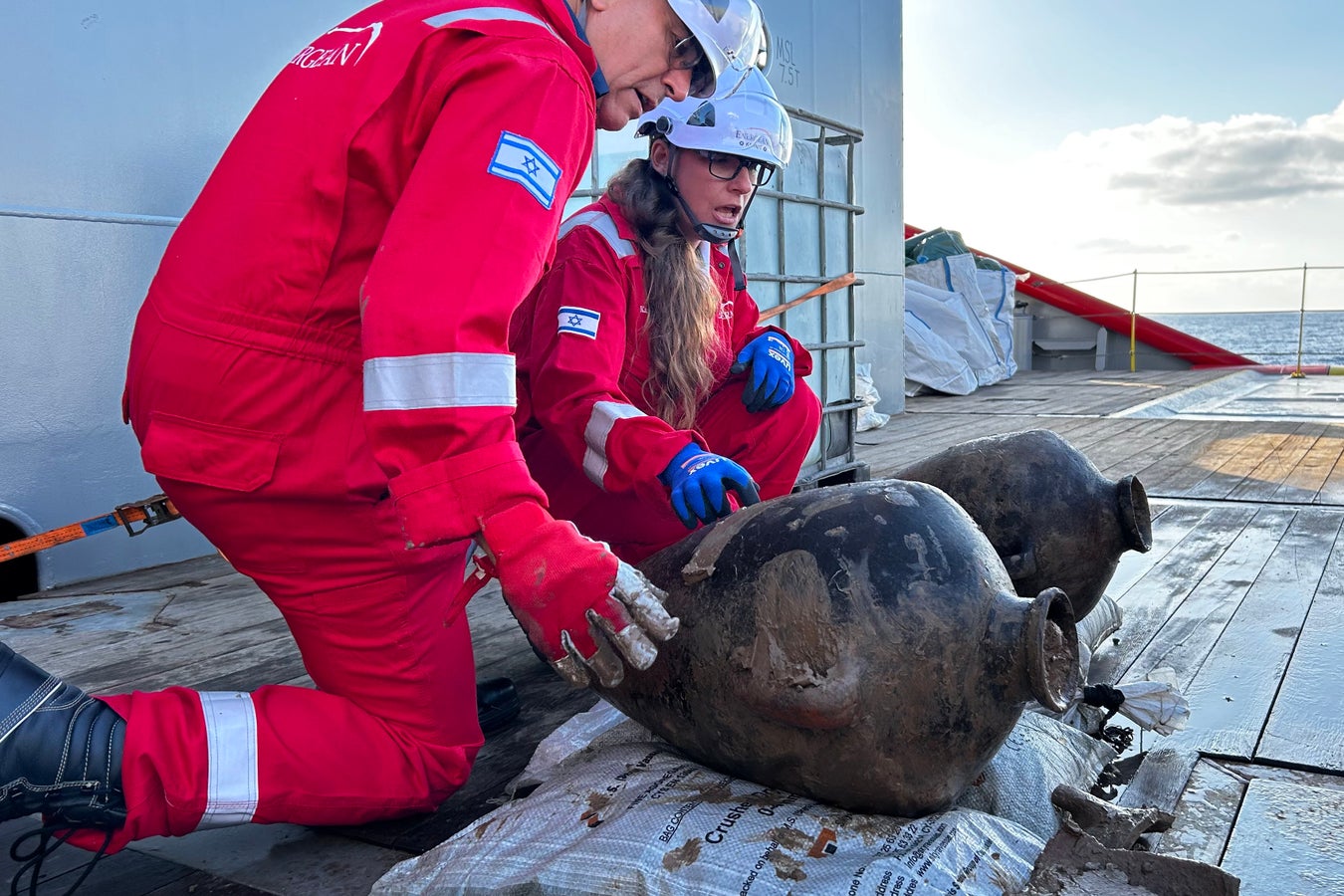
Photo: Ilan Ben Zion.
IAA archaeologist Jacob Sharvit (left) and Energean environmental lead Karnit Bahartan examine Canaanite storage jars retrieved from the seafloor of the Mediterranean on May 30, 2024. They are from the Bronze Age (which ran about 3300 to 1200 BC, according to Wikipedia).
Judging from past comments here, we all like archaeology stories, especially those that explore the mysteries of shipwrecks. It must be something about realizing that nothing is ever completely lost.
At Scientific American, Ilan Ben Zion reports on the recent discovery of a Bronze Age shipwreck in the Mediterranean.
“Golden sunlight fell on the two amphorae, still caked in brown ooze, as they breached the Mediterranean’s waves. Their ascent from the seafloor, more than a mile down and 60 miles from land, had taken three hours. It was the first daylight they had seen in at least 3,200 years, and they came from the only Bronze Age shipwreck discovered in deep waters.
“Archaeologists retrieved these Canaanite storage jars, just two from a cargo of dozens located far off northern Israel’s coast in May.
” ‘It’s the only ship from this period that was found in the deep sea,’ one of the final frontiers of archaeology, says Jacob Sharvit, director of marine archaeology at the Israel Antiquities Authority. Only a handful of other Late Bronze Age ships have been discovered — all of them in shallow coastal waters of the Mediterranean Sea, including in the Aegean Sea.
“Sharvit helped spearhead a complex archaeological operation far offshore, along with the Israel Antiquities Authority (IAA) and offshore gas firm Energean to retrieve the jars from the seafloor.
“In the Bronze Age people shipped these storage jars across the Levant starting around 2000 B.C.E., when maritime trade in the Mediterranean exploded.
“ ‘They’re always either pointy or rounded at the bottom,’ so they rock with ship’s motion but don’t tip over and break, says Shelley Wachsmann, a nautical archaeology expert at Texas A&M University, who was not involved in the research.
“These workaday ceramics evolved so consistently over the centuries that they can be reliably dated with an examination of their shape and design. Based on the recently discovered jars’ neck, the pronounced angle of their shoulders and their pointed base, these amphorae are estimated to date to between 1400 and 1200 B.C.E., the IAA said in a recent press release.
“At that time, the ship and its crew sailed a world of prolific international trade, diplomacy and relative stability in the eastern Mediterranean, which was dominated by the Egyptian and Hittite empires. Merchant ships carrying olive oil, wine, ores, timber, precious stones and numerous other goods plied the seas between Greece, Cyprus, Anatolia, the Levant and Egypt.
” ‘This is the time that the Mediterranean is globalized,’ says Eric Cline, a professor of archaeology at George Washington University. ‘You’ve got lots of commerce, lots of diplomacy and lots of interconnections’ between the Egyptian, Hittite, and Assyrian empires and the lands between them, says Cline, whose newly published book, After 1177 B.C.: The Survival of Civilizations, explores the aftermath of the collapse of this Late Bronze Age international order.
In our own era of globalization, this disintegration draws particular interest among scholars looking for clues into how stable civilizations foundered in the past.
“The first signs of the shipwreck surfaced in 2023, during an environmental survey that Energean conducted ahead of its development of a new undersea natural gas field. The survey’s sonar scans were meant to locate and protect deep-sea ecological hotspots from undersea construction, says Karnit Bahartan, Energean’s environmental lead.
“Subsea surveys of the nearby Leviathan gas field conducted in 2016 by Noble Energy (now part of Chevron) reportedly turned up at least nine deep-sea archaeological sites, including a Late Bronze Age shipwreck. But details of the finds were never disclosed, and the sites were never excavated, according to a Haaretz report in 2020.
“ ‘What we were doing is looking for sensitive areas, sensitive habitats, anything that can be worth saving,’ Bahartan recalls.
“Closer examination of the sonar hits revealed that most were modern trash, Bahartan says as she flips through photographs taken by a remotely operated vehicle (ROV). The images show plastic bags, deck chairs, oil drums and a porcelain toilet, seat included. Occasionally, she says, she and her colleagues might find a solitary amphora or ceramic fragments.
“But one sonar blip turned out to be a large assemblage of jars jutting out of the seabed. ‘I didn’t know if it was something dramatic or not. I just sent it to the [Israel] Antiquities Authority,’ Bahartan says.
“Energean offered the IAA a ride onboard the Energean Star, an offshore supply and construction vessel. … Six hours out of Haifa’s port, the Energean Star hovered over the wreck’s coordinates, and a crane lowered a truck-sized, canary-yellow-and-black ROV into the sea. It took an hour to descend to the bottom. Nearing the seabed, operators released the ROV toward the site. …
“Dozens of jars, nearly identical and about half a meter long, clustered in an oblong patch roughly 46 feet long and 19 feet across. … The ROV circumnavigated the wreck, taking a high-resolution video that would be stitched into a photomosaic of the site. Sharvit picked out a couple jars from the fringes that could be extracted with minimal disturbance.
“Sharvit had hoped to find the ancient crew’s personal effects to help nail down the ship’s origin but spotted none. The IAA is running a so-called petrographic analysis of the ceramics to try to pinpoint where they came from; analyses of residue and trace elements could help identify their contents.
“Cline, who was not involved in the IAA mission or its preliminary study, says the proposed date ‘would place the wreck right in the middle of the most interconnected period of the Late Bronze Age in the Aegean and eastern Mediterranean, which is exciting.’ ”
More at Scientific American, here.

 Suzanne's Mom's Blog
Very cool find. I look forward to reading the full article.
LikeLike
Rebecca, it’s great that you want to go deeper. But I can’t imagine how you have enough hours in the day to engage so thoughtfully with all your zillions of followers. You are always an inspiration!
LikeLiked by 1 person
You are too kind, M2S! Our household receives Scientific American each month, so the article will be close at hand.
LikeLike
Oh, OK!
LikeLiked by 1 person
A little dizzying to think of how old they are. Also, sobering to think of the rise and collapse of once thriving empires. We shouldn’t get too smug.
LikeLike
Countries come and go. If we think they are worth saving, we need to constantly renew them, freshen them up.
LikeLiked by 1 person