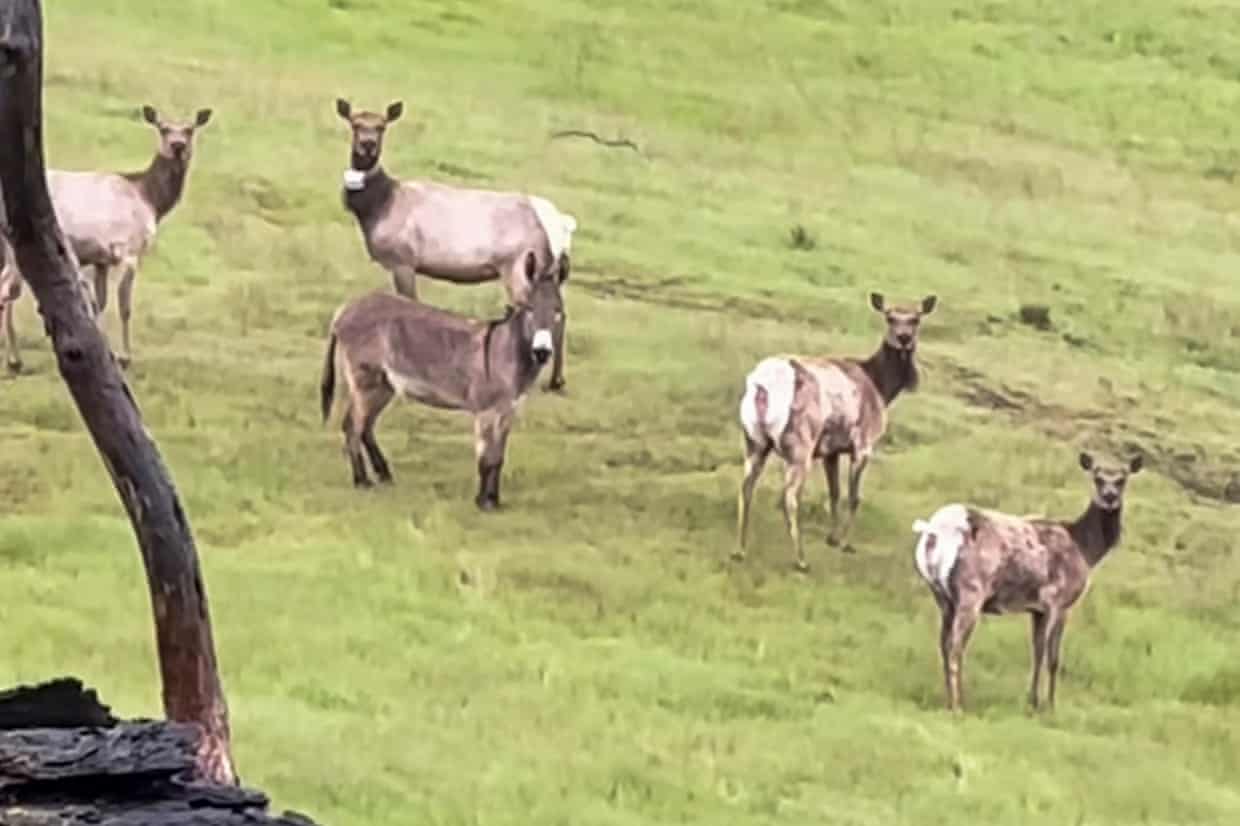
Photo: Instagrammer @maxfennell.
A hunter spotted a donkey living with elks in northern California.
A donkey-owning family in California lost its pet to a wild elk herd — and decided he was better off. What would you have done? Would it depend on how long your pet was missing?
The Guardian reports: “A donkey spotted apparently living with a herd of wild elk in a video that went viral on the internet has been identified as Diesel, a once beloved pet who had apparently run away five years ago.
“The video was taken earlier this year, when Max Fennell, a hunter in northern California, filmed a group of wild elk apparently hanging out with a donkey who appeared to be a member of their herd.
“The short clip of the unusual scene rapidly spread across social media. Now Terrie Drewry and her husband, Dave, have told CBS news that they are convinced the free-roaming burro is their missing pet Diesel, who had scarpered into the wilderness five years earlier. …
“ ‘Finally, we know he’s good. He’s living his best life. He’s happy. He’s healthy, and it was just a relief,’ Drewry told CBS.
“The Drewrys revealed that Diesel had gone missing after getting scared on a trail while on a hiking trip with his human family. They searched for him in vain, though a trail camera spotted him, and hoof prints showed that he was still alive.
“Despite their joy, in seeing Diesel alive and apparently thriving as a want-to-be elk, they have no plans to try to capture him.” More at the Guardian, here.
That got me curious about donkeys that normally live in the wild, and poking around on the web, I ended up at the Young People’s Trust for the Environment (YPTE), which works to inspire “young people to look after our world.”
“There are still several types of donkey living wild in various parts of the world including: the ‘Kiang’ in India and Nepal the ‘Somali’ wild ass in Africa the endangered ‘Onager’ in Mongolia, Turkestan, Iran and Syria. …
“In the wild, donkeys don’t live in such close herds as horses and ponies do, since they occupy marginal desert-lands where food is generally scarce. As a result they have developed very loud ‘voices,’ which can carry just over three kilometres [~2 miles]. This allows them to keep in contact with one another. Their larger ears also allow them to hear the distant calls of their neighbors. Donkeys also use their ears as a form of visual communication and they may help dissipate some of the hot desert heat.
“Donkeys have a very tough digestive system that can break down almost inedible vegetation and at the same time extract and save as much moisture as possible.” More here.

 Suzanne's Mom's Blog
Absolutely love this. He fits right in with the elk—have to look twice!
>
LikeLike
Me, too. This story is the reverse of the one a while back about the magpie and the dog. https://suzannesmomsblog.com/2024/05/28/the-magpie-and-the-dog/.
LikeLike
I have since thought about the donkey’s bray and how the elk deal with it. It would normally produce panic, maybe a stampede. Did the donkey learn to stay quiet? Or did the elk and the donkey work it out.
LikeLike
What a thoughtful question! You really have an empathy with animals to be thinking things through like that. Reporters don’t even think of those questions. I didn’t either.
LikeLike
I love this story so much! Bravo to the family for letting Deisel live among the elk. I would have made the same decision. Never heard of taking a donkey for a hike. My guess is that it is not terribly common and is somewhat risky.
LikeLike
Yes, that struck me as unusual and maybe foolhardy.
LikeLiked by 1 person
I like this story of inter-species friendship. I wonder if elk and donkey languages are similar.
LikeLike
What a good question! Makes me smile.
LikeLiked by 1 person