Photo: Arian Zwegers/Flickr.
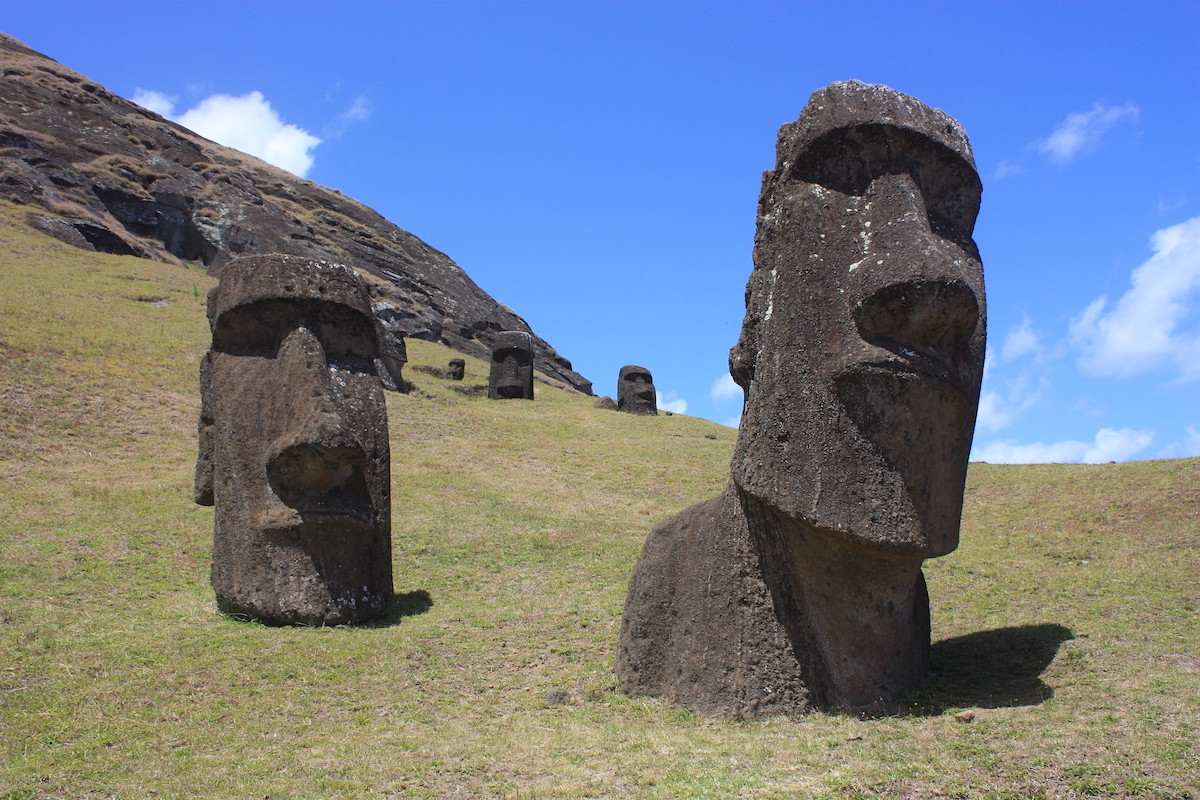
The monumental statues of Easter Island.
Imagine all the work that has gone into figuring out how dead civilizations died! Even now it often feels like guesswork. But I like how new research provides new details on how people lived.
Consider this report at YaleEnvironment360.
“A new study casts doubt on the narrative often told about Easter Island, of an ancient society that plundered its forests to the point of collapse. Researchers have found fresh evidence for another [story] that the islanders learned to live within the bounds set by nature.
“When Europeans first arrived to the remote South Pacific island in 1722, they found hundreds of massive statues, evidence of considerable manpower, but only around 3,000 people, too few to easily explain the monuments. Historians inferred that the Polynesians who settled Easter Island must have seen their population grow to a large and unsustainable level, at which point they destroyed their forests, exhausted their soils, and hunted seabirds to oblivion before seeing their own numbers collapse.
“But in recent years a competing narrative has taken hold. It posits that the population never exploded, but that instead a small number of people learned to sustain themselves on the arid and relatively barren island. Researchers found evidence for this view in the remains of ‘rock gardens,’ where islanders grew sweet potatoes, their staple crop.
“To protect crops from sea winds and supply minerals to the soil, islanders grew potatoes among densely packed rocks. It has been difficult to determine, however, how much of the island was composed of rock gardens, which would indicate how many people farming sustained. Prior research found that rock gardens potentially covered more than 12 percent of Easter Island, which, scientists estimate, could have supported as many as 25,000 people.
“For the new study, researchers aimed to improve on previous inventories of rock gardens by studying gardens on the ground and then training artificial intelligence to identify them in satellite imagery. To better distinguish between rock gardens and rocky outcroppings, they also gathered satellite data on the levels of moisture and nitrogen in the soil, markers of cultivation.
“With this additional data, researchers determined that rock gardens covered less that 0.5 percent of the island. Accounting for other potential sources of food, such as fish, bananas, taro, and sugar cane, they estimated that Easter Island would have supported around 3,000 people, the number first recorded by Europeans. The findings were published in Science Advances.
“ ‘The population could never have been as big as some of the previous estimates,’ said lead author Dylan Davis, a postdoctoral researcher at Columbia University. ‘The lesson is the opposite of the collapse theory. People were able to be very resilient in the face of limited resources by modifying the environment in a way that helped.’
“History will show that the islanders did ultimately face collapse, but after Europeans arrived.” Europeans, alas, brought disease and slavery. No wonder the population died out!
More at YaleEnvironment360, here.

 Suzanne's Mom's Blog
Fascinating. I saw an article on Easter Island this morning, but can’t find it now. There is an excavation of some of the largest heads, and it appears they were buried, even though of colossal size. There have been studies of excavations of the heads’ bodies, with an explanation that they were buried by shifting earth, but the colossi are so big that the new theory is that they have been buried. Sorry I can’t find the story, but how interesting that it came across my phone the day you post this!
H
>
LikeLiked by 1 person
You always have something interesting to say. I looked online and found a 2017 article saying the heads had bodies that were buried! https://www.forbes.com/sites/trevornace/2017/07/26/famous-easter-island-heads-have-hidden-bodies/
LikeLiked by 1 person
You have much wider contacts than I!! And the article did say that they knew the smaller ones had bodies, but weren’t sure about the colossi. Now they know. I’m sure we haven’t heard the last.
>
LikeLiked by 2 people
Now that is definitely an interesting take and one worth considering.
LikeLiked by 2 people
Mainland Chile claims the island. Chileans taught us the name Rapa Nui, the name islanders use for their home. I’m glad to hear the islanders story was of living within the means of the environment. We saw a wonderful documentary on PBS about how the monumental heads were “walked” into place. Fascinating culture.
LikeLike
Cool. I love thinking about them walking.
LikeLiked by 1 person
PBS clip- https://www.pbs.org/video/how-ancient-easter-island-statues-walked-lz6y8g/
LikeLike
Many thanks! Love it!
LikeLiked by 1 person