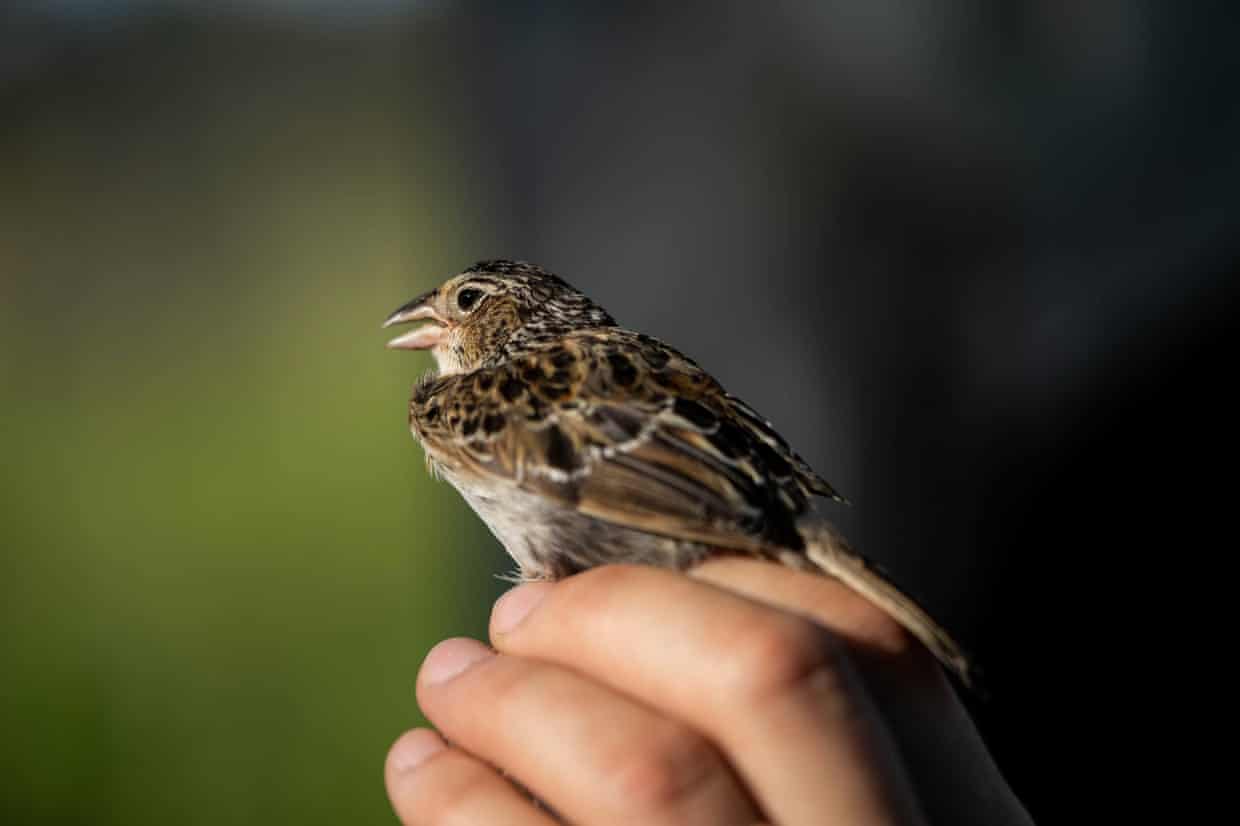
Photo: Carlton Ward Jr.
A grasshopper sparrow in Florida.
Continuing on the subject of endangered birds, let me introduce Florida’s grasshopper sparrow. Now, you may think that with all the troubles in the world, the future of the grasshopper sparrow is the least of your worries.
But I like how the story represents bigger things — how we can make the world better if we try, how there are people who devote their lives to some small area that has big implcations.
Richard Luscombe writes at the Guardian, “Scientists in Florida are hailing the landmark release this week of a tiny bird only 5 inches tall as an oversized success in their fight to save a critically endangered species.
“Numbers of the Florida grasshopper sparrow, seen only in prairies in central regions of the state, dwindled so severely by 2015, mostly through habitat loss, that authorities took the decision to remove remaining breeding pairs into captivity. Their wager was that a controlled repopulation program would be more successful than leaving the birds to their own devices.
“[Their] gamble was rewarded. Partners joined the Florida Fish and Wildlife Conservation Commission (FWC) to release into the wild the 1,000th bird bred under controlled conditions, adding to an increasingly stable population that researchers believe has turned the tide towards the species’ survival.
“ ‘The recovery and release program diverted the extinction of the Florida grasshopper sparrow,’ said Adrienne Fitzwilliam, lead sparrow research scientist at the FWC’s fish and wildlife research institute.
“The fear was we might just be expediting their demise by bringing in proven breeders, so to see these birds making it in the wild, breeding with wild birds and other release birds, and their offspring going on to breed, has just been incredibly rewarding.’ …
‘Releases, which began in 2019, have taken place at three sites, with the newly freed birds monitored by patient teams of observers with binoculars and lawn chairs at two more. Birds are released in batches at about 40 days of age and, Fitzwilliam said, quickly set about setting up their ‘territory.’
“ ‘There’s a lot of sitting and waiting and watching because their nests are incredibly hard to find,’ she said.
“At the Avon Park military range south of Orlando where the milestone release took place this week, researchers have this year recorded 16 nesting pairs and 30 ‘singing’ males looking for a mate.
“At Three Lakes wildlife management area, the program’s first release site where once only 11 pairs were present, the observers found 40 pairs and 68 males, and are hopeful of more with the breeding season still in progress. …
“ ‘These numbers mean released birds successfully survive, breed and raise young in the wild, which is a huge success,’ Fitzwilliam said. ‘It has diverted extinction and allows partners to research possible landscape-level solutions.’
“Grasshopper sparrows, per their name, eat mostly grasshoppers and seed, and according to the FWC, the loss of large areas of prairie habitats to agriculture fields has vastly reduced their range and numbers. … FWC’s program partners, which include Audubon, White Oak Conservation and the Fish and Wildlife Foundation of Florida (FWF), are researching potentially beneficial land management practices such as roller chopping, which prepares land for controlled burns and speedier regeneration of native grasses. …
“News of the recovery of grasshopper sparrow numbers follows an upbeat report by a coalition of prominent universities for the future of Florida’s wildlife, if the climate emergency is mitigated properly.
“Andrew Walker, FWF president and chief executive, said: ‘These little birds represent a big beacon of hope that our commitment, partnership and holistic approach can save vulnerable wildlife from the brink of extinction.’ “
More at the Guardian, here.

 Suzanne's Mom's Blog
I found this so heartening. It is my feeling that this little sparrow has as much right to life as any creature.
LikeLike
As with the snail darter and the Northern Spotted Owl, what happens with these little guys is part of a bigger picture.
LikeLiked by 1 person
The birds would prove their worth if there were many grasshoppers eating crops. Glad people did a captive breeding program so they’d survive.
LikeLiked by 1 person