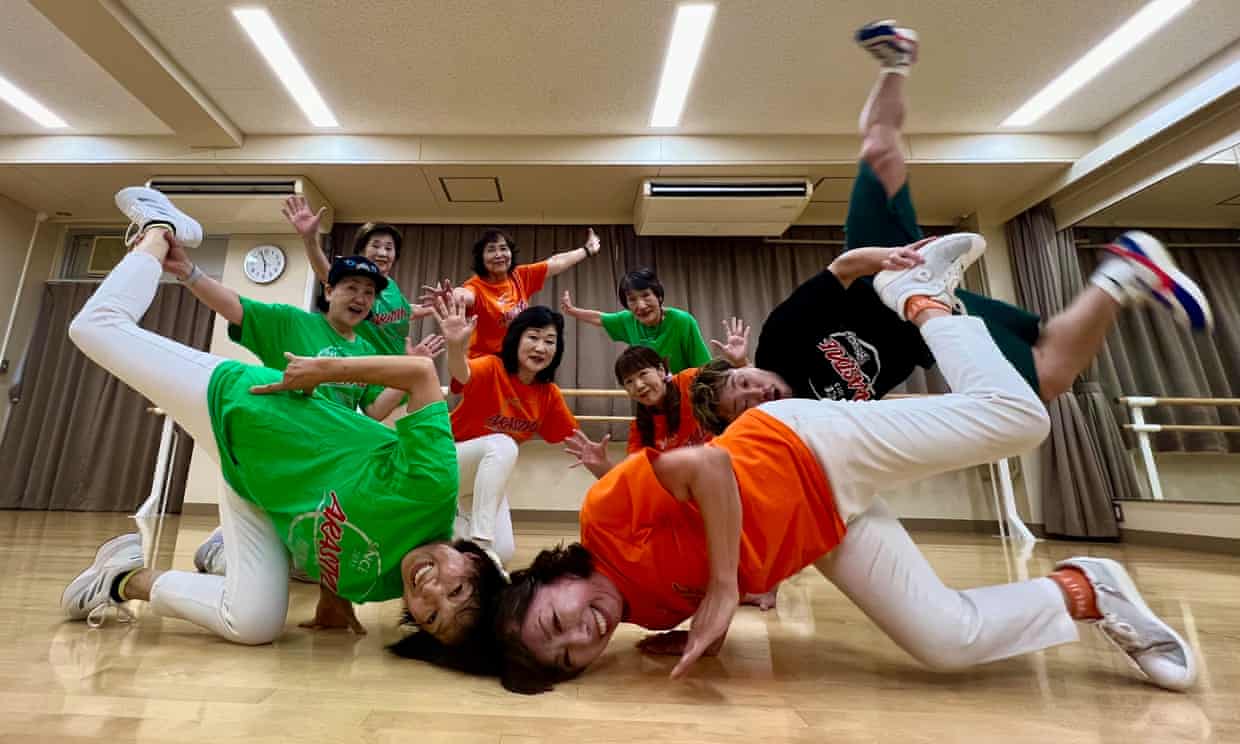
Photo: Justin McCurry/The Guardian.
Members of Ara Style Senior breakdancing club at a recent class in Tokyo, Japan.
When John was in middle school, he got into breakdancing for a while, an activity that seems manageable for young people. But what about for the elderly? For them, the more recent nomenclature, “breaking,” seems more appropriate.
But not in Japan. Justin McCurry filed another story at the Guardian about that endlessly fascinating country.
“Ten people – wearing bright orange and green T-shirts that mark them out as members of Ara Style Senior – do not belong to the demographic you would normally associate with breakdancing. Their average age hovers just below 70, and the oldest is 74.
“But on a hot afternoon in an eastern Tokyo suburb, amid nervous smiles and initial timing issues, the group ends with a perfectly executed pose the dance’s originators in 1970s New York neighborhoods would probably agree is not too shabby at all.
“Senior breaking is one of a growing category of sports tailored to Japan’s large population of older people who, thanks to the country’s extraordinary longevity statistics, are determined to keep popping and locking for as long as their bodies will allow.
“ ‘At first I thought, there was no way I could breakdance at my age,’ says 69-year-old Hitomi Oda. ‘And of course, we can’t do anything extreme, but it’s fun just to do the easy moves and get your body working.’
“These superannuated b-girls and b-boys, who meet twice a month at a community center in the capital’s Edogawa ward, have the organizers of this summer’s Paris Olympics, and former breaking national champion Yusuke Arai to thank for this novel approach to fitness in their later years.
“ ‘Some of my mother’s friends told her they were interested in learning how to breakdance, and when it was chosen as an Olympic sport, I thought, “Why not give it a go?” ‘ Arai tells the Guardian. …
“The 39-year-old tailors his class to bodies that may not be as supple as the children he has been teaching for almost a decade. ‘You have to lower the hurdles to make it possible for older people to do the moves, so I begin with a focus on easy moves using the top half of the body,’ says Arai. …
“The class is just a few minutes old when the dancers, faces flushed from stretches and warm-up exercises, take the first of several breathers. The genteel approach works: since the classes started last year, not a single dancer has so much as sprained an ankle.
“A few have backgrounds in other forms of dance, but most had never tried breaking until a combination of Olympic excitement and gentle peer pressure brought them through Arai’s door. Now they are converts, practicing together between sessions with the help of YouTube tutorials.
“The class ends with a meticulously rehearsed routine that combines toprocks and floor moves and, as its sign-off, a baby freeze the dancers are asked to re-create multiple times by a visiting Japanese TV crew.
“ ‘The rhythm and the perseverance mean it stimulates your brain as well as your body,’ says Kazuharu Sakuma, the only male dancer, who is here taking a trial class.
“The 71-year-old says he will be back. ‘It’s not like you have to memorize the moves … you just do them two or three times and you realize, “yes, I can actually do this.” That’s when it becomes really enjoyable. It’s also great for general fitness … I’m hoping it will make it easier to walk up stairs.’
“Class regular Takako Mizutani removes her trucker cap and pronounces herself ‘not in the least bit tired. … It doesn’t matter if you’re not very good at it, it’s a lot of fun and a proper workout,’ adds Mizutani, who has a background in jazz dance. ‘I plan to keep breaking for as long as I can.’ ”
More at the Guardian, here. No paywall.

 Suzanne's Mom's Blog
Truly wonderful
LikeLike
They’re clearly having fun.
LikeLiked by 1 person
Fun! And hats off to them. As someone who sometimes uses a cane to walk, I am impressed.
LikeLike
Can’t help thinking breakdancing would * cause * me to use a cane to walk!
LikeLike