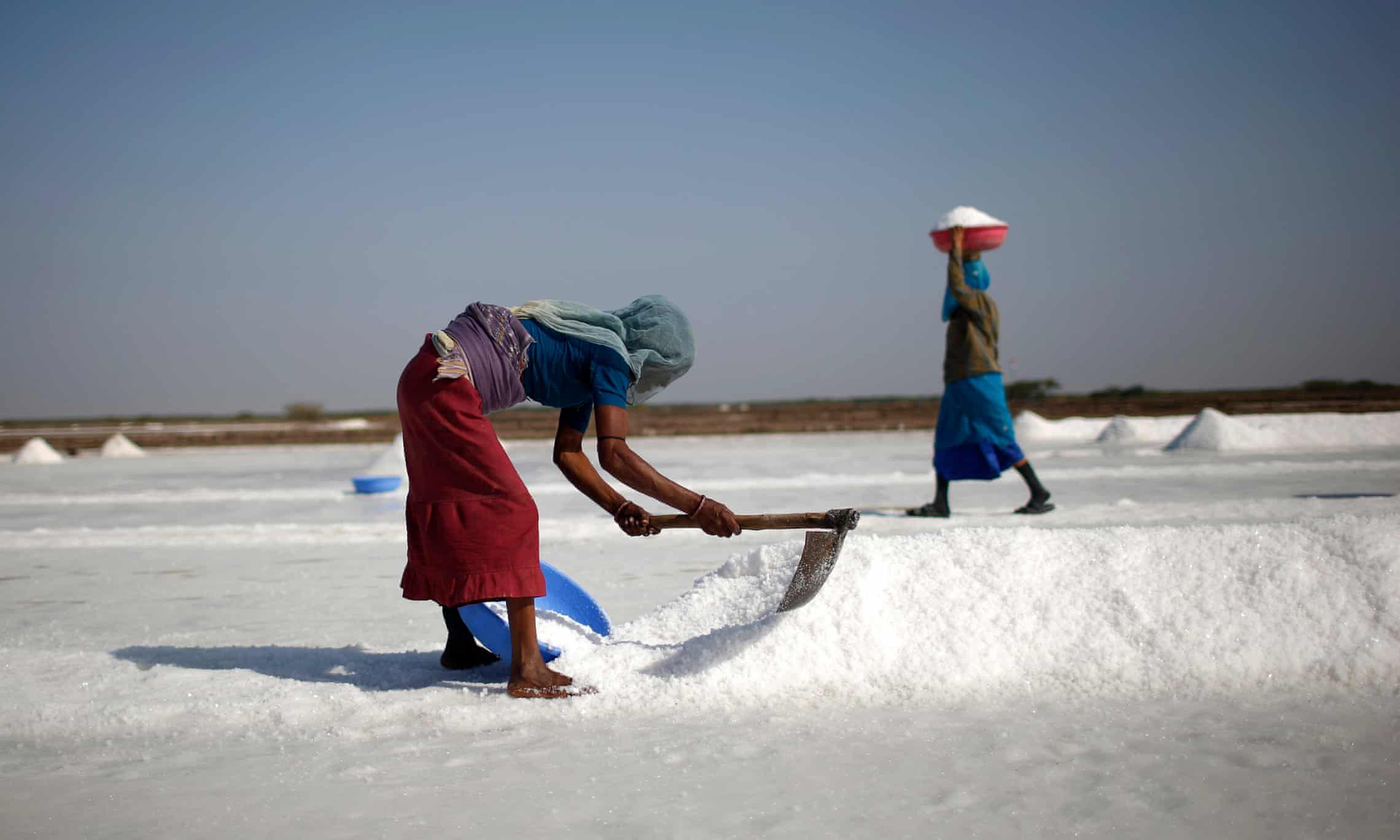
Photo: Ahmad Masood/Reuters.
Working on a salt pan in the western Indian state of Gujarat. The marshes produce 30% of India’s inland salt.
I’m always up for a little good news from distance places, as I hope you are, too. Today we learn about the benefits of solar energy for one hands-on industry in India.
Suchak Patel writes at the Guardian, “In the expansive salt marshes of the Little Rann of Kutch the bleakness of the sunburnt, treeless landscape is matched only by the drudgery of the salt farmers who toil there for eight months of the year.
“In October, as the monsoon recedes and the flooded salt pans dry out, farmers and their families hop on to trucks and tractors to migrate to the Little Rann of Kutch in Kutch district, Gujarat, where they pitch tarpaulin shelters and begin mining the underground deposits.
“An estimated 10,000 families of farmers, known as agariyas in Gujarati, migrate to the marshes from across the state. They start each season by digging wells to pump out brine using diesel pumps; the brine is then poured into shallow, squarish plots carved on the salt pans and left to evaporate under the sun to produce salt crystals. These marshes produce 30% of India’s inland salt, typically table salt.
“Life in the salt marshes is uniquely challenging. Drinking water comes not from pipes but tankers, children attend schools inside buses not buildings, and the only avenue to healthcare is weekly mobile vans from the health department. Basic amenities such as an electricity grid and toilets are nonexistent.
“ ‘My entire family, including my brother’s two daughters, lives in the desert these eight months, and my nieces attend primary school in a mobile school bus,’ says Bharatbhai Shyamjibhai Mandviya, 45.
“Contracts made with salt traders before each season, where the traders pay an advance to the farmers to buy pumps, diesel, and to meet household expenses mean most farmers start the season in debt, with the harvest income barely enough to cover their costs, let alone allow them to save.
“Diesel constitutes nearly 65% of the input costs in salt farming, and about 1,800 litres [~476 gallons] of the fuel is needed to produce [about] 750 tons of salt, according to Purshottam Sonagra, area manager of nonprofit Vikas Centre for Development that works with salt producers in the region. …
“But the introduction of solar panels to the pans has triggered a significant shift in the lives and lifestyles of the impoverished salt workers. In 2017, the Gujarat government gave solar pumps to salt farmers at nearly 80% subsidy, as part of a larger push to cut emissions and bring down the costs involved in salt production.
“ ‘Solar-powered pumps have reduced the cost of salt farming to one-third of what it was,’ says Sonagra.
“Mandviya has installed three pumps on the salt pan he works on, the savings from which have led to many firsts in his life.
“ ‘We have now built a two-bedroom house with a separate hall and a kitchen in Kharaghoda [his home village],’ says Mandviya. The new home with tiled walls and built-in cupboards which he will share with his brother and family, is a big upgrade from the kuccha [mud and straw] house they lived in before.
“The brothers also bought a motorcycle and a refrigerator from the money they managed to save.
“With more than 5,500 solar-powered pumps now dotting the region, energy costs have fallen [and] the agariyas such as Mandviya are no longer as dependent on the capital from traders, which gives them greater negotiating power over salt prices. …
“Solar pumps and the financial stability they grant have improved access to health, education and mobility, while also offering freedom to salt farmers from an endless work cycle, campaigners say.
“ ‘Steady supply from the solar panels is powering not only pumps but also televisions. Children of salt makers are switching to state-run ‘edutainment’ programs to make up for the loss of education,’ says Bhavna Harchandani, a research scholar at the Indian Institute of Technology Gandhinagar, who has tracked the agariya community as part of her studies. …
“Sonagra says it was difficult to find an office assistant with basic secondary-school education among agariyas until a few years ago.
“ ‘Today, many agariya children attend private schools, complete ITI (vocational) courses, and some manage to go to college. Solar pumps have opened up educational opportunities for the next generation of the community,’ he says.”
More at the Guardian, here.

 Suzanne's Mom's Blog
Leave a comment. Website address isn't required.