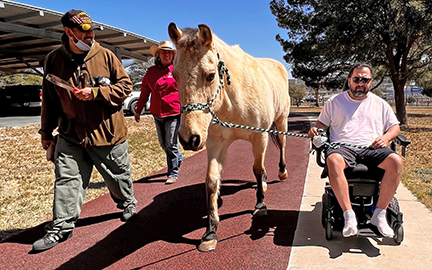
Photo: va.gov.
Army Veteran Carlos Longoria takes a trip on the track with Biscuit.
Whenever it gets close to Veterans Day, I start seeing stories about therapy for traumatized veterans. We know that, inevitably, some of the young people we send off to war will come back in bad shape. And unfortunately, our government spends a lot more on sending them off than on what they may need when they get back.
Often it’s civilian nonprofits that step up, like an arts group in Asheville, North Carolina, that offered supportive pottery classes to vets — that is, before Hurricane Helene. (Click here.)
Today’s article by Jason Kucera describes an ongoing Veterans Administration (VA) initiative.
“Mankind and horses have carried on beneficial, strong relationships with one relying on the speed, endurance, and raw power while the other affection and care. For a US Marine Corps Veteran such as Kody Wall, this special bond saved his life.
“ ‘I moved home to Montgomery (Texas) after my time as a Marine and very little went well. I had a really hard time adapting, so it wasn’t long until I was divorced and sleeping on an air mattress at my sister’s house,’ Wall said.
“During this time, he said he was battling suicidal thoughts, wanting to just ‘give up.’ Though he had been getting his routine care at a Houston VA outpatient clinic, he did not feel comfortable going into an office or trying to work through appointments over the phone. While hopelessness set in, the darkness would soon clear thanks to a unique therapeutic approach focused on his relationship with a horse.
“ ‘My sister pushed me to visit Sunny Creek Ranch as she knew how much I enjoyed being around horses. It was the best thing that could’ve happened for me,’ said Wall. ‘I’ve been attending sessions since 2016 and spend any extra time I have to help.’ He also shares his own experiences with other Veterans attending sessions, which can really help to open them up.
“Sunny Creek Ranch hosts an intensive equine-assisted therapy Eagala-certified program in this heavily forested, southeast Texas town, just about an hour north of Houston. Launched by Shannon Novak, an Air Force Veteran spouse, the ranch is a partner of Houston VA. …
“She added that for a lot of Veterans and their family members that participate, they find the relationship with these horses to be similar to that of their own personal relationships. ‘Horses are so intuitive, they know everything about you, and they never forget you.’ …
“Houston VA recently began referring Veterans to equine therapy and plans to ramp up referrals to other holistic therapy approaches in the future. ‘Evidence-based talk psychotherapies for trauma are effective, but we know not every Veteran wants to address their trauma by sitting down in an office or virtual appointment with VA,’ said Dr. Shannon Sisco, whole health coordinator at the Houston VA. …
“Wall said working with the horses in equine therapy has helped him learn to communicate more openly with his young son, resulting in a better and more trusting relationship.
“ ‘The challenge in equine therapy is to develop a trusting relationship with your horse, which in many ways brings out lessons about our own relationships and helps us learn new ways of being in them,’ Sisco said.
“Veterans do not need experience working with horses to participate in the therapy. They will not actually be riding horses, just interacting with them alongside a professionally licensed therapist. ‘The difference between connecting with horses versus people is that it all depends on your actions rather than your words,’ Sisco said. ‘They are watching what you do and listening to your tone. If you’re not earning their trust, they’re going to let you know.’ …
“Veterans can choose to participate in individual equine therapy sessions, along with immediate family members, or in small groups with other Veterans. For more information or to request a referral for equine therapy or any of the VA’s Whole Health programs.”
Although this story focused on Texas, there are similar VA programs around the country. Search here on “horses.” More on today’s feature, here.

 Suzanne's Mom's Blog
Some elderly ladies turn to cats: it’s definitively not reflecting well on their socialization skills.
LikeLike
Excellent program. I have heard that teenagers often benefit from working with horses as well.
LikeLike
Yes. And people with all sorts of disabilities. My cousin volunteers at a place that does that work.
LikeLiked by 2 people