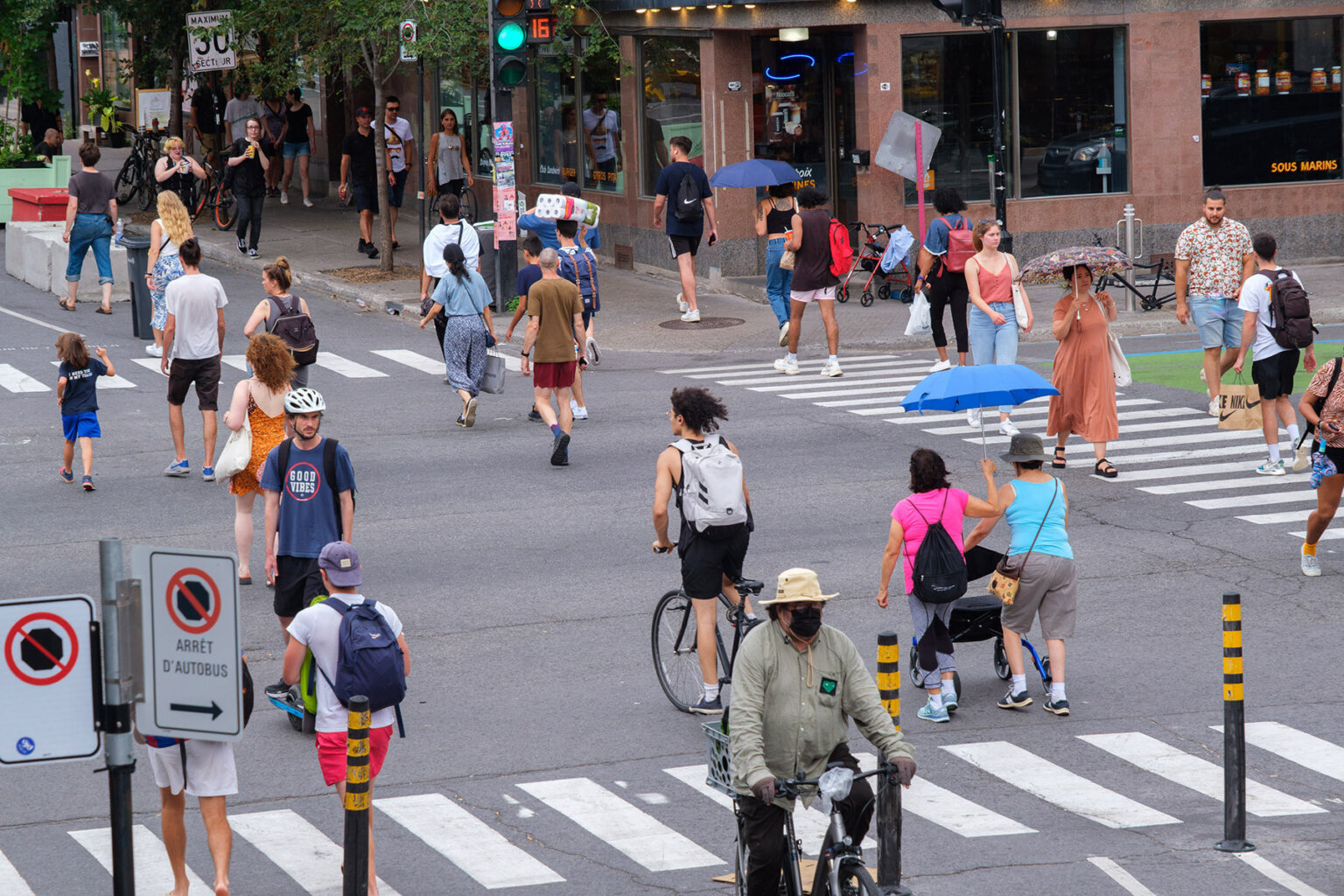
Photo: Marc Bruxelle.
Montreal’s pedestrian revolution has been good for the city.
I like the idea of a walkable city, and often that means a city more friendly to pedestrians than to cars. When a move toward walkability is proposed — even in a small area, even as a pilot — shops on the street expect to lose business. But is that what really happens?
Toula Drimonis reports at the Walrus on a Montreal experiment: “In 2020, during the first pandemic summer, Montreal’s Projet Montréal administration, led by mayor Valérie Plante, closed a two-kilometer stretch of Mont-Royal Avenue to motorists for a few months. The idea was simple: get people out shopping and socializing while also respecting physical distancing guidelines.
“The pilot project faced criticism from business owners concerned that removing cars would deter driving clients and complicate deliveries. But once merchants saw the street fill with milling crowds, they were convinced. The pandemic initiative became an annual event. By 2023, the avenue’s commercial vacancy rate plummeted from 14.5 percent in 2018 to 5.6 percent. A few years earlier, in 2021, the pedestrianization of Wellington Street in the Verdun borough had increased foot traffic and shoppers by 17 percent. A once-drab strip is now lined with restaurants, bars, and cafes. On Fridays, hundreds gather to dance salsa and bachata.
“The pilot kept growing. As of this summer, eleven streets in total have been transformed into seasonal pedestrian-only destinations, creating almost ten kilometers of walkable car-free surfaces across several boroughs. The experiment has proven so popular that it has drawn praise, and not a little astonishment, from visiting urban planners. … Mayor Plante makes no secret of how she feels about the car-free streets, calling them ‘the lifeblood of Montreal’s neighborhoods.’
“Flâneur-friendly cities don’t just materialize. It took strategic planning and years of push and pull. A little over a decade ago, then Plateau-Mont-Royal mayor Luc Ferrandez set out to make his borough’s streets safer and reclaim public space. He wanted a neighborhood people could live in and not just drive through. His first move, in 2010, was to convert a two-way ten-block stretch of Laurier Avenue to a one-way to clear more room for pedestrians, cyclists, and community activities. He didn’t stop there: he kept closing roadways that ran through parks and changing the direction of streets to divert traffic.
“Resistance was fierce.” Find out what happened, here.
Jason Magder at the Montreal Gazette has more: “With summer winding down, Montrealers were walking, cycling and using scooters on Mont-Royal Ave. Thursday afternoon, with the closure of part of the street to all cars extended until October this year.
“The pedestrianization of this street has been a resounding success, borough mayor Luc Rabouin said, with more than 33,000 people flocking to the area between St-Laurent Blvd. and Fullum St. While most of the street was reopened at the end of last month, the portion between St-Laurent and St-Denis St. remains closed to vehicles until Oct. 14 for the first time, as a trial project.
“ ‘The other streets don’t even come close,’ Rabouin said during an interview Thursday while sitting on the terrasse of the bar Bily Kun. … Rabouin said the city wants to go even further on pedestrianization, with more money dedicated to projects and more predictability.
“The Plante administration will announce Friday morning that it will renew the pedestrianization of all nine streets that were closed this year for a three-year period starting next year. … The city is also almost doubling the funding available to the merchants associations to put together the pedestrian-only zones, to $700,000 per year from $375,000.
“Alia Hassan-Cournol, an associate executive committee member handling economic development, said adding predictability, rather than announcing the streets every year, will help businesses. The new money will allow local businesses to hire liaison agents to prepare the streets several months in advance, and will allow the associations to conduct impact studies. The city is also adding $1.1 million per year to support new pedestrian zones on other roads. Overall, the city will spend $12 million for three years for pedestrian streets, up from $10 million for the previous three-year period.”
More at the Gazette, here.

 Suzanne's Mom's Blog
We have just started this in Philadelphia. South St. did a couple this summer, and September saw the posh Rittenhouse area carless. All at weekends for now, but they have been a hit and hopefully will continue.
Hannah
>
LikeLike
Good to know. Philadelphia would be perfect for this.
LikeLike
I love pedestrian malls. They are great for exercise and for business.
LikeLike
I don’t know why people have to be convinced over and over. There’s a lot of data on their benefits.
LikeLiked by 1 person
My dad who was in urban planning says we treat cars as more important than people.
LikeLiked by 1 person
Every time we pass through an US airport, we wonder why there are so much more people there that need to be wheeled around compared to other airports around the world. Have no experience with Canadian airports, but it looks like the problem should not be that acute over there.
LikeLike
There are a few wheelchair users who just don’t like walking far but are not normally considered disabled.
LikeLiked by 1 person
Oh, excellent!
LikeLiked by 1 person