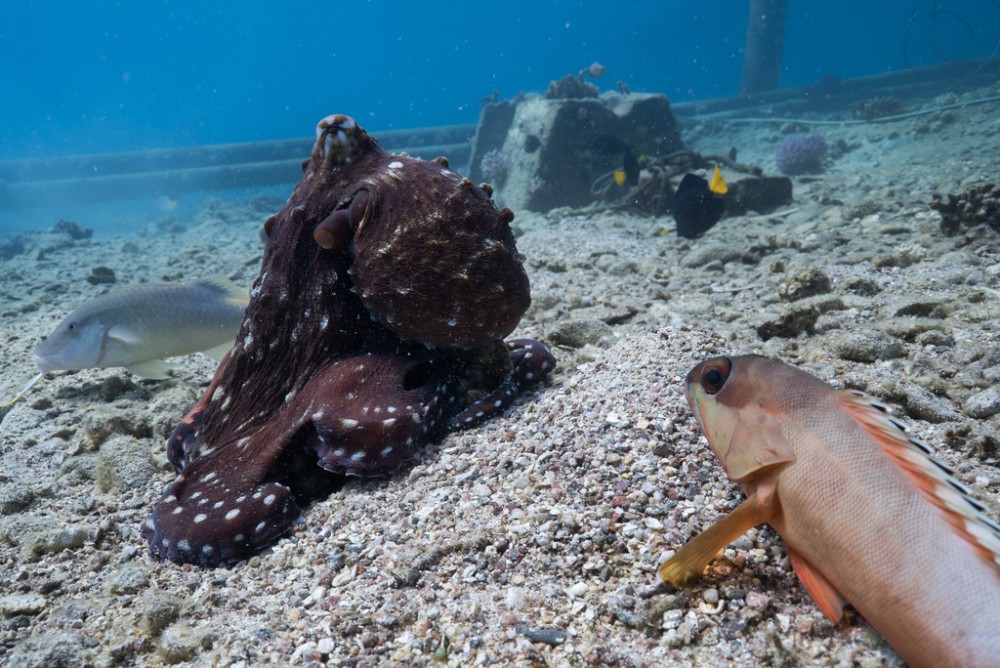
Photo: Eduardo Sampaio and Simon Gingins.
An Octopus cyanea, center, hunts with a blacktip grouper on one side and a blue goatfish on the other.
There are trends, I think, in which animals are popular and get the most news coverage. Lately, octopuses seem to be “in.” That is probably because the people who know them best, like naturalist Sy Montgomery, have demonstrated how intelligent octopuses are.
Now we learn that some octopuses hunt with partners from other species and may make the group decisions.
Evan Bush writes at NBC News, “A new study shows that some members of the species Octopus cyanea maraud around the seafloor in hunting groups with fish, which sometimes include several fish species at once.
“The research, published in the journal [Nature], even suggests that the famously intelligent animals organized the hunting groups’ decisions, including what they should prey upon.
“What’s more, the researchers witnessed the cephalopod species — often called the big blue or day octopus — punching companion fish, apparently to keep them on task and contributing to the collective effort.
“Octopuses have often been thought to avoid other members of their species and prowl solo using camouflage. But the study [is] an indication that at least one octopus species has characteristics and markers of intelligence that scientists once considered common only in vertebrates. …
“Said Eduardo Sampaio, a postdoctoral researcher at the Max Planck Institute of Animal Behavior and the lead author of the research, ‘We are very similar to these animals.’ …
“To understand the inner details of octopus lives, researchers dived for about a month at a reef off the coast of Eilat, Israel, and tracked 13 octopuses for a total of 120 hours using several cameras. The team followed the octopuses for 13 hunts, during which they observed groups of between two and 10 fish working with each octopus.
“These hunting groups typically included several species of reef fish, such as grouper and goatfish. The octopuses did not appear to lead the groups, but they did punch at fish to enforce social order — most often at blacktip groupers.
“ ‘The ones that get more punched are the main exploiters of the group. These are the ambush predators, the ones that don’t move, don’t look for prey,’ Sampaio said. …
“ ‘If the group is very still and everyone is around the octopus, it starts punching, but if the group is moving along the habitat, this means that they’re looking for prey, so the octopus is happy. It doesn’t punch anyone, Sampaio said.
“The researchers think fish benefit from such hunting groups because an octopus can reach into crevices where prey hides and root out lunch. The octopus benefits, they believe, because it can simply follow the fish to food, rather than perform what the researchers call speculative hunting. …
“After shooting their video, the researchers fed all of their hunting scenes into software that creates a three-dimensional representation, then used another program to track each animal and log its position in relation to others. The data allowed the researcher to measure how close the creatures remained to one another and which creatures anchored or pulled the group in one direction or another.
“The data showed that a particular fish species, the blue goatfish, would roam off and lead the hunting groups in that direction, but the group of fish would linger if the octopus didn’t immediately follow.
“The goatfish ‘are the ones exploring the environment and finding prey,’ Sampaio explained. ‘The octopus is the decider of the group.’
“The researchers did not see evidence that the creatures shared prey. All the species involved are generalists that eat crustaceans, fish and mollusks, but whoever was able to catch the prey got a meal. Questions remain, however, including whether certain octopuses recognize or prefer to hunt with a favorite fish companion. … It’s also not clear if this social hunting behavior is something octopuses learn or if it’s innate.
“ ‘In my intuition, I think it’s something they learn, because the smaller octopuses seem to have a higher difficulty to collaborate with fish than the large ones,’ Sampaio said.
“Jonathan Birch, a professor of philosophy at the London School of Economics who studies animal sentience but was not involved in the new research, said he … appreciated that the study’s observations were made outside a laboratory setting, where a lot of animal cognition research takes place. Octopuses can be difficult to study outside their natural setting. …
“ ‘Octopuses were seen as a problem case because they are intelligent and yet solitary, it was assumed, so researchers puzzled for a long time about what’s going on there,’ Birch said. ‘[This study shows that] For at least one species of octopus, there is quite a rich social life.’ “
More at NBC, here. No paywall.

 Suzanne's Mom's Blog
I have become infatuated with octopusesAfter reading Remarkably Bright Creatures and the Montgomery bookI fell
LikeLike
Sy Montgomery is always interesting no matter what creature she’s into. The only living thing I ever heard her say a harsh word about is the Bobbitt Worm.
LikeLike