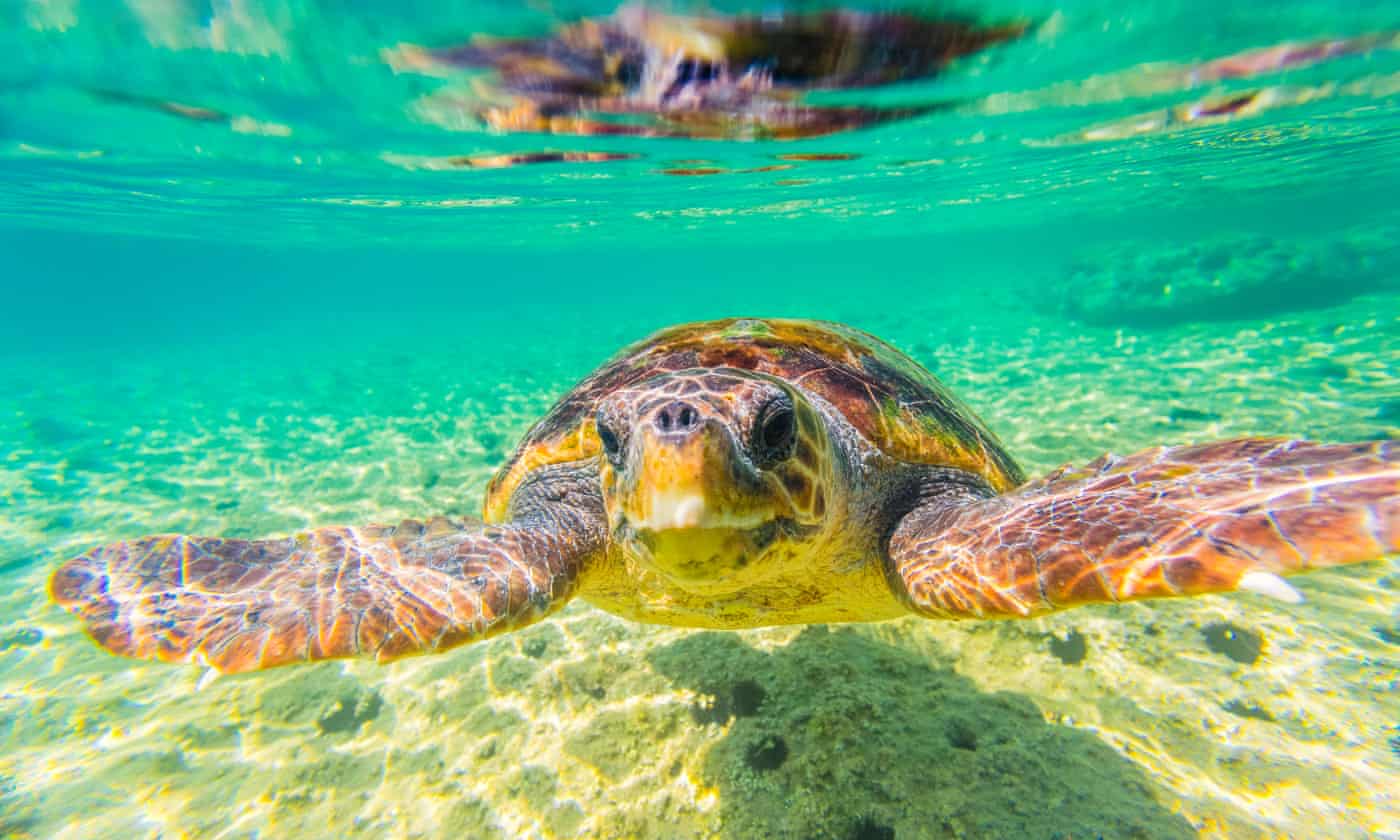
Photo: Giacomo Augugliaro/Getty Images.
A loggerhead turtle (Caretta caretta) off Elafonissos island in Greece, where the rebound in population has been called “phenomenal.”
Today’s article is about the resurgence of turtles in Greece. But before I get into it, I need you to indulge my current train of thought about turtles.
There are the chocolate, caramel, and pecan-footed “turtles” that my sister-in-law makes every Christmas, turtles that this week have gotten certain farflung relatives wildly excited.
There are songs about turtles like one I just found out my exercise teacher made for a fundraiser years ago, here.
And there are turtle fans all over the world who are bringing real turtles back from the brink of extinction. Slowly but surely.
Helena Smith writes for the Guardian about that.
“After nearly a quarter of a century observing one of the world’s most famous sea turtle nesting grounds,” she reports, “Charikleia Minotou is convinced of one thing: nature, she says, has a way of ‘sending messages.’
“Along the sandy shores of Sekania, on the Ionian island of Zakynthos, what she has seen both this year and last, has been beyond her wildest dreams. The beach, long described as the Mediterranean’s greatest ‘maternity ward’ for the Caretta caretta loggerhead sea turtle, has become host to not only record numbers of nests, but record numbers of surviving hatchlings as the species makes an extraordinary resurgence.
“ ‘The message sea turtles are sending is very clear,’ said Minotou, who coordinates the WWF program in the protected area. ‘And that is the measures we have taken over the past 25 years to ensure conditions are right for the marine turtles to nest here are working … It’s fantastic.’
“One of the oldest living species, sea turtles are believed to have existed for more than 100m years. Although highly migratory – over a lifetime, the reptiles cross thousands of miles of seas and oceans – female turtles always return as mature adults, about 20 to 25 years later, to the habitat where they were born to lay eggs. It is a reproductive cycle that happens with perfect synchronicity. In Sekania and other nesting grounds in Zakynthos and around Greece, turtles tagged at birth by conservationists a quarter of a century ago are now reappearing to nest.
“ ‘It’s hugely moving,’ says Minotou, a sustainable development expert who highlights the importance of technological advances, including the installation of CCTV cameras, in helping to ward off seagulls, ghost crabs and other predators. ‘This year more than 1,200 nests have been recorded in Sekania, which is one every 50cm [~20 inches] of beach. An amazing number.’
“From Spain in the west to Cyprus in the east, the Mediterranean has witnessed a record rise in sea turtle nesting – testimony to the painstaking efforts of environmentalists determined to save an ancient mariner that not that long ago was on the verge of extinction. Only one in 1,000 turtle hatchlings makes it to adulthood, making the turnaround even more remarkable.
“In Greece, which hosts 60% of Caretta caretta nests, the rebound has been phenomenal: from an average of 5,000 to 7,000 nests per year, since 2023 over 10,000 nests have been recorded annually, according to Archelon, the Sea Turtle Protection Society of Greece. …
“Thirty years ago, before the creation of a state-funded marine park on Zakynthos – the country’s biggest sea turtle nesting ground after the bay of Kyparissia in the Peloponnese – Greek authorities appeared oblivious to the plight of a species whose survival is now widely recognized as vital for marine ecosystems and the region’s ecological biodiversity.
“Few have more vivid memories of the dangers the creatures once faced than Lily Venizelos, who founded the UK-based Mediterranean Association to Save the Sea Turtles (Medasset) in the 1980s.
“The doughty campaigner, now in her 90s, spent years lobbying successive Greek governments to legislate policies to protect Caretta caretta from the then nascent threat of tourism and other perils posed by speedboat propellers, beach furniture and human activity in marine turtle habitats, conservationists say. …
“ ‘It’s been the most wonderful news, at my age, to find out that the Caretta caretta are no longer so threatened, but it’s crucial protective measures continue to be enforced. One false move and everything could be lost.’ ”
Do you have any thoughts on why turtles are so beloved? I think for me it’s their patience, the way they get everything done that they need to do while moving slowly.
More at the Guardian, here. No firewall.

 Suzanne's Mom's Blog
Good news about turtles! I think they are some of the friendliest reptiles out there. : )
LikeLiked by 1 person
This is great news and proof that effort can reap rewards. I think that for me it is the shape of turtles I like the best. It’s something about a being, wandering around with a shelter built right in, little arms and legs sticking out from underneath it.
LikeLike
Lovely! That makes me smile. Trust an artist to point that out!
LikeLiked by 1 person