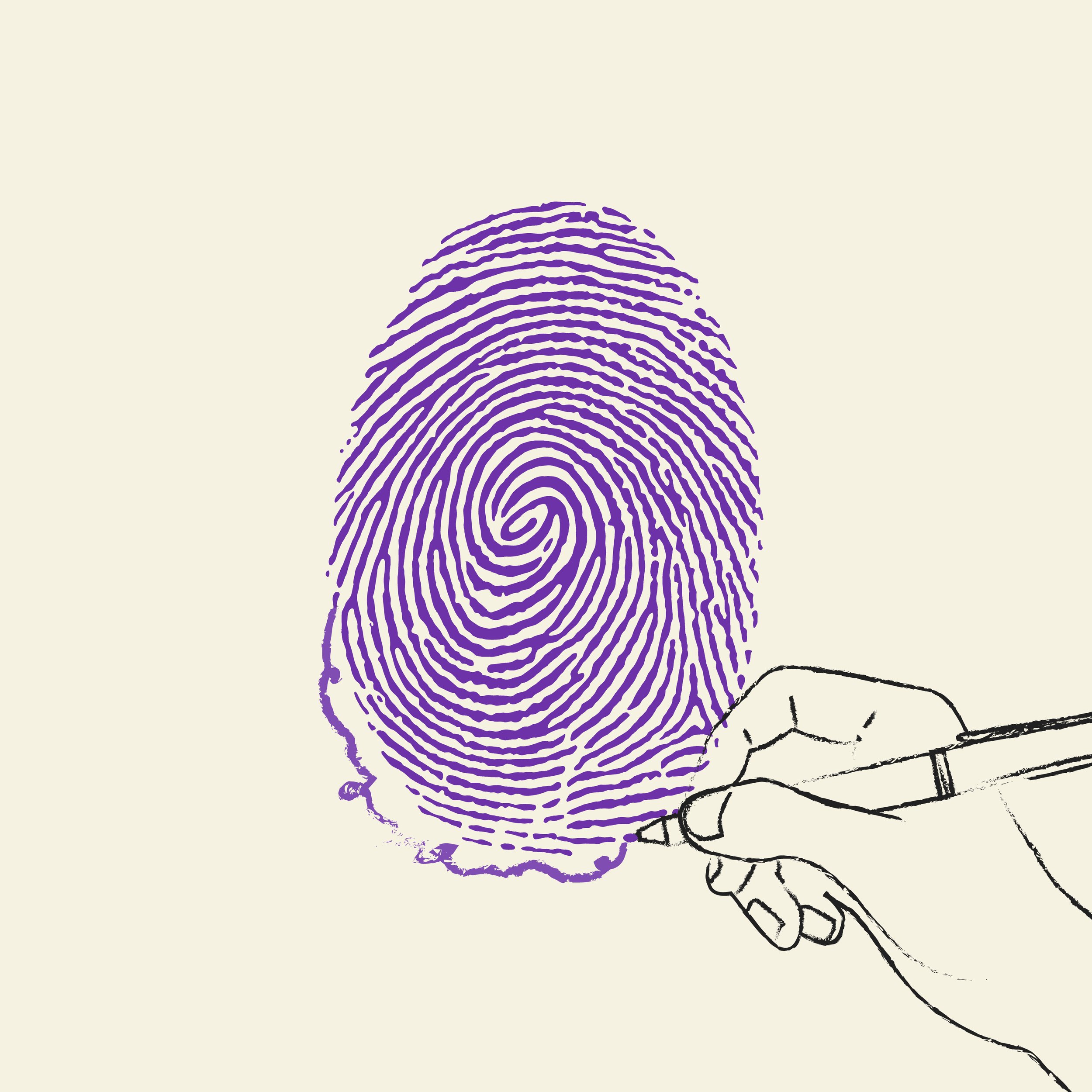
Image: The Dial.
I read a lot of murder mysteries. They are not the only type of book I like, but I like the puzzles and sometimes even the writing. So I was drawn to today’s article on the emergence of an unlikely crew that has gotten involved in solving tough cases.
Julia Webster Ayuso wrote recently at the Dial about forensic linguists.
“On the evening of October 16, 1984, the body of four-year-old Grégory Villemin was pulled out of the Vologne river in Eastern France. The little boy had disappeared from the front garden of his home in Lépanges-sur-Vologne earlier that afternoon. His mother had searched desperately all over the small village, but nobody had seen him.
“It quickly became clear that his death wasn’t a tragic accident. The boy’s hands and feet had been tied with string, and the family had received several threatening letters and voicemails before he disappeared. The following day, another letter was sent to the boy’s father, Jean-Marie Villemin. ‘I hope you will die of grief, boss,’ it read in messy, joined-up handwriting. ‘Your money will not bring your son back. This is my revenge, you bastard.’
“It was the beginning of what would become France’s best-known unsolved murder case. The case has been reopened several times, and multiple suspects have been arrested. Grégory’s mother, Christine, was charged with the crime and briefly jailed but later acquitted. Jean-Marie also served prison time after he shot dead his cousin Bernard Laroche, who had emerged as a prime suspect. …
“More than three decades after Grégory’s murder, police brought in a team of Swiss linguists from a company called OrphAnalytics to examine the letters and their use of vocabulary, spelling and sentence structure. Their report, submitted in 2020, and part of which was leaked to the press, pointed to Grégory’s great-aunt, Jacqueline Jacob. The results echoed earlier handwriting and linguistic analysis that had led to Jacob and her husband’s arrest in 2017. (The couple was freed later that year over procedural issues.)
“While the new evidence has not yet been presented in court, some believe it could help to solve the case that has haunted an entire generation. It has also shone a spotlight on the little-known field of forensic linguistics. In France, the use of stylometry — the study of variations in literary styles — has largely been confined to academic circles. The Grégory case is the first time it has been applied in a major criminal investigation.
“The use of forensic linguistics in the case was initially treated with skepticism. … The general prosecutor at the Court of Appeal of Dijon, Philippe Astruc … cautioned: ‘To imagine that it will suddenly be settled with a single report is an illusion.’
“ ‘The press didn’t understand it, and the lawyers are saying it can’t work,’ Claude-Alain Roten, CEO of Orphanalytics, told me over the phone from his office in Vevey, a Swiss town on Lac Léman. But he assured me his results are reliable. ‘We came to similar conclusions to the conclusions they had already reached by other means,’ he said, adding that OrphAnalytics last year completed another report commissioned by the general prosecutor of Dijon, who oversees the Villemin investigation, analyzing an additional anonymous letter. ‘It gives us a very precise idea of who the person who wrote the letter is.’
“According to forensic linguists, we all use language in a uniquely identifiable way that can be as incriminating as a fingerprint. … The term ‘forensic linguistics’ was likely coined in the 1960s by Jan Svartvik, a Swedish linguist who re-examined the controversial case of Timothy John Evans, a Welshman who was wrongfully accused of murdering his wife and daughter and was convicted and hanged in 1950. Svartvik found that it was unlikely that Evans, who was illiterate, had written the most damning parts of his confession, which had been transcribed by police and likely tampered with. The real murderer was the Evans’ downstairs neighbor, who turned out to be a serial killer.
“Today, the field is perhaps still best known for its role in solving the ‘Unabomber’ case in the United States. Between 1978 and 1995, a mysterious figure sent letter bombs to academics, businessmen and random civilians, killing three people and injuring at least 24. The lone bomber was careful not to leave any fingerprints or DNA traces, evading the authorities for 17 years and triggering one of the longest and most expensive criminal investigations in U.S. history. But in 1995, he made a crucial mistake. He told the police he would pause his attacks on the condition that a newspaper publish his 35,000-word anti-technology manifesto.
“When the document appeared in the Washington Post, the New York Times and Penthouse magazine, several people — including the perpetrator’s brother— reached out to say they recognized the writing style. Meanwhile, FBI linguist James Fitzgerald and sociolinguist Roger Shuy, who had been studying the bomber’s letters, had identified patterns in his language that helped narrow the list of suspects: Spellings such as ‘wilfully for ‘willfully’ and ‘clew’ for ‘clue’ pointed to someone from the Chicago area, for example. Eventually, the linguistic evidence was strong enough to issue a search warrant for the home of a reclusive mathematician named Theodore Kaczynski, raised in Chicago but living in rural Montana, where investigators found copies of the manifesto and homemade bombs. …
“At OrphAnalytics, Roten, who has a PhD in microbiology, explains that algorithms identify patterns in syntax much like in a DNA sequence. The difference, he tells me, is ‘there are very few errors in genome sequences, which is not the case when we compare texts,’ he said. Unlike with DNA, which a perpetrator can’t control, the author of a poison-pen letter is likely to try to obscure his writing style, for example by trying to sound less educated or to seem foreign.
“Still, linguists argue that style is almost impossible to hide because many of the choices we make are unconscious. Someone may decide to spell a word wrong, but forget to modify less noticeable details, such as their use of punctuation. ‘People say a lot about themselves when they’re trying to hide their writing,’ said Roten.”
More at the Dial, here. No firewall.

 Suzanne's Mom's Blog
My gosh, what a story! And using linguistics as a way to solve a crime does make sense.
LikeLike
I love learning about things like that!
LikeLiked by 1 person
the prosecution in this case has been wildly chaotic and many people, included the parents of the child, have been falsely incriminated and arrested before THEY could prove their innocence. Guilty till proven otherwise seems to be the norm in this investigation.
LikeLike
Interesting. I had not heard of it.
LikeLiked by 1 person
Very interesting lines of reasoning to catch the perpetrators.
LikeLike
If it points to someone, I can see that you would need corroborating evidence.
LikeLiked by 1 person