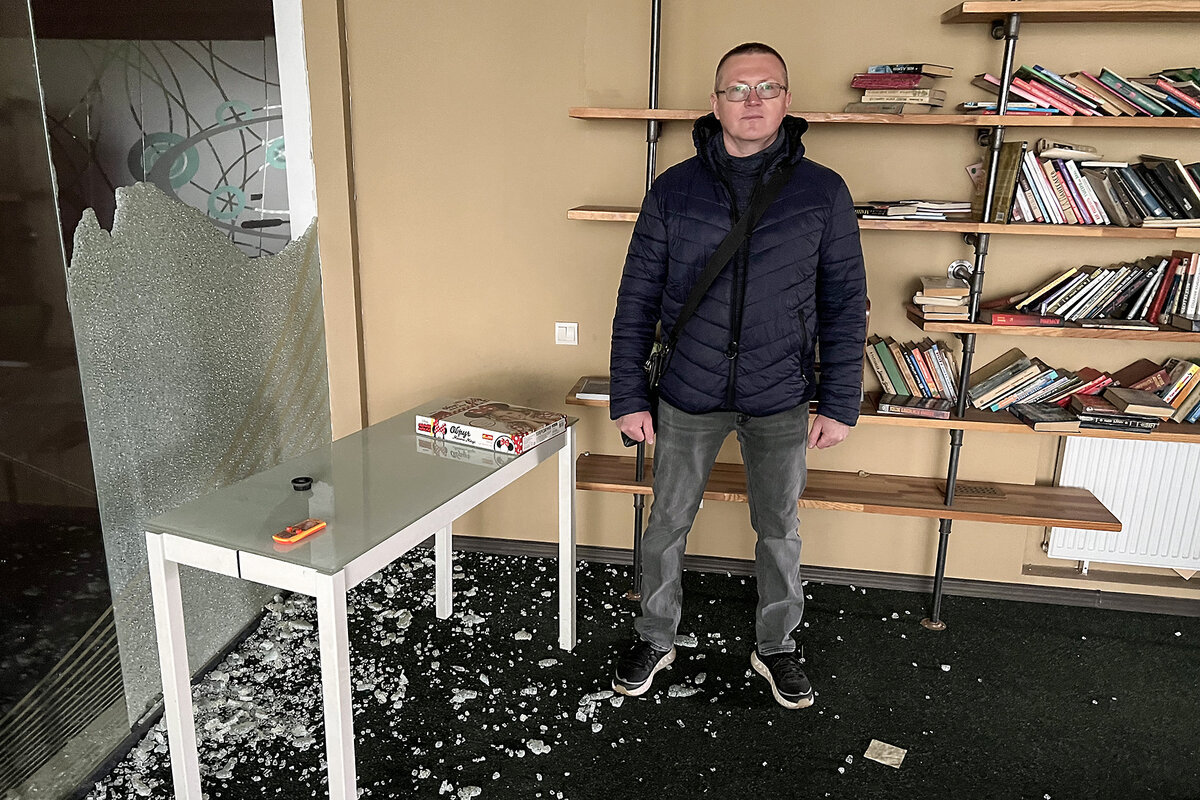
Photo: Howard LaFranchi/The Christian Science Monitor.
Ihor Pohorielov, commercial director of Ranok Publishing, at the company’s bomb-damaged offices, in Kharkiv, Ukraine, Nov. 4, 2024.
If ants can keep working and rebuilding after we’ve knocked over their anthill, how much more humans in war zones?
Among the many buildings damaged or destroyed by the Russian invasion in Ukraine are publishers of books. But books remain strong and Ukrainians keep reading.
Here’s a story by Howard LaFranchi at the Christian Science Monitor.
“Across Ukraine, but especially in Kharkiv, the country’s publishing capital, Russia’s war has been something of a boon to the nation’s publishing industry. More Ukrainians are seeking solace and distraction in books, and interest in Ukrainian literature and Ukrainian-language books is spiking.
“Many of the country’s publishing houses – from textbook-publishing giants to boutique operations specializing in culture – are keeping busy. And this despite the fact that Russian President Vladimir Putin has made publishing houses a key target of his war on Ukrainian culture.
“Publishers say a combination of their resolve to keep operating and a reawakened enthusiasm for books among a variety of readers is keeping the presses running.
“ ‘The war is reminding Ukrainians that books are an outlet for joy, for culture, for travel, when other outlets are closed to us,’ says Yuliia Orlova, general director of Vivat Publishing.
“ ‘We hear all the time about people rediscovering the joys of books as they spend less time on their computers and phones,’ she says. ‘People want to distract themselves from all the sad and depressing things going on around them, so they turn to fiction and fantasy. It’s their way to escape.’
“One night in November, Ihor Pohorielov was awakened by a Russian bomb blast that nearly shook him out of bed. His thoughts went to the modern offices and cavernous storage facilities where he works as the commercial director for Kharkiv’s Ranok Publishing, and which had already been the target of Russian air strikes. …
” ‘I thought of the orders we need to get out and the clients we need to serve – so I came into work’ the next day. …
“Across Ukraine, but especially in Kharkiv, the country’s publishing capital, Russia’s war has been something of a boon to the book publishing business.
“As more Ukrainians seek solace and distraction in books, and as interest in Ukrainian literature and Ukrainian-language books spikes, many of the country’s publishing houses – from textbook-publishing giants to boutique operations specializing in culture – are keeping busy.
“And this despite the fact that Russian President Vladimir Putin has made publishing and printing houses a key target of his war on Ukrainian culture.
“Kharkiv’s publishing industry was shaken to its core last May when a Russian S-300 missile struck the giant Faktor-Druk, one of Europe’s largest printing houses. The blast destroyed presses, incinerated some 100,000 books, and knocked out the three publishing companies housed there. …
“But the sense of devastation was short-lived. In a show of solidarity, several European publishers offered to print Ukrainian books for distribution to millions of Ukrainian refugees around Europe.
“An American philanthropic organization, the Howard G. Buffett Foundation, quickly agreed to pick up the tab for Faktor-Druk’s reconstruction. …
“ ‘Printing in Kharkiv is hanging on despite the almost daily attacks on the city,’ … says Yuliia Orlova, general director of Vivat Publishing, a division of the Faktor Group. …
“Ms. Orlova does not hide the fact that the war has been devastating for Ukrainian publishing in many ways, especially for the people who work in the sector. ‘The attacks and the destruction in the city have a big impact on the mental health of our workers. People don’t sleep and they are constantly worried for their families,’ she says. …
“Since 2022, the number of registered publishers in Ukraine has plummeted from about 1,600 to 150, Ms. Orlova says. …
“But Ms. Orlova cites another statistic that underscores the bright side of Ukrainian book publishing: Over the same period, the total number of books printed grew by 70%.
“The reasons for that jump are largely related to the war. Russia’s systematic destruction of Ukraine’s infrastructure has meant widespread power outages and spotty access to the internet, Ms. Orlova says. ‘We hear all the time about people rediscovering the joys of books as they spend less time on their computers and phones,’ she says. …
“Mr. Putin’s war on Ukrainian culture – targeting museums, churches, universities, and publishing houses – is feeding a renewed interest in history, language, art, and literature that confirm Ukrainian nationhood, publishers say.
” ‘Interest among Ukrainians in who we are was already starting to grow, but it was the full-scale invasion that really encouraged this desire to know more about our history and culture,’ says Oleksandr Savchuk, whose specialty Kharkiv publishing house carries his name.
“ ‘For many Ukrainians, the picture of who we are was like a puzzle with lost pieces,’ he says. ‘But now people are finding those pieces so we can complete the full picture.’
“To help nurture that process, in 2023 the philosophy professor and publisher opened a facility he calls a ‘Book Strongroom,’ a combination bookstore, event space, and neighborhood bomb shelter adjacent to his publishing operations. …
“Oleksandr Savchuk is a small player who has published about 50 titles over the last decade. … ‘For the 12 years before the invasion I was suffering to try to show people their great history and culture. It was a hard-going process,’ he says. … ‘I see now that I’m being heard.’ “
More at the Monitor, here. No firewall, reasonable subscriptions rates for a paper unusually strong in international news.

 Suzanne's Mom's Blog
I never would have guessed this, but it makes sense.
LikeLike
The great escape.
LikeLike