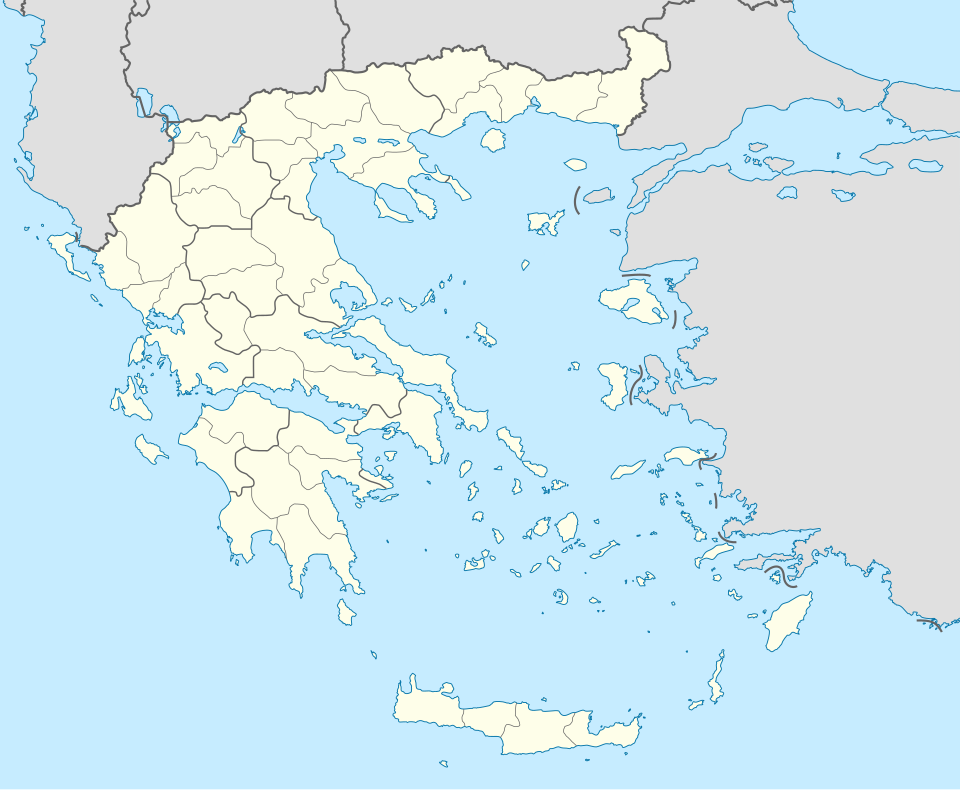
Map: Lencer.
Do you see the group of three islands on the west coast of Greece? Lefkada is the furthest north of the three, kind of a bell shape.
Like many of us, I have contradictory memories of being a teenager. There’s a lot of “on the one hand,” “on the other hand.” On the one hand, when I think of my trip to Greece, there were all those confused interactions with other teens on the independent schools’ trip and with an Athenian power couple for whom I had a letter of introduction.
On the other hand, seeing the Ancient Greek ruins in the Aegean Islands was something to cherish.
I had been interested in Ancient Greece since childhood and ultimately took five years of the language. I remain curious about the old tales from that part of the world, and especially any information on new excavations — like the one in today’s article.
Min Chen reports at Artnet, “More than a century after its initial discovery, the only known amphitheater on the Ionian Islands is finally seeing the light of day.
“Perched on a hillside on Lefkada, an island off the west coast of Greece, the structure has been excavated by archaeologists from the Ephorate of Antiquities of Aitoloakarnania and Lefkada over the past decade. While the upper part of the building has not been well preserved, the team was able to study its cavea, or semicircular seating area. The researchers have also estimated that construction on the theater began around the 4th century B.C.E., when ancient Lefkada was experiencing economic prosperity.
“ ‘Although damaged by time,’ the researchers said in a press announcement, ‘the theater, fully and harmoniously integrated into the geomorphology of the hill, with a panoramic view of the wider area, is undoubtedly the most important and imposing monument that has come to light in ancient Lefkada.’
“Ancient Lefkada was settled sometime before the 7th century B.C.E. by seafaring Corinthians. They homed in on the locale for its strategic position along major sea routes, which fueled the flourishing of the city-state. …
“In 1901, the ruins of the arena were found by German archaeologist E. Kruger and later logged by his collaborator Wilhelm Dörpfeld in his 1927 volume Alt Ithaka. Following their survey, the Germans reburied the monument. Over the years, as the grounds grew over with olive groves and became dotted with makeshift warehouses, the location of the theater was lost.
“It took decades before the structure was rediscovered in 1997 by archaeologists studying the geomorphological characteristics of the area. From 2015, a systemic excavation of the building commenced. Large olive trees had to be uprooted and extensive earthworks carried out in a project that archaeologists deemed ‘particularly difficult and demanding.’ So far, the project has unearthed the building’s cavea, orchestra pit, most of the stage, and various walls.
“The cavea boasted 21 rows of seats, likely topped by a diazoma, or horizontal aisle, which led up to a further three rows. Two cavea walls were found standing at lengths from 65 to 91 feet. The theater, however, appears to have been unfinished. Still, the team calculates it could have seated about 3,500 spectators; if completed, estimates put its capacity at 10,000 to 11,000.
“The orchestra pit, meanwhile, was discovered carved into natural rock in a perfect circle some 54 feet in diameter. A stone frame encircles it. Remains of the stage area were also discovered, including parts of sandstone columns and architraves. These fragments once formed part of the Ionic facade of the theater’s loggia, or external gallery, which once boasted 16 columns and was flanked by ramps.
A highlight during the dig, the team noted, was the unearthing of fragments of three stone thrones.
“These seats, once decorated with reliefs depicting dolphins, birds, and lion paws, were intended for prominent guests, whether priests or city officials.
“Quite likely, the theater saw modifications during its lifetime before it was abandoned as Lefkada declined during the Roman era. In 31 B.C.E., Roman emperor Augustus founded Nicopolis, a new capital city near Preveza, at which the majority of Lefkada residents were made to settle. Ancient Lefkada was deserted, with many of its buildings, including the theater, being mined for construction material.
“At the remains of the monument that once dominated the ancient city, archaeologists will next survey its upper cavea and part of the stage. The team is also awaiting approval for its plans to conserve the theater.”
Interesting. I hadn’t hear of covering up a partial excavation as the German archaeologists did in the early 20th century. I assume they had reason to think the ruins need protection.
Good pictures at Artnet, here. No firewall.

 Suzanne's Mom's Blog
Took a look at those pictures. Absolutely fabulous! I have always preferred the ancient Greeks to the ancient Romans. Maybe it’s because of their love of theater.
LikeLike
Yes, they seem to be more artistic. I know every culture has artists, but the Romans always seem more militaristic and staid for some reason.
LikeLike
Wonderful
LikeLiked by 1 person
My maternal grandfather Christos Mikronis came to this country from Lefkada! Am going to keep your post and reread. xoxoMeredith
LikeLike
How splendid, Meredith! I wonder how much he knew about what was there!
LikeLike