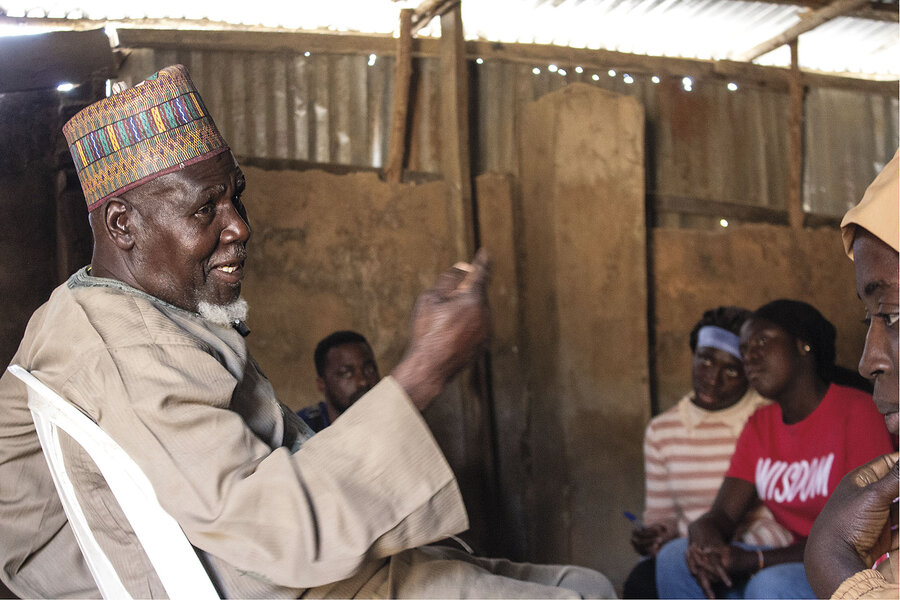
Photo: Nathaniel Bivan.
Ahmed Haruna speaks during a storytelling session in Nigeria.
I know I pick sides when I read about wars. It’s pretty clear that Russia invaded an independent neighbor when it launched attacks on Ukraine, for example. I have to remind myself that civilians on all sides suffer. And then for years after — sometimes generations after — bitterness festers. Not a good thing.
So I was interested to read how some Nigerians are working to ease longlasting enmity. Whatever works, I’d say.
Nathaniel Bivan writes at the Christian Science Monitor, “Seven years ago, when Dalyop Timothy Toma was 15, an angry mob came in the night to torch his family’s home in Kyeng village. Everyone but his grandfather fled outside into the bushes to safety.
“ ‘He couldn’t run because he was disabled,’ recalls Mr. Toma, his face contorting in grief at the memory of his grandfather’s killing. Then he adds matter-of-factly, ‘We were planning revenge.’
“Mr. Toma and his family, who are Christians from the Berom ethnic group, blamed Muslims, mainly from the Fulani group, for the attack. Sectarian tensions run high in Kyeng and other communities in Nigeria’s Plateau state. Disputes often involve politics or land and sometimes erupt into violence.
“But in 2022, a youth leader from Kyeng invited Mr. Toma to do something extraordinary: Recount his painful story aloud to a large room full of people from different ethnic groups that he distrusted. That gathering, organized by a nongovernmental organization called Youth Initiative Against Violence and Human Rights Abuse (Yiavha), changed Mr. Toma’s attitude toward those he thought were his enemies.
‘Telling my story helped me heal gradually,’ says Mr. Toma, explaining that he no longer thirsts for vengeance.
“Yiavha has made him a peace ambassador, tasked with spreading his story of grace and forgiveness at intergenerational storytelling sessions in his community and in others.
“Plateau state, in central Nigeria, is home to some 4 million people. Jacob Choji Pwakim, a longtime peace-building activist in Jos, the state’s capital, founded Yiavha to change the narrative in communities that have been riven by ethno-religious attacks.
“The origins of the violence in Plateau state can be traced to a tumultuous week in Jos in early September 2001. More than 1,000 people were killed and tens of thousands displaced amid a long-running struggle for political and economic power among the area’s different ethnic groups. Disputes also flared between settlers and people indigenous to Jos.
“Yiavha has held at least 66 storytelling sessions across the state. Elders have given accounts of bygone times when residents from various ethnic groups lived in harmony, even sharing gifts during religious celebrations for Eid and Christmas. Meanwhile, young people have recounted why they destroyed farms or livestock belonging to members of a different faith or tribe.
” ‘This was what inspired me to set up Yiavha in 2014, with the objective of creating a platform where young people across the divide can talk about their experiences without judgment,’ Mr. Pwakim says.
“So far, Yiavha has worked with up to 3,300 young people, including more than 300 who have been trained as peace ambassadors who might eventually organize storytelling sessions in their communities. Other young people become agents of change after attending the sessions, organizing interfaith meals, youth soccer competitions, and trash cleanups. …
“One sunny afternoon in February, a group of young people is assembled at a soccer viewing center in Kambel, a community in the Anglo-Jos settlement within Jos. Ahmed Haruna is at the front of the room telling stories to the rapt audience, which includes residents of both Kambel and Channel Seven, another community in Anglo-Jos.
“ ‘Growing up, we didn’t even know the difference, who was Muslim or Christian among us,’ Mr. Haruna says. Over the years, residents have lived in segregated areas, with Christians mainly in Kambel and Muslims mainly in Channel Seven. But the storytelling sessions are gradually bringing them together to interact once again.
“After Mr. Haruna finishes sharing stories about the settlements’ tranquil past, peace ambassador Joshua Tsok opens the floor for questions. …
“Training for peace ambassadors is extensive. In 2023, for example, peace ambassadors gathered in Barkin Ladi, another community in Plateau state known for violent sectarian conflict. A training facilitator, Hussaini Umaru, who is an associate professor in the department of theater and film arts at the University of Jos, says he divided the young people into groups and asked them to narrate and dramatize personal experiences of conflict, and then discuss the episodes.
“It is not easy for ambassadors to trust their trainers. Umar Farouk Musa, a development consultant who facilitated a training session last August, explains that this is typically the first hurdle. ‘Some thought we were there to introduce an agenda or to spy. But we built their confidence,’ he says.
“The government’s Plateau Peace Building Agency is a key partner with Yiavha. Kenneth Dakop, a team lead for the agency, says that Yiavha’s initiatives have helped transform young people who previously were drivers of violence in their communities. ‘Most of them are either unemployed or into substance and drug abuse,’ he says.
“Yiavha’s ambassadors have seen transformations in themselves. ‘I want to become a professional teacher,’ Mr. Toma says.
“This year, Yiavha paired Mr. Toma with a Fulani boy and assigned each of them to plant a pear tree in the other’s village to signify a commitment to peace.”
More at the Monitor, here.

 Suzanne's Mom's Blog
This is a hopeful story and maybe a lesson for those of us living in North America.
LikeLike
We need *something*!
LikeLiked by 1 person