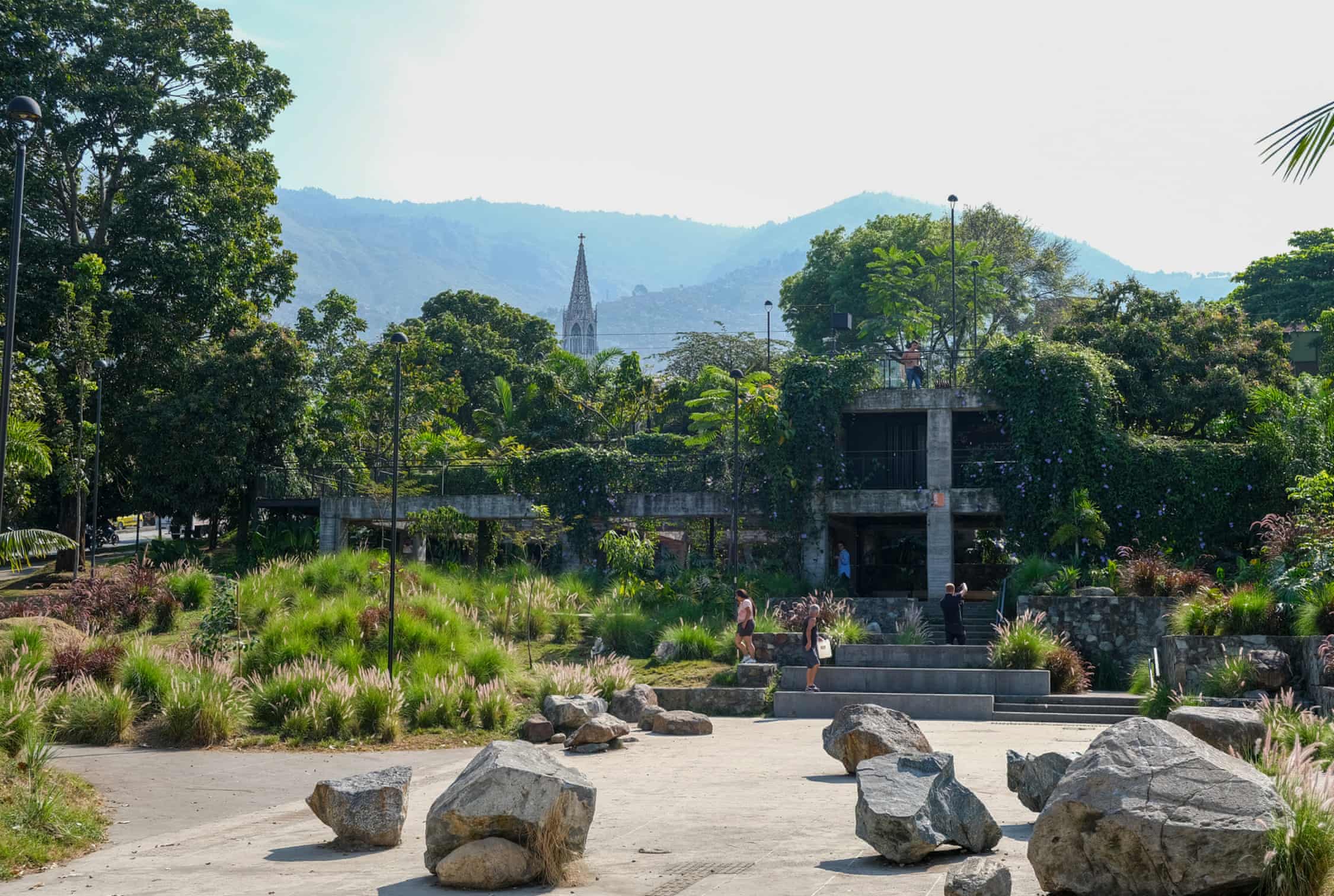
Photo: Connatural Archive.
Surrounded by hills: Colombia’s Parque Prado, no longer abandoned to illegal activity.
What is your first reaction to the words Medellín and Colombia? If you have kept up on the news for a few decades, your associations may include both drug wars and change.
Oliver Wainwright at the Guardian focuses on the change.
“Lilac-flowering creepers engulf an abandoned house on a street corner in Medellín, Colombia, spilling from the roof and smothering most of the upstairs windows. A giant fan palm is visible through one opening, while a knotty tangle of aerial roots cascades down to the pavement from another. Step through the doorway of this overgrown ruin, and you find not a scene of desolation and decay but a sleek steel frame holding up the crumbling facade, which forms an unusual entrance to an enchanting new public park.
“ ‘We behaved more like archaeologists than landscape architects,’ says Edgar Mazo of Connatural, the firm behind the Parque Prado, in the working-class neighborhood of Aranjuez. He leads me through a series of planted terraces; fountain grasses and trumpet trees sprout from where a derelict car park and abandoned homes once stood. ‘You dig up the concrete, water gets into the ground, vegetation grows up, and the people come back,’ he adds, speaking through a translator. ‘That’s natural regeneration.’
“In recent decades, Medellín has been widely celebrated for its astonishing urban transformation. In the 2000s, it went from being one of the most dangerous cities on the planet, riven by murderous drug cartels, to a case study in the miraculous peace-bringing powers of architecture and landscape. Sergio Fajardo, the son of an architect who served as Medellín’s charismatic mayor from 2004 to 2008, was hailed for sprinkling the city’s poorest neighborhoods with dazzling new libraries, stadiums and swimming pools.
“These determinedly ‘iconic’ projects were enthusiastically feted on the pages of glossy design magazines, and their stories recounted in keynotes at international conferences. Impoverished hillsides were connected to a new metro system with an elegant web of cable cars and outdoor escalators, while parks dotted with expressive architect-designed canopies sprang up across the city. The dramatic fall in crime during Fajardo’s term was largely credited to this vision of ‘social urbanism,’ and the increase in the amount of public space per citizen.
“But the Medellín miracle has since lost some of its sparkle. Take the Biblioteca España, one of the flagship projects, designed by Colombian star architect Giancarlo Mazzanti. It stands as a striking cluster of chiseled concrete boulders, rising from the hillside in the formerly no-go barrio of Santo Domingo. But it has been shuttered since 2015, due to structural defects. …
“Mazo’s work takes a markedly different approach from the 00s penchant for spectacle. When he was asked to look at the sloping half-hectare site in Aranjuez, which was home to a rundown car park and six boarded-up houses, abandoned for more than a decade, there was an existing plan to raze everything and replace it with a park traversed by a big zigzagging ramp. It looked like a hangover from the earlier lust for shape-making, something that might photograph well from a helicopter.
“Instead, Mazo and his team decided to keep most of what was already there. Almost 70% of the material on-site remains, albeit in a new form. Walls and floor slabs were chiseled from the two-storey parking structure, and the rubble used to fill the basements of the houses, with soil packed on top. The buildings’ roof timbers were reclaimed and used to make benches, while the landscape was shaped in such a way that rainwater is retained, meaning that no artificial irrigation is needed. The team even collected seeds from the plants that had sprung up on the plot, so they could be scattered around the new park after the project’s construction – allowing the natural colonizers back in.
“The project was built during the pandemic for a cost of just [$1.5m] and the lockdowns allowed time for the plants to establish, without the threat of being trampled by visitors. Five years on, the planting has reached a level of maturity that makes this urban oasis seem like it’s always been there. …
“The former car park’s concrete frame makes for an imposing armature at the centre of the park, supporting a raised steel walkway and framing a series of semi-enclosed spaces beneath it. Reclaimed bricks and stacked roof tiles serve as retaining walls, creating a rugged backdrop to lush clumps of grasses and palms. Gabion cages filled with rocks and rubble line water retention ponds, and provide platforms for seating. A sandy clearing down below makes space for ballgames and events, while park-goers can watch the action from the terraced decks above, and enjoy a grandstand view across the sprawling city and its seven hills.
“ ‘When people first colonized this valley,’ says Mazo, ‘they used to climb up to the top of the hills to communicate with each other. The park now becomes part of that system, giving people an elevated view to connect with others.’ …
“Crucially, there’s a space for everyone here – from elevated walkways, to quiet shrub-lined reading areas, to seating tucked away from prying eyes. The sense of fragmentation, as well as the level changes, allow different social groups to coexist.”
Read more about this and other pilot projects at the Guardian, here. No paywall, but anything you can donate helps to keep factual news accessible to all.

 Suzanne's Mom's Blog
Amazing how places can change. Maybe there is hope for us.
LikeLiked by 2 people