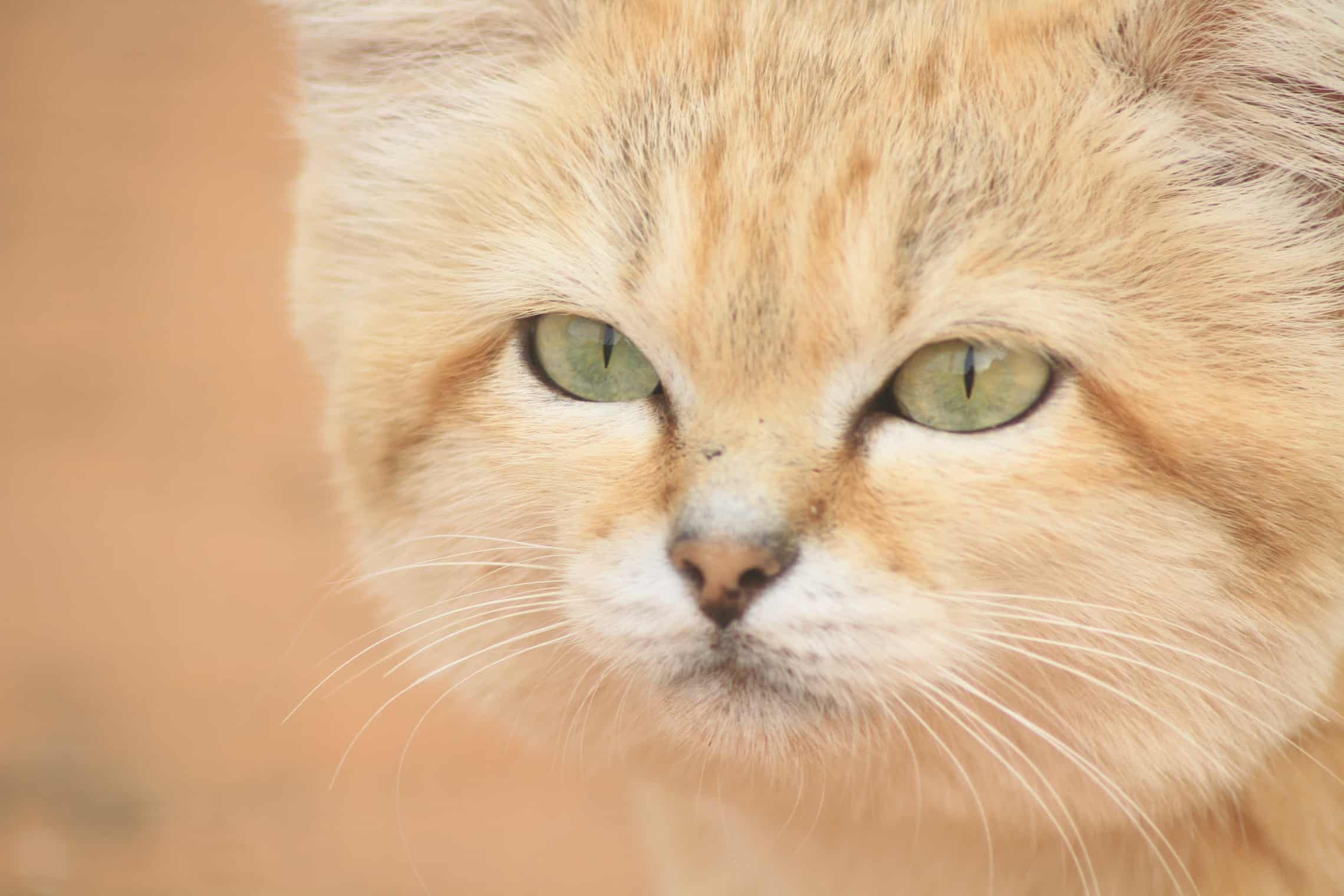
Photo: Mohammed Almuntasir.
Sand cats (Felis margarita) like this are the world’s only felids adapted to true desert conditions.
Here’s another example of just how far human curiosity can take us when we persevere. For years, the idea that a catlike animal could survive in the desert was thought to be more myth than fact. But a wildlife photographer in Libya was determined to find out if it was possible.
Amr Fathallah writes at the Guardian, “When wildlife photographer Mohammed Almuntasir uploaded 18 seconds of footage to YouTube, he thought little more about the small, pale cat seen digging a hollow in the sand in the remote dunes of south-west Libya.
“The video, however, posted in 2017, turned out to be the first material evidence that the sand cat (Felis margarita), the world’s only felid adapted to true desert conditions, existed in the country.
“ ‘When I posted it, nobody believed it had been filmed in Libya,’ he said. ‘Everyone denied it, but I kept insisting that the cat is here, in several places; one of them was only 70km (43 miles) from Zintan, where I live.’
“Nearly a decade later there is increasing evidence that this was not just one sand cat but that south-western Libya may represent a previously unrecognized stronghold for the species. The sand cat is no bigger than a domestic cat and its sandy color means it is almost impossible to spot in the terrain it inhabits, earning it the nickname ‘ghost of the desert.’
“Almuntasir did not actively circulate his film of the cat, but it drew attention on its own, prompting numerous researchers to contact him over the years, including Firas Hayder, a zoologist specializing in small carnivores and a postdoctoral researcher at Sol Plaatje University in South Africa.
“ ‘He convinced me that we should collaborate on a study to document the return of this animal to Libya and register it among Libyan wildlife species,’ Almuntasir says.
“Libya’s south-west is one of the least studied terrestrial environments in north Africa and Hayder says he had reviewed every scientific source that mentioned the sand cat in Libya and found that none had produced a single piece of evidence or set of coordinates.
“ ‘When I asked Mohammed where he had seen the cat, he told me he had observed it in multiple areas,’ Hayder says. ‘That was what surprised me.’ …
“After meeting, Hayder and Almuntasir embarked on an eight-year collaboration conducted almost entirely remotely.
“ ‘I taught Mohammed the field research methods from South Africa – how to record GPS coordinates, how to document each sighting with photographs or video,’ Hayder says. ‘He applied all of that across the south-western desert, collecting testimony from local Tuareg communities who know the terrain intimately.’
“Almuntasir, who grew up in the Nafusa mountains, where residents are deeply familiar with Hamada al Hamra, a vast rocky desert plateau in south-western Libya covering 84,000 sq km, joined local hunters on their expeditions, carrying a camera instead of a rifle.
“ ‘They would tell me about places where they had seen the sand cat and record the coordinates, and I would compile them all to plan a dedicated trip to visit each location,’ he says.
In some cases, he and his guides followed paw prints for days to locate a burrow, then pitched a tent and waited for the animal to emerge.
“Their efforts culminated in a peer-reviewed study published in the Journal of Arid Environments in February 2026 documenting the sand cat at 13 sites across the Libyan Sahara, as well as the Saharan striped polecat at eight new locations, seven of them outside the species’ recognized [range]. A high proportion of sand cat sightings, 15 out of 36, were concentrated in Wadi Armet, an isolated valley roughly 1,000km [621 miles] south-west of Tripoli. …
“ ‘There has always been a large question mark over Libya because of the scarcity of studies and surveys,’ Ibrahim Elkahwage, head of the Libyan Wildlife Trust … tells the Guardian. ‘This research is an important contribution that could help reveal the enormous biodiversity hidden in the Libyan Sahara.’ “
This story was produced in collaboration with the journalism group Egab.
More at the Guardian, here.


Wow! I am forwarding this to my cat-loving sisters…
LikeLike
Thank you, Will. The cat pictures are beautiful, but somehow I can’t imagine this tough cat ever being domesticated!
LikeLiked by 1 person
I agree. And some cat owners might suggest that their (modern, non-desert-dwelling) cat is still only partly domesticated…
LikeLiked by 1 person
Amazing how life finds a way even in a harsh climate. I like “ghost of the desert.”
LikeLike
Yes. Good name!
LikeLiked by 1 person