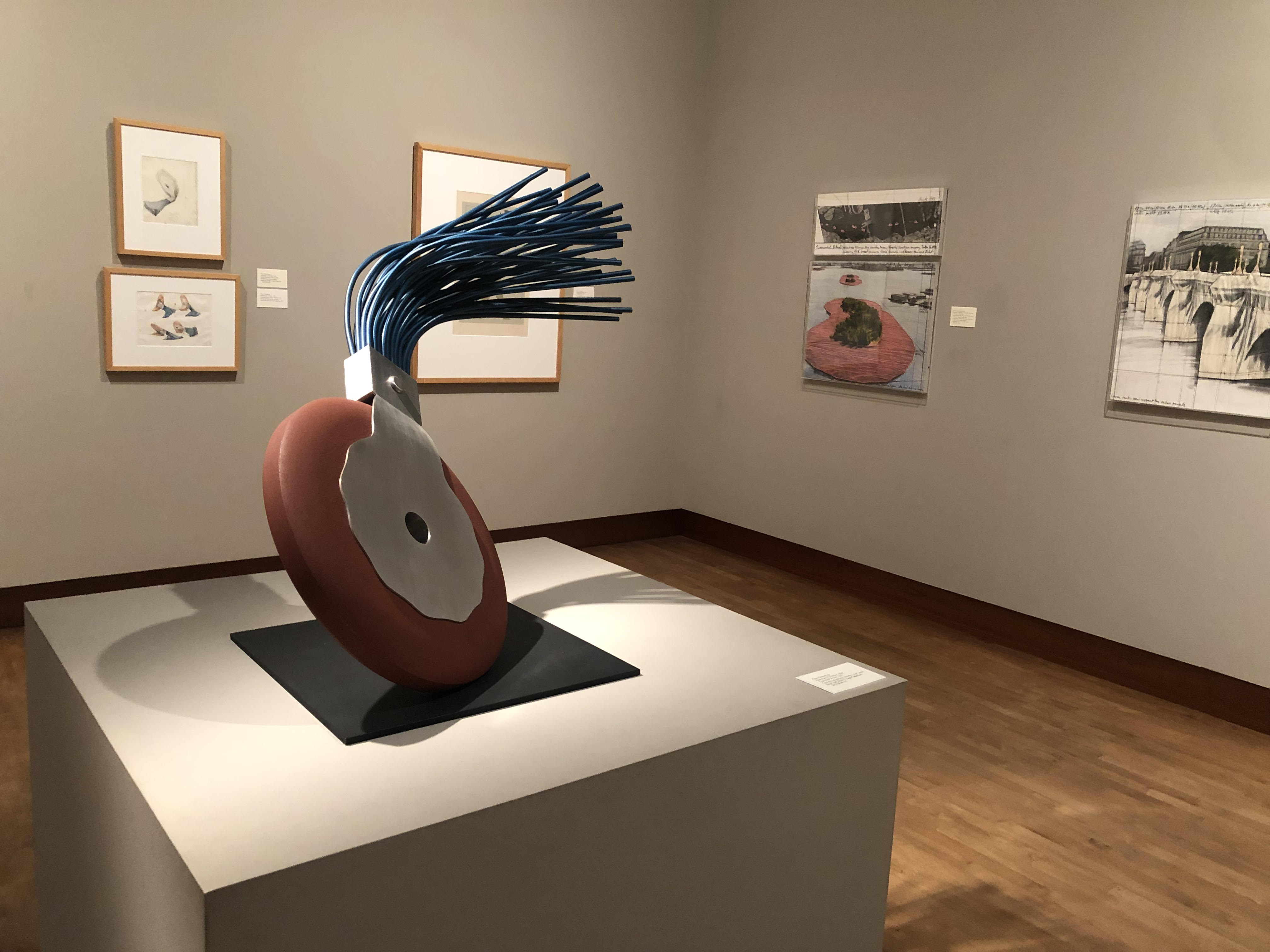
Photo: John and Suzanne’s Mom.
“Typewriter Eraser,” by Claes Oldenburg, at Chazen Museum of Art, Madison, Wisconsin, August 2022.
When I saw this a year and a half ago in Madison, I loved so much that Claes Oldenburg was drawn to the artistic possibilities of a typewriter eraser that I took a picture.
More recently, a larger, outdoor version of that eraser drew in an owl.
Alisa Tang has the story at the Washington Post.
“It was the morning of Friday the 13th, and staff members were tending the grounds of the National Gallery of Art Sculpture Garden when they spotted something amiss: feathers sticking out of the blue bristles of the gigantic typewriter eraser.
“As they stepped in for a closer look, they realized a barred owl was stuck in the brush of ‘Typewriter Eraser, Scale X‘ — the garden’s six-meter-tall steel-and-fiberglass sculpture of the once-common office relic.
“The bird was still. But as the gardeners approached, it turned its head and blinked. …
“Brett McNish, the garden’s supervisory horticulturist, wrote in an email, ‘Occasionally, we see hawks momentarily perched on other taller sculptures in the garden, but never on Eraser. This is the first Owl seen in the garden.’ …
“There is a lot of wildlife in the garden, including dozens of species of birds and small mammals, McNish wrote. Hawks mainly like to sit on ‘Graft,’ a stainless steel sculpture of a leafless tree, though they tend not to stay for long. …
“Then came Friday the 13th and the extraordinary owl in the eraser. It was unclear how the owl got into its predicament, but staff members sprang into action. ‘It clearly needed help,’ McNish wrote.
“Workers hauled out a ladder and steadied it under the eraser. McNish, feeling ‘slightly anxious’ because of the bird’s thrashing as staff members neared, put on goggles and heavy-duty rose-gardening gloves for protection. He climbed the rungs and extracted the bird.
“The gallery’s sculpture conservation department provided a quilted cotton blanket normally used to move artwork to swaddle the owl, and McNish said that within an hour of its rescue, the owl was delivered into the care of City Wildlife, an animal rescue center in D.C.
“ ‘It was extremely lethargic, and it looked really sad,’ said Jim Monsma, City Wildlife’s executive director. ‘An owl during the day should not just be lying there in a box. It should be trying to fly away. It looked like it had just given up.’ …
“Staff members evaluated the owl, X-rayed it and found no broken bones. But its right shoulder was swollen, its ‘gums’ were pale, and it wouldn’t eat, said Sarah Sirica, a veterinarian and City Wildlife’s clinic director.
“The clinic put the owl on pain and anti-inflammatory medication, injected it with an electrolyte solution around the base of its leg and put it in a private room in a large cage that was lined with cloth so it wouldn’t damage its wings. The clinic bought frozen dead mice, thawed them and left them in the cage overnight — which is when owls normally eat — but the owl didn’t touch the food.
“So staff members hand-fed it: One person held the owl, while another, sometimes Sirica, wore gloves, opened the owl’s beak and put pieces of chopped-up thawed mice into its mouth, ‘a finger-length down,’ Sirica said.
“After about a week, Sirica deemed the owl healthy enough to travel; the swelling on its shoulder had gone down, and its gums were pink again. On Oct. 21, a City Wildlife volunteer drove the bird to Tri-State Bird Rescue & Research in Newark, Delaware. Upon arrival, staff at the facility placed it directly inside a 100-foot-long, gravel-floored flight enclosure for ‘prerelease flight conditioning,’ said Lisa Smith, the executive director of Tri-State Bird Rescue.
” ‘It gives them the opportunity to have a long flight. Then we can evaluate that they are flying properly — you can’t do that in a small enclosure,’ Smith said. ‘You have to see multiple flaps. Also, the enclosure is 20 feet high, so you want to make sure they can get from the ground up and make it from one end to the other at that height.’ …
“Tri-State Bird Rescue has admitted … ducklings that fall into storm drains, and birds that lose their nests during storms or get caught in sticky glue traps. But eraser owl was a novelty. …
“Tri-State Bird Rescue normally will return an adult bird of prey to the area where it was found, but it avoids transporting younger raptors because they can injure their wings in the carrier. Besides, as juvenile birds of prey become adults, they often have to find territory away from where they were raised anyway, Smith said. … ‘For the birds’ safety, we tend to release them here. It’s good habitat. It’s migration season.”
More at the Post, here.
And just for no reason, here’s a handy expression you can use the next time you are in Sweden: “Det är ugglor i mossen.” There are owls in the marsh. Erik’s mother says, “It is something that is not quite OK or not reliable. You should really not believe it. It’s a sort of feeling.” Maybe “I smell a rat”?

 Suzanne's Mom's Blog
Phew, I live near the one that’s not a bird hazard. 🦉
LikeLike