Feeds:
Posts
Comments

Posts Tagged ‘Oldenburg’

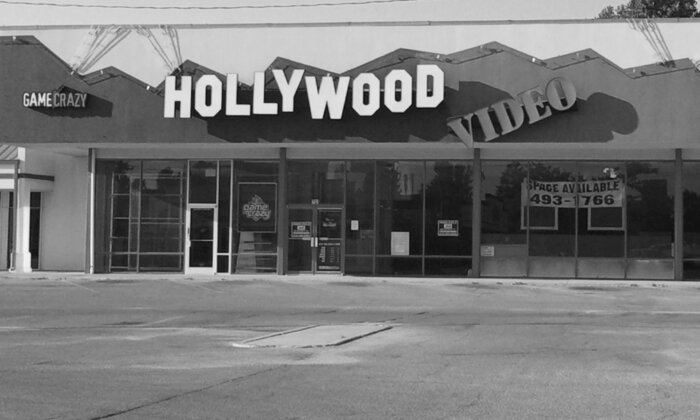
Photo: Flickr / The MIT Press Reader.
Hollywood Video was a VHS, DVD, and video game rental shop company started in 1988. It ceased operations, after declaring bankruptcy, in 2010.

Today’s story reminds us how much the old video stores provided a hangout for like-minded people. You can probably think of analogies, from certain coffee shops to high-end record stores of the 1960s. I remember one of those in New York City that my friends loved. It had enclosed listening booths that were like old-time phone booths. You could ask the staff to let you listen to a record, and off you’d go. They did get tired of teens who didn’t end up buying the record, though.

Joshua M. Greenberg writes at MIT Press, “If a DVD owner from the year 2005 found herself transported back to a video store circa 1982, she would likely find the space remarkably familiar: videocassette cases lining the walls, a movie playing on a television set, maybe some marquee lights framing an announcement board over the checkout counter — all in all, not terribly unlike the video store of two and a half decades later.

“However, understanding the video store simply as a transactional space in which money is exchanged for goods and services misses the forest for the trees.

“That same time-traveling video renter might find herself startled by the employee offering to recommend a movie, or by the knot of customers hanging out by the counter, shooting the breeze and discussing film. The early video store was often a place to talk as well as to shop, and the persona and expertise of retailers and clerks structured the consumer experience of home video as much as the shelves on the wall. …

“Consider the English pub, the French café, the German beer garden, or the American tavern: These are places where patrons can buy food or drink. But an analysis that focuses only on the producer/consumer exchange would overlook the vital role these and other spaces play in establishing and maintaining broader social relationships. Sociologist Ray Oldenburg describes such spaces as ‘third places.’ … Such places serve to unite the neighborhood through simple, day-to-day interaction. For example, Oldenburg writes, ‘In many [American] communities, the post office served this function well when everyone had a mailbox there; when everybody had to walk or drive to it.’ …

“As Oldenburg puts it, ‘Nothing more clearly indicates a third place than that the talk there is good; that it is lively, scintillating, colorful, and engaging.’

“This orientation toward lively conversation was also a social leveler; third places ‘counter the tendency to be restrictive in the enjoyment of others by being open to all and by laying emphasis on qualities not confined to status distinctions current in the society. Within third places, the charm and flavor of one’s personality, irrespective of his or her station in life, is what counts.’ Another core attribute of third places is the sense of shared ownership among its regulars, regardless of who actually owns the building. ‘Those who claim a third place typically refer to it in the first person possessive (“Rudy’s is our hangout”).’ …

“The traditional story told about home video is that its sudden appearance fragmented the moviegoing audience into individuals. As [sociologist Richard Butsch] and others have argued, home video helped the viewing public wall themselves off in their separate living rooms. What this argument misses, however, is the shared practice of acquiring those tapes and then watching them at home — in its early years, the video store became a third place where customers, retailers, and clerks met, talked, and shared a common experience of movies on videocassette. …

“While clerks were usually seen as the in-store experts, the flow of information was by no means unidirectional. Many of the earliest video store customers were film buffs themselves, and the lucky clerk who happened to be working when one came in might be in for an education. ‘I remember [one customer who] really knew the old stuff . . . like old B movies and serials,’ says Lance Strate, who worked at Arthur Morowitz’s Video Shack in the early 1980s. ‘That’s where I first learned about Tom Mix and the Phantom Empire’.” …

“At their best, video clerks and store owners fostered a true third-place atmosphere in their stores. ‘There was always conversation in our store,’ recalls Jerry Frebowitz, owner of Philadelphia’s Movies Unlimited. ‘Especially on Saturdays . . . there was so much film talk going on. Total strangers were talking to each other; it was really a phenomenon.’ Though his customers always came to rent a movie, Frebowitz says, ‘They definitely stayed to talk . . . hardly anybody came in to get the movie and leave.’ ”

More at MIT Press, here. What other third places can you think of? Alternatively, are there places where people with shared interests gather and no one gets to know anyone else? I thought yoga classes were disappointing in that regard.
Read Full Post »

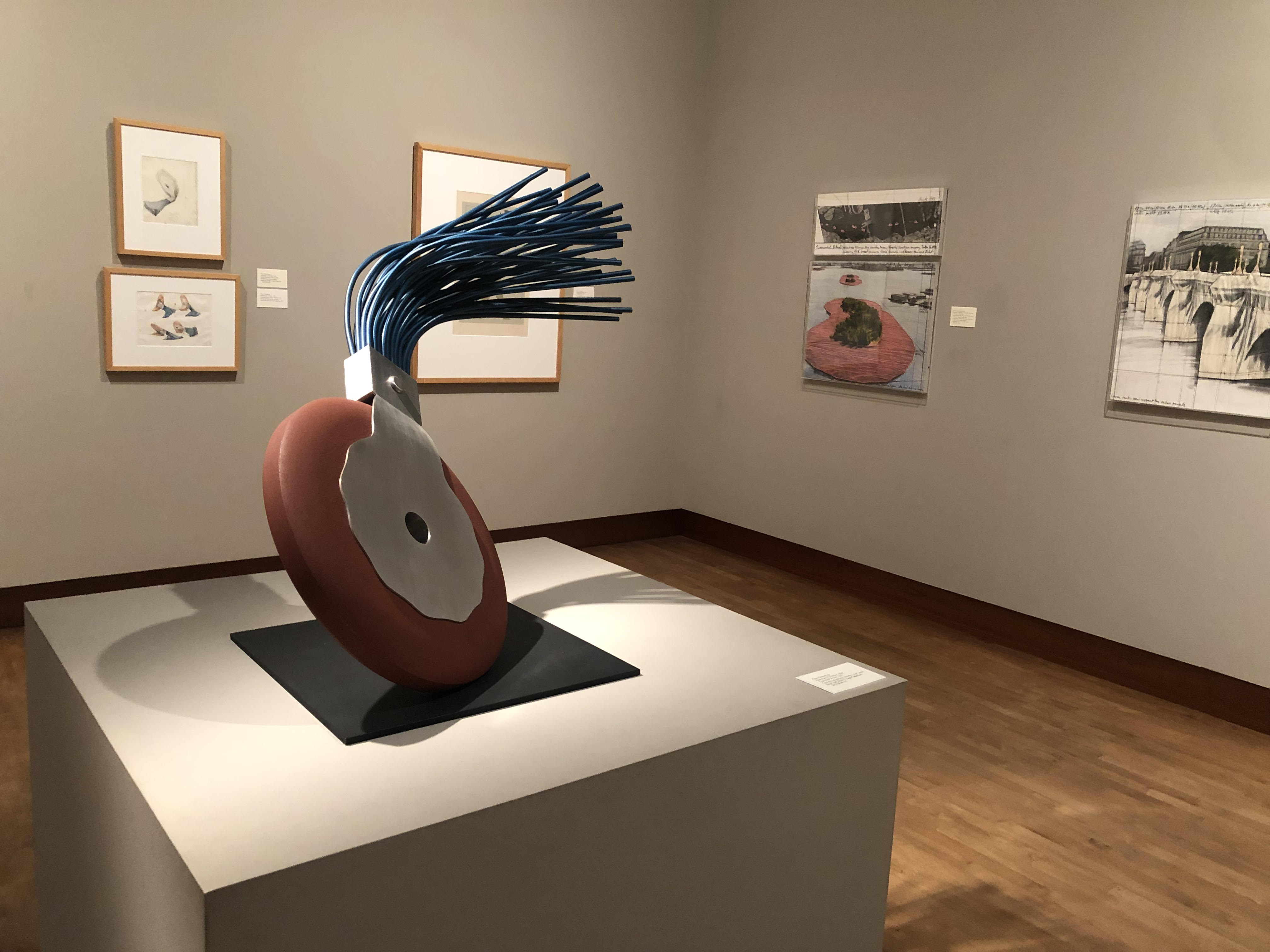
Photo: John and Suzanne’s Mom.
“Typewriter Eraser,” by Claes Oldenburg, at Chazen Museum of Art, Madison, Wisconsin, August 2022.

When I saw this a year and a half ago in Madison, I loved so much that Claes Oldenburg was drawn to the artistic possibilities of a typewriter eraser that I took a picture.

More recently, a larger, outdoor version of that eraser drew in an owl.

Alisa Tang has the story at the Washington Post.

“It was the morning of Friday the 13th, and staff members were tending the grounds of the National Gallery of Art Sculpture Garden when they spotted something amiss: feathers sticking out of the blue bristles of the gigantic typewriter eraser.

“As they stepped in for a closer look, they realized a barred owl was stuck in the brush of ‘Typewriter Eraser, Scale X‘ — the garden’s six-meter-tall steel-and-fiberglass sculpture of the once-common office relic.

“The bird was still. But as the gardeners approached, it turned its head and blinked. …

“Brett McNish, the garden’s supervisory horticulturist, wrote in an email, ‘Occasionally, we see hawks momentarily perched on other taller sculptures in the garden, but never on Eraser. This is the first Owl seen in the garden.’ …

“There is a lot of wildlife in the garden, including dozens of species of birds and small mammals, McNish wrote. Hawks mainly like to sit on ‘Graft,’ a stainless steel sculpture of a leafless tree, though they tend not to stay for long. …

“Then came Friday the 13th and the extraordinary owl in the eraser. It was unclear how the owl got into its predicament, but staff members sprang into action. ‘It clearly needed help,’ McNish wrote.

“Workers hauled out a ladder and steadied it under the eraser. McNish, feeling ‘slightly anxious’ because of the bird’s thrashing as staff members neared, put on goggles and heavy-duty rose-gardening gloves for protection. He climbed the rungs and extracted the bird.

“The gallery’s sculpture conservation department provided a quilted cotton blanket normally used to move artwork to swaddle the owl, and McNish said that within an hour of its rescue, the owl was delivered into the care of City Wildlife, an animal rescue center in D.C.

“ ‘It was extremely lethargic, and it looked really sad,’ said Jim Monsma, City Wildlife’s executive director. ‘An owl during the day should not just be lying there in a box. It should be trying to fly away. It looked like it had just given up.’ …

“Staff members evaluated the owl, X-rayed it and found no broken bones. But its right shoulder was swollen, its ‘gums’ were pale, and it wouldn’t eat, said Sarah Sirica, a veterinarian and City Wildlife’s clinic director.

“The clinic put the owl on pain and anti-inflammatory medication, injected it with an electrolyte solution around the base of its leg and put it in a private room in a large cage that was lined with cloth so it wouldn’t damage its wings. The clinic bought frozen dead mice, thawed them and left them in the cage overnight — which is when owls normally eat — but the owl didn’t touch the food.

“So staff members hand-fed it: One person held the owl, while another, sometimes Sirica, wore gloves, opened the owl’s beak and put pieces of chopped-up thawed mice into its mouth, ‘a finger-length down,’ Sirica said.

“After about a week, Sirica deemed the owl healthy enough to travel; the swelling on its shoulder had gone down, and its gums were pink again. On Oct. 21, a City Wildlife volunteer drove the bird to Tri-State Bird Rescue & Research in Newark, Delaware. Upon arrival, staff at the facility placed it directly inside a 100-foot-long, gravel-floored flight enclosure for ‘prerelease flight conditioning,’ said Lisa Smith, the executive director of Tri-State Bird Rescue.

” ‘It gives them the opportunity to have a long flight. Then we can evaluate that they are flying properly — you can’t do that in a small enclosure,’ Smith said. ‘You have to see multiple flaps. Also, the enclosure is 20 feet high, so you want to make sure they can get from the ground up and make it from one end to the other at that height.’ …

“Tri-State Bird Rescue has admitted … ducklings that fall into storm drains, and birds that lose their nests during storms or get caught in sticky glue traps. But eraser owl was a novelty. …

“Tri-State Bird Rescue normally will return an adult bird of prey to the area where it was found, but it avoids transporting younger raptors because they can injure their wings in the carrier. Besides, as juvenile birds of prey become adults, they often have to find territory away from where they were raised anyway, Smith said. … ‘For the birds’ safety, we tend to release them here. It’s good habitat. It’s migration season.”

More at the Post, here.

And just for no reason, here’s a handy expression you can use the next time you are in Sweden: “Det är ugglor i mossen.” There are owls in the marsh. Erik’s mother says, “It is something that is not quite OK or not reliable. You should really not believe it. It’s a sort of feeling.” Maybe “I smell a rat”?

Read Full Post »