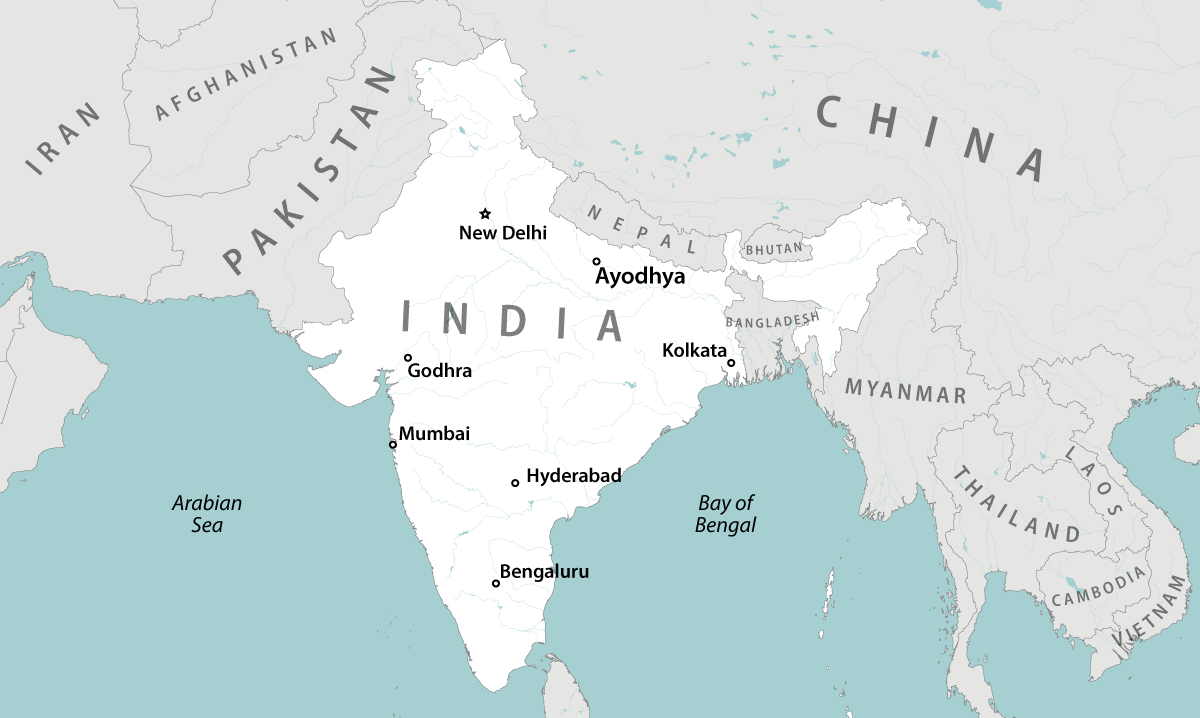
Map: Jacob Turcotte/CSM.
There are still people in India who appreciate having friends from other religions.
There is not much to celebrate about Hindu-Muslim relations in India these days, where the current power structure seems to have turned its back on peaceful coexistence. But trust the Christian Science Monitor to come up with a rare upbeat story! It’s about an interfaith friendship between Sadiq Ali, a Muslim, and Mahant Gyan Das, a Hindu, that has survived many political storms.
Shweta Desai writes, “The light blue walls of Sadiq Ali’s living room are adorned with photos of Hindu seer Mahant Gyan Das. The two have been friends since the 1980s, when Mr. Ali was a volleyball player and Mr. Gyan Das a wrestler. They bonded over their shared love of sports, and Mr. Gyan Das regularly visited Mr. Ali’s family tailoring shop to get his tunics stitched.
“About 20 years ago, their friendship took on a new meaning. Days of violent riots had rocked the nation and left more than 700 Muslims dead. It tore open old wounds in Ayodhya, a north Indian city where the Muslim community was still reeling from the destruction of the historic Babri mosque by a Hindu mob in 1992.
“Sensing the need for an olive branch, Mr. Gyan Das, then head priest of the city’s historic Hanuman Garhi temple, invited 1,000 Muslims to the temple premises during Ramadan to break their daily fast. Mr. Ali helped host the feast, which still fills its organizers with pride and nostalgia – especially as Ayodhya is once again in the spotlight for Hindu-Muslim tensions.
“[Recently] Prime Minister Narendra Modi unveiled an opulent Hindu temple on the site where the Babri mosque once stood.
“Like the mob which leveled the mosque, Mr. Modi and his supporters in the ruling Bharatiya Janata Party (BJP) claim that Babri was built over the birthplace of Hindu deity Ram, and the construction of the new Ram temple has become a rallying point for India’s growing Hindu nationalist movement. …
“In such polarized times, Mr. Gyan Das and Mr. Ali’s friendship offers a reminder of what Ayodhya could have – and perhaps still can – become: a symbol of multiculturalism and tolerance.
‘Ordinary people here want to live in peace,’ says Valay Singh, author of Ayodhya: City of Faith, City of Discord.
“He argues that the city’s reputation as India’s ‘ground zero’ of communal conflict overshadows its history as a heartland where different religious traditions have long intersected. In fact, he notes, the land for the Hanuman Garhi temple was donated to the region’s Hindu community by Muslim ruler Shuja-ud-Daula in the 18th century.
“ ‘It was a common tradition for the religious establishments to receive patronage from the Muslim rulers,’ he says. …
“[The] religious strife has deep roots – several weaving back toward Ayodhya. The destruction of the Babri mosque, for instance, came after decades of campaigning by right-wing Hindu groups, such as the Vishva Hindu Parishad (VHP), and led to months of communal violence across India. In Ayodhya, Muslims and their properties were singled out. Mr. Ali’s shop was plundered multiple times. …
“Indeed, the mosque’s demolition and resulting chaos left deep fissures between the Hindu majority and Muslim minority throughout the country.
“Those rifts grew during the 2002 Gujarat riots, which were sparked by a deadly fire on a train carrying Hindu pilgrims from Ayodhya to Godhra, Gujarat. …The following year, Mr. Gyan Das approached Mr. Ali with his idea to organize an interfaith iftar fast-breaking meal at Hanuman Garhi.
“At first, the tailor was baffled. He reminded Ayodhya’s most influential seer that after breaking fast, Muslims must offer the namaz prayers. Will the Hindu seers accept prayers to Allah on the temple’s premises? Mr. Gyan Das was confident they would.
“In November 2003, with fanfare and high security, saffron-robed priests from several local temples welcomed their Muslim guests, serving them fruits and yogurt. Around sunset, calls of ‘Allahu Akbar!’ mingled with the sounds of conch shells and temple bells, as rows of Muslims bowed down to read the namaz. Both sides prayed together for peace and brotherhood to prevail across the country.
“The Muslim community reciprocated. After the iftar, hundreds of seers marched to Mr. Ali’s home to break the Hindu Ekadashi fast with seviyan, a traditional sweet prepared by Muslims on festive occasions. …
“The iftar [inspired] Yugal Kishore Shastri, one of few outspoken Hindu priests who have left the far-right and put their faith in the spirit of Indian secularism. Mr. Shastri says he split from the VHP after discovering that there was ‘no evidence of an ancient Ram temple under the mosque structure.’ …
“Although it’s getting harder for activists to cut through the vitriol and bring communities together … ‘There will always be a place for people who work for Hindu-Muslim peace,’ he says.”
More at the Monitor, here.


Delightful story, thank you
LikeLike
Yes, an encouraging piece. Good for the Moniter for finding the story and printing it.
LikeLiked by 1 person
It takes so few people to lead the way. Two.
LikeLiked by 1 person