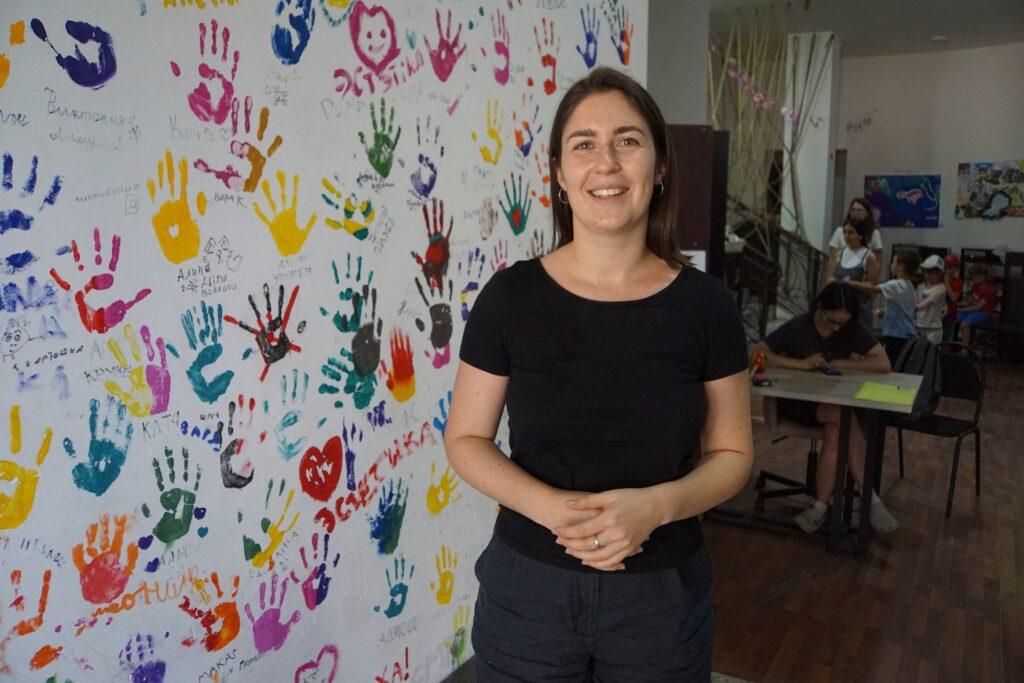
Photo: Daniel Ofman/The World.
Elena Chegodaeva is the founder of the Liberated School in Yerevan, Armenia. Most of the students are the kids of Russian immigrants who left Russia because of the war in Ukraine.
When tyrants like Putin have total control over the media, it’s easy to forget that there may be some people in the country who are not supportive of tyranny. In today’s story we learn about Russian dissenters who fled to Armenia after Russia’s full-scale invasion of Ukraine — and how they are trying to make a new life there. (Do you know why media outlets always say “full-scale” invasion? Because Russia has been doing other, more limited invasions for a long time.)
With contributions from Stepan Adamyan, Daniel Ofman reported the story for Public Radio International’s The World.
“Russian Elena Chegodaeva left Moscow in early March of 2022 — about a week after Russia began its full-scale invasion of Ukraine.
“Chegodaeva was against the war and fled to Yerevan, Armenia. … Chegodaeva is among the hundreds of thousands of Russians who have left their homeland since the invasion of Ukraine. Most of them oppose Russia’s war in Ukraine, or they fear getting drafted.
“Many have wound up all over Europe — and Turkey, Georgia and Armenia have become some of the most-frequent destinations for exiled Russians. According to some estimates, more than 100,000 Russian citizens fled to Armenia alone. This reality has led to some changes within Yerevan, the Armenian capital, as the new residents try to put down roots.
“Chegodaeva, an educator, soon realized the need for a school for the Russian children coming to the city. So, after coordinating with families and securing teachers and a space within a couple of weeks, she started the Svobodnaya Shkola, which is Russian for Liberated School. …
“At first, the school only had 40 students — all kids of Russian immigrants. Back then, many of the families thought the war would end and they would soon return to Russia. The school operated out of an apartment. Now, 2 1/2 years later, many of the families are still here, and the student body has grown to 250, with classes held in two different buildings. Lessons are taught in Russian and English, while Armenian is also taught twice a week. …
“Yura Boguslavsky, a parent of two sons, ages 10 and 15, at Chegodaeva’s school, said that their education is one of the reasons he left Russia. … [And] when he and his family first arrived in Armenia, they also struggled. ‘I think the first two or three weeks was just a shock; we managed to find someplace to live, and all the streets in Yerevan were full of lost people with backpacks who were very sad.’ …
“Back in Russia, Boguslavsky attended anti-war protests, and was opposed to the Kremlin’s politics. Professionally though, Boguslavsky said, he was thriving. In Moscow, he ran a studio and an animation school. But once he got to Yerevan, he had to start from scratch. …
“A year after arriving in Yerevan, Boguslavsky started a new animation studio called Invisible Friends. He also teaches animation to students of all ages. He produced a Claymation, stop-motion documentary called, We flew, we came here, based on interviews that Armenian students conducted with Russian kids who had recently arrived in Yerevan.
“In the film, one child says that he didn’t know how long they were leaving Russia for — but when he found out, he says he ‘began missing his friends’ and sometimes cried at night. The kids described the toys they took with them and the ones they left behind.
“Boguslavsky said that the kids were a lot more expressive than the adults were. That’s why he chose to feature children in the film.
“ ‘All the adults … were saying almost the same things, just retelling the news. And the kids were sometimes even funny; they talked about how they understood what their parents told them. They were speaking a lot about their feelings.’
“Boguslavsky said that this film inspired him to find a way to keep teaching animation in Armenia. He said that nowadays, he feels comfortable in Armenia, but he knows that many other people are having a hard time.
“Finding affordable housing, and consistent work, is a challenge for many Russian immigrants who don’t work in the tech sector. A lot of people are also having trouble adjusting because they’re still hoping to return to Russia.
“ ‘I know many people who were suffering a lot, and not living their lives, and they were stuck in the past, and I don’t want to be like that, you know.’
“Boguslavsky said that it’s unlikely that he’ll return to Russia anytime soon. He said that he’s focused on making a life for himself and his family here in Armenia.
“Chegodaeva said that’s her mindset as well, and one of the reasons she founded the school. However, she said she still holds out hope that she’ll one day go back to Russia.”
More at The World, here.


The fact they felt strongly enough to exile themselves speaks volumes. I’m glad they are finding new ways to live and learn.
LikeLike
I volunteered with Ukrainian journalists for a few months, and a few could not see Russians as having any humanity at all. That’s a sad thing that can happen to people in wartime.
LikeLiked by 1 person
Thanks for humanizing these Russians.
LikeLiked by 1 person
The problem with Russia is that the the sheer size of the country calls for an autocratic regime that has a tendency to see the surrounding countries as their “backyard”. The USA is sick in the same bed by transforming itself into a theocracy where fundamentalist Christians are controlling the Supreme Court, Congress, and the Federal Government.
LikeLike
When people are willing to migrate to a foreign country where they can’t even speak the language, they usually have good reasons. It’s striking to read the 100,000 statistic. I wonder what percentage of Armenians resent their presence and want to deport them.
LikeLike
I don’t know. Some people are welcoming of migrants in distress, knowing it could happen to them — maybe also knowing that all world religions call it right to welcome the strsanger. Funny how people pick out the parts of their religion that are convenient for them!
LikeLiked by 1 person
Yes. Germany certainly opened its arms when Merkel was chancellor, but Nationalism is also a growing concern in Europe.
Your statement about religion reminds me of Susan B Anthony’s, “I distrust those people who know so well what God wants them to do because I notice it always coincides with their own desires.”
LikeLike
LOL. Good one!
LikeLike