Feeds:
Posts
Comments

Posts Tagged ‘mutual aid’

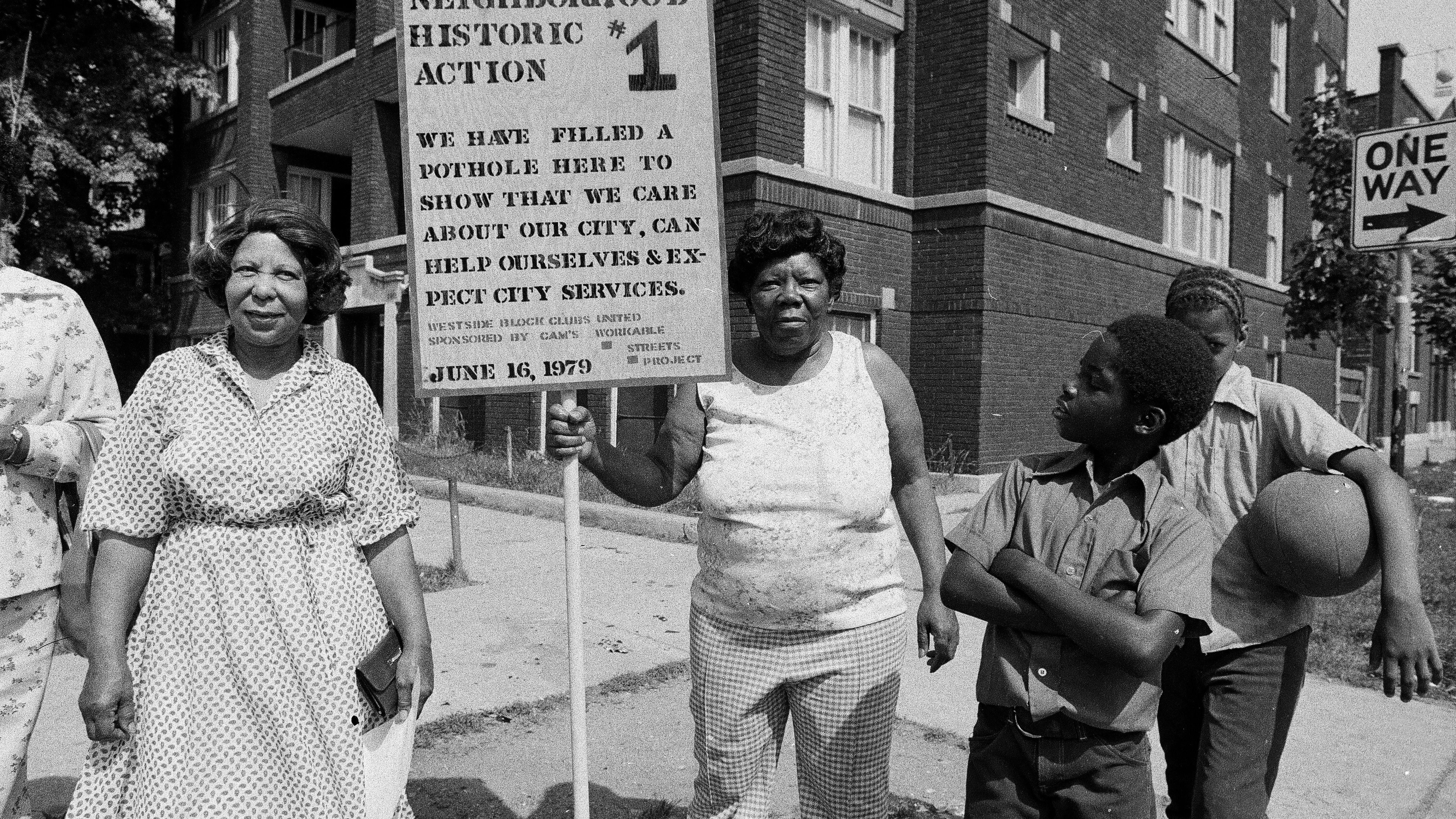
Photo: Chicago Sun-Times/Chicago History Museum.
Block club members at West Van Buren and South Springfield Avenue, Chicago, in 1979.

What a difference a small group of determined individuals can make when they band together!

For example, read what Jewél Jackson reported for WBEZ about people who improved their neighborhood in Chicago by organizing block clubs.

“Helen King sits in her dining room in West Garfield Park. She’s been living in the home for more than 50 years and chuckles at the couch and lampshades covered in plastic.

“ ‘Can you imagine that color if I didn’t have plastic on? All the kids and stuff,’ she asked.

“King raised her children here with her late husband, Harry. She takes pride that her couches are still their original shade of yellow. …

“ ‘Alexa, play Ray Charles,’ she said as she walked over to the kitchen. The music takes her back to summer parties organized by her block club. Neighbors gathered outside for some barbecue and good company. …

“Today, you’ll still see evidence of block clubs in South Side and West Side neighborhoods: colorful signs, often wooden and hand-painted. They might be decorated with flowers and trees, and most tell readers what is allowed or not allowed on the block.

“Block clubs are coalitions of neighbors who volunteer to improve the physical and social conditions of their block. That can range from planting flowers on the parkway to buying abandoned homes in order to increase the neighborhood’s market value. These clubs differ from homeowners associations because they are not legally mandated for residents to participate in or pay fees toward.

“The history of block clubs in Chicago go back to the Great Migration. According to Amanda Seligman, author of Chicago’s Block Clubs: How Neighbors Shape the City, block clubs likely originated in Atlanta. In 1908, Lugenia Burns Hope started the Atlanta Neighborhood Union, where she and a team of mothers worked to bring education and health programs to African American families. It’s often credited as the road map for the Civil Rights Movement and block clubs.

“ ‘[Block clubs] really grew to their mature form in Chicago, especially thanks to the work of the Chicago Urban League,’ said Seligman, who is a professor of history and urban studies at the University of Wisconsin Milwaukee.

“During the early 20th century, over 6 million African Americans left the Jim Crow South for Northern cities like Chicago, Detroit and New York. The Chicago Urban League helped to provide financial and community support, including the formation of block clubs.

“ They wanted to … cultivate local leadership skills and to improve the physical environment that African Americans were living in,’ Seligman said. ‘And also to demonstrate to white organizations and leaders in Chicago that Black people would make good neighbors.’ …

“Helen King is a member of the Westside Block Club Association. When the association leader, Talei Thompson, started the block club, he was told to speak with neighbors and elders like King. She moved to Chicago in the 1950s from Jackson, Mississippi. …

WBEZ
“After you moved to Chicago, what happened?

Helen King
 ”I did get a job, and I kept a job until I eventually retired. I got  married, and my husband and I were able to purchase our own home, something that we picked out, and I’m so pleased with it.

WBEZ
“What were block clubs like when you first bought your home? …

King
We’d meet at each other’s home, once a month. We’d have little refreshments, and if we had issues or if we were planning anything, we would just discuss stuff that was important. I kept track of the funds we took up. …

“It starts with a small group, and then it grows. Back in the day, we’d take the kids on trips, and we’d have cookouts for the kids. We didn’t do an awful lot because we paid very little, $5 or something, nothing much. 

“It starts with a small group, and then it grows. Back in the day, we’d take the kids on trips, and we’d have cookouts for the kids. We didn’t do an awful lot because we paid very little, $5 or something, nothing much. But it was just the idea that everybody owned their own home, so they wanted something.

“If one had a problem, then the next had a problem. We worked together. We all needed and wanted the same things. We wanted success, and we wanted our kids to be safe.”

Read more at WBEZ, here.

Read Full Post »

There are many stories about how people in poor or immigrant communities pull together to help one another when the government doesn’t. Today’s article is about the mutual aid systems of black communities in Canada, the US, and other countries.

Vicky Mochama writes at the Walrus, “There aren’t, compared to Ontario and Quebec, that many Black people in British Columbia: less than one-tenth of the overall Black Canadian population. But, when troubles [strike], official numbers don’t matter. …

“As covid-19 began to take hold, a group of activists and organizers did something that, for Black folks, is as old as time: they started a mutual-aid group.

“ ‘Our community members are likely to be found in the blind spots of the [federal] agencies that are giving out the money,’ says Kevonnie Whyte, one of the group’s organizers. The money the group has collected has gone to Black migrants without permanent residency, Black students stuck in Canada on visas that limit their ability to work, and Black people trapped in the rinse cycle of the gig economy — taxi drivers, delivery couriers, cleaners, and dog walkers.

“The premise of the fund is simple: for the duration of the pandemic, any Black person in BC can apply to get $150 to use for whatever they need. The fund prioritizes Black people who, for whatever reason, don’t get access to government supports like the Canada Emergency Response Benefit. …

“A group of young women in Boston started a mutual-aid drive to get help — cash, food, assistance — to the vulnerable in their community. Students at Pittsburgh’s Carnegie Mellon University started spreadsheets to help people cover basic expenses. … By late May, Whyte says, the Black in BC Mutual Aid collective had raised nearly $20,000 and had disbursed three-quarters of that to over 100 people. …

“Then, in June, everything changed. In the aftermath of the killing of George Floyd, the group received an astounding influx of donations, quintupling their fund in ten days to over $100,000; by early July, they had topped $170,000. …

“Over decades and centuries, mutual aid has helped people pay rent, buy groceries, and acquire medicine; it has given workers something where there is so much nothing to be had, and it has given luckier people a way to help out in desperate times.

“So why weren’t we doing mutual aid before — everybody, all the time? Well, Black people were.

” ‘Mutual aid is not new. It’s a long-standing practice of Black communities. ‘Mutual aid is just something that we’ve always done,’ says Caroline Shenaz Hossein, a professor in York University’s social science department. …

“In the late aughts, Hossein’s research took her to the Caribbean, where she met the ‘banker ladies’: women who ran and participated in money pools. Money pools are deeply familiar to many people from Black diasporas. …

“There’s a magical quality, money appearing as if from nowhere. Depending on where you’re from and who invited you in, the pools have different names: sol (Haiti), susu (Ghana), box hand (Guyana), jama (Kenya), hagbad (Somalia). There are cultural nuances in how you get into one, and the amounts may range, but the principle is almost universally the same — you get out what you put in.

“A typical arrangement might look like this: ten women decide to each contribute $30 a month to a pool, and they each get their turn receiving money from the pool — a $300 cash injection when they do. …

“1932, at the height of the Great Depression, Black people in Gary, Indiana, developed a local economy though mutual aid. ‘The last bank had just pulled out of their neighbourhood. Everybody was unemployed,’ says political economist Jessica Gordon-Nembhard.

“The way she tells it, they didn’t know exactly what to do. Maybe, they thought, we could start a co-op for groceries or just to share what little we do have. Twenty African American families joined a study group; for a year and a half, they met monthly to talk and plan, chaired by a local high school teacher, Jacob L. Reddix, with a passion for cooperative economics. (A cooperative economy is one in which ‘most of the economic activity is organized around cooperative ownership … in a democratic way so that they all participate in decision making about the economic activity,’ Gordon-Nembhard explains.)

“Eventually, they pooled enough money ($24 at first) to buy their groceries in bulk. Next came a credit union. Within five years, the area added a gas station and two branches of a co-op grocery store, and at the school, they began to teach a curriculum on cooperative enterprises.

“In the middle of a depression and despite the continued closure of the steel mills, the Consumer’s Cooperative Trading Company was bringing in $160,000 (US) in sales and had a membership in the hundreds. The title of their agenda — ‘A Five Year Plan of Cooperative Action for Lifting the Economic Status of the Negro in Gary’ — was precise: in good times and bad, the people must prosper with the economy.”

It’s a pretty interesting article. Read more here.

Read Full Post »