Feeds:
Posts
Comments

Posts Tagged ‘organize’

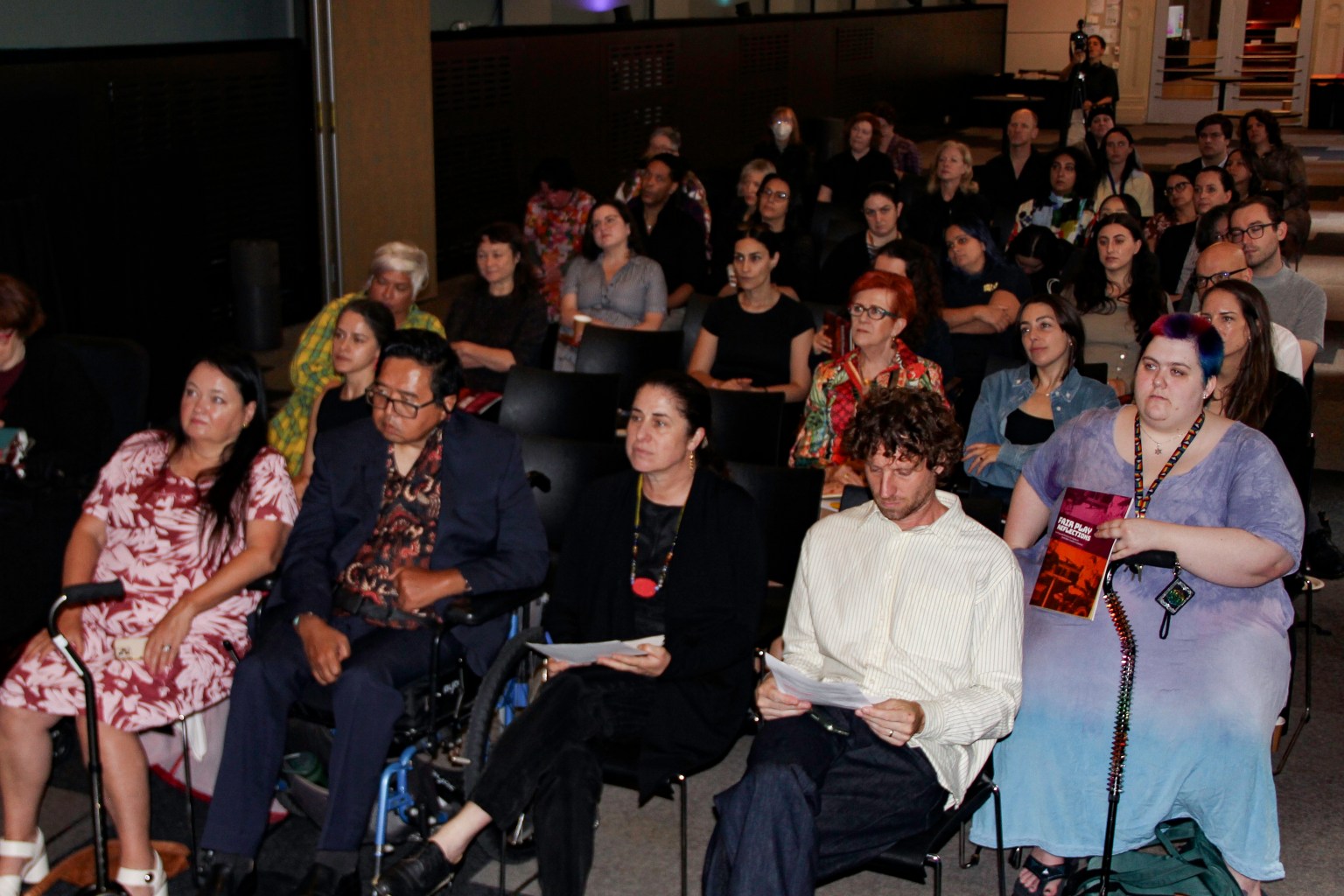
Photo: Mahla Karimian/ArtsHub.
The launch of Diversity Arts Australia’s Fair Play: Equity, Inclusion and the Creative Industries report. Australia supports concepts like diversity, equity, and inclusion.

When I was around seven or eight, I hadn’t had the advantage of being around any children with a disability and didn’t know how to relate to a girl in Sunday school who had a condition like cerebral palsy. I was ignorant. Why did that girl walk like that? Why did she talk so slowly? I felt uncomfortable, and it never occurred to me to wonder how she herself felt about things.

Maybe she liked the same books I liked. Maybe she watched the same tv shows. I never found out. The best I can say for my benighted self is I was horrified when the minister’s daughter made mean comments. Time, experience, and knowing more kinds of people make a big difference.

Today people with different abilities are organizing. From the following report, we learn that creatives with disabilities are making change in Australia.

Sarah-Mace Dennis wrote in March at ArtsHub, “Between 2023 and 2024, the cultural and creative industries contributed $67.4 billion to the Australian economy. Proportionally, audiences with disability attend the arts as much as non-disabled audiences. This means that making these industries accessible for the more than 20% of our population who identify as disabled is an economic imperative. But what will it take to make Australia’s arts and cultural sector truly accessible?

“Established in 2022, the Access Fringe program at the Melbourne Fringe Festival is a 10-year partnership with Arts Access Victoria supporting d/Deaf and disabled artists through commissions, mentorships and specialized development programs. The initiative shows how embedding access into every space and conversation can lead to change across the entire cultural sector.

“At last year’s Access Fringe, Cultural Equity Consultant Caroline Bowditch hosted talks with national and international industry speakers about ‘radical access.’ As she said, ‘Radical Access imagines a radical version of best practice accessibility for the independent arts sector. It moves the conversation beyond the provision of access services into a space of cultural equity.’

“Reimagining ableist practices means understanding the effects of our everyday habitual behaviors and approaching our work with curiosity and care for how we might work together to create change. What becomes possible when we create space for bodies that think and move in different ways?

“Last month’s launch of Diversity Arts Australia’s Fair Play: Equity, Inclusion and the Creative Industries report at Melbourne’s Wheeler Centre shows how sustained, behind-the-scenes work to shift equity and access across the creative industries can create important structural changes.

“The Fair Play program was developed in 2019 to address systemic exclusion in the creative industries for First Nations people, d/Deaf and Disabled people, and artists and arts workers from underrepresented culturally and linguistically diverse backgrounds. Since its launch, it has grown into a national program that supports organizations to unlearn the systemic biases that no longer serve our communities or our creative sector.

“Reaching more than 75 organizations and over 2000 participants through training, mentoring and sector conversations, Fair Play is proof that long-term collaboration and shared learning can ensure that diversity, accessibility and inclusion become an integral part of organizational thinking.

“Speaking at the launch of the report, Fair Play trainer and mentor Kochava Lilit said: ‘A lot of disability justice practices benefit everyone. For people who are tired, who need flexible working arrangements because they are parenting, caring or living with disability and chronic illness.’

“Last year’s Art, Access and the Digital Now symposium at the Fremantle Biennale brought together world leading artists and arts organizations to discuss whether digital technologies such as artificial intelligence are tools for inclusion or exclusion.

“Although the unanimous undercurrent at the symposium was to exercise caution when it came to machine vision, there were many examples of using technology for good too. A clear standout was Scottish dance company Indepen-dance and their use of online and digital tools to enhance accessibility for disabled performers. Another example came from Nat Lim, Director of Singapore’s A11YVerse, who runs a living lab where technology provides opportunities for diverse communities to experiment with new approaches to work and learning.

“Examples like these show that for technology to be accessible, it must be introduced and developed in collaboration with communities – testing, adapting and asking: ‘does this work for you?’ …

“Disability, inclusion and equity consultant Morwenna Collett has devoted much of her career to examining best practice approaches and implementing systems to make creative experiences more accessible. With the support of a Churchill Fellowship and Music Australia, she has travelled the world researching how music festivals and cultural organizations are making real change when it comes to accessibility.

“When I asked Collett how the creative community can work together to make the future more accessible for all Australians she said: ‘I believe we all need to just jump in and start somewhere, seek regular feedback, plan for improvements and connect with each other to keep learning.’ “

Many more examples at ArtsHub, here. No firewall.

Read Full Post »

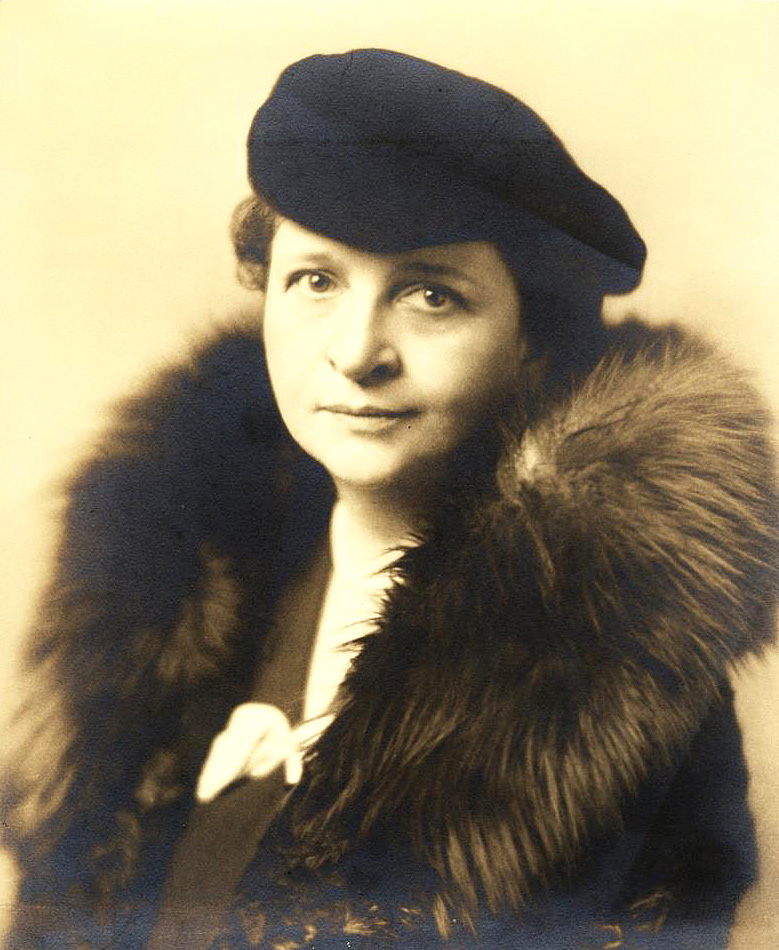
Photo: Frances Perkins Center.
Frances Perkins, President Franklin D Roosevelt’s Secretary of Labor, had more to do with shaping the New Deal than most Americans realize.

A few years ago, someone recommended a book to me, a biography of President Franklin D Roosevelt’s Secretary of Labor. I had heard of Frances Perkins, but until I read that book (see GoodReads, here), I really had no idea what an extraordinary woman she was — and how influential.

For Labor Day this year, I thought I would share what the AFL-CIO has to say about her, while also encouraging you to get a biography out of your library.

“Frances Perkins was secretary of labor for the 12 years of Franklin D. Roosevelt’s presidency and the first woman to hold a Cabinet post. She brought to her office a deep commitment to improving the lives of workers and creating a legitimate role for labor unions in American society, succeeding admirably on both counts. …

“Born in Boston in 1880, Perkins grew up in a comfortable middle-class Republican family descended from a long line of Maine farmers and craftsmen. When Perkins was two, the family moved to Worcester, Mass., where her father opened a profitable stationery business. Her parents were devoted Congregationalists and instilled in Perkins an earnest desire to ‘live for God and do something.’ At Mount Holyoke College … Perkins majored in the natural sciences, but she studied economic history, read How the Other Half Lives, Jacob Riis’s exposé of the New York slums, and attended lectures by labor and social reformers such as Florence Kelley, general secretary of the National Consumers League.

“After graduation from Mount Holyoke in 1902, Perkins accepted a series of teaching positions and volunteered her time at settlement houses, where she learned firsthand the dangerous conditions of factory work and the desperation of workers unable to collect their promised wages or secure medical care for workplace injuries. By 1909, she had given up teaching science and moved to New York to study at Columbia University, where she earned a master’s degree in economics and sociology in 1910. For the next two years, she served as secretary of the New York Consumers League; working closely with Florence Kelley, she successfully lobbied the state legislature for a bill limiting the workweek for women and children to 54 hours. …

“One of the pivotal experiences of her political life occurred in 1911, when she watched helplessly as 146 workers, most of them young women, died in the Triangle Shirtwaist fire.

Many, she remembered, clasped their hands in prayer before leaping to their deaths from the upper-floor windows of a tenement building that lacked fire escapes.

“It was, as Perkins later explained, ‘seared on my mind as well as my heart — a never-to-be-forgotten reminder of why I had to spend my life fighting conditions that could permit such a tragedy.’

“During these years, Perkins also witnessed the widespread labor upheavals among garment and other New York City workers and learned from friends such as labor leader Rose Schneiderman the one-word solution to poverty: organize. …

“In 1918, Perkins accepted Gov. Al Smith’s invitation to join the New York State Industrial Commission, becoming the first female member of the commission. In 1926, she became chairwoman of the commission, and then, in 1929, the new governor, Franklin D. Roosevelt, appointed Perkins industrial commissioner of the state of New York, the chief post in the state labor department. Having earned the cooperation and respect of a wide range of political factions, Perkins, ever the master deal-maker, helped put New York in the forefront of progressive reform. She expanded factory investigations, reduced the workweek for women to 48 hours and championed minimum wage and unemployment insurance laws.

“When Roosevelt tapped her as labor secretary in 1933, Perkins drew on the New York State experience as the model for new federal programs. She put every ounce of her formidable energy into weaving a safety net for a Depression-scarred society, securing a remarkable array of benefits for American workers. … Her vision found concrete expression in such landmark reforms as the Wagner Act, which gave workers the right to organize unions and bargain collectively, and the Fair Labor Standards Act, which established for the first time a minimum wage and a maximum workweek for men and women. Perkins also chaired the Committee on Economic Security, which developed and drafted the legislation that became the Social Security Act in 1935.

“As secretary of labor during the 1930s and early 1940s, Perkins played a crucial role in the outcome of the dramatic labor uprisings that marked the era. She consistently supported the rights of workers to organize unions of their own choosing and to pressure employers through economic action. In one famous incident captured in a widely circulated newspaper photo, an indomitable Perkins strides toward the U.S. post office in Homestead with thousands of steelworkers trailing behind her. Denied a meeting hall by the mayor and steel executives, Perkins found an alternative site where she could inform the workers directly of their collective bargaining rights. It was also the unflappable Perkins who advised President Roosevelt to ignore the pleadings of state and local officials for federal troops to quell the 1934 San Francisco General Strike. The successful resolution of that strike as well as countless others during her tenure as labor secretary laid the foundation for the rebirth of American labor. …

“In 1945, Perkins resigned from her position as labor secretary to head the U.S. delegation to the International Labor Organization conference in Paris. President Truman subsequently appointed her to the Civil Service Commission, a job she held through 1953. In the last years of her life, Perkins assumed a professorship at Cornell University’s School of Industrial and Labor Relations. She died in New York at the age of 85 and was buried in her family’s plot in New Castle, Maine.”

More at the AFL-CIO, here.

Read Full Post »