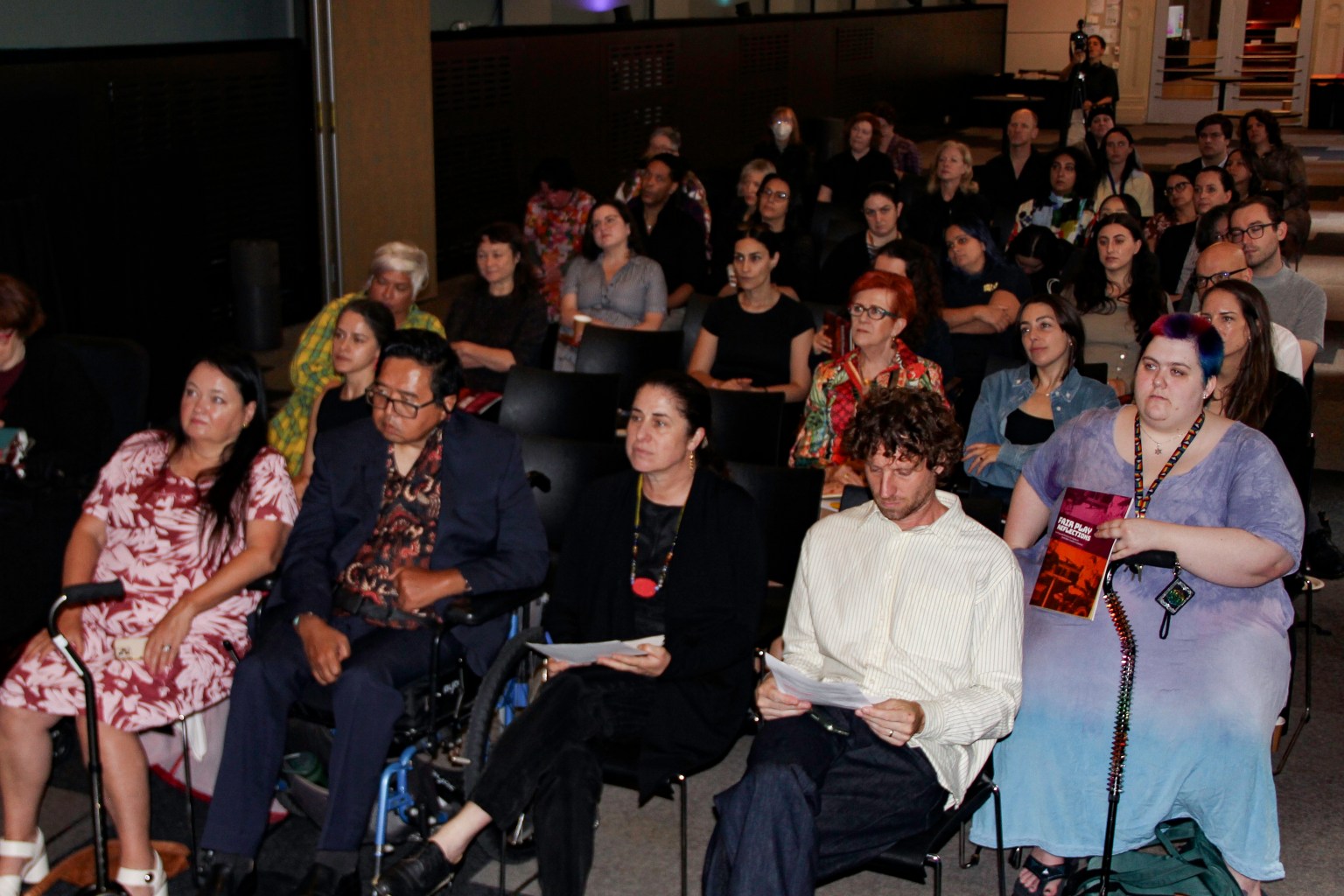
Photo: Mahla Karimian/ArtsHub.
The launch of Diversity Arts Australia’s Fair Play: Equity, Inclusion and the Creative Industries report. Australia supports concepts like diversity, equity, and inclusion.
When I was around seven or eight, I hadn’t had the advantage of being around any children with a disability and didn’t know how to relate to a girl in Sunday school who had a condition like cerebral palsy. I was ignorant. Why did that girl walk like that? Why did she talk so slowly? I felt uncomfortable, and it never occurred to me to wonder how she herself felt about things.
Maybe she liked the same books I liked. Maybe she watched the same tv shows. I never found out. The best I can say for my benighted self is I was horrified when the minister’s daughter made mean comments. Time, experience, and knowing more kinds of people make a big difference.
Today people with different abilities are organizing. From the following report, we learn that creatives with disabilities are making change in Australia.
Sarah-Mace Dennis wrote in March at ArtsHub, “Between 2023 and 2024, the cultural and creative industries contributed $67.4 billion to the Australian economy. Proportionally, audiences with disability attend the arts as much as non-disabled audiences. This means that making these industries accessible for the more than 20% of our population who identify as disabled is an economic imperative. But what will it take to make Australia’s arts and cultural sector truly accessible?
“Established in 2022, the Access Fringe program at the Melbourne Fringe Festival is a 10-year partnership with Arts Access Victoria supporting d/Deaf and disabled artists through commissions, mentorships and specialized development programs. The initiative shows how embedding access into every space and conversation can lead to change across the entire cultural sector.
“At last year’s Access Fringe, Cultural Equity Consultant Caroline Bowditch hosted talks with national and international industry speakers about ‘radical access.’ As she said, ‘Radical Access imagines a radical version of best practice accessibility for the independent arts sector. It moves the conversation beyond the provision of access services into a space of cultural equity.’
“Reimagining ableist practices means understanding the effects of our everyday habitual behaviors and approaching our work with curiosity and care for how we might work together to create change. What becomes possible when we create space for bodies that think and move in different ways?
“Last month’s launch of Diversity Arts Australia’s Fair Play: Equity, Inclusion and the Creative Industries report at Melbourne’s Wheeler Centre shows how sustained, behind-the-scenes work to shift equity and access across the creative industries can create important structural changes.
“The Fair Play program was developed in 2019 to address systemic exclusion in the creative industries for First Nations people, d/Deaf and Disabled people, and artists and arts workers from underrepresented culturally and linguistically diverse backgrounds. Since its launch, it has grown into a national program that supports organizations to unlearn the systemic biases that no longer serve our communities or our creative sector.
“Reaching more than 75 organizations and over 2000 participants through training, mentoring and sector conversations, Fair Play is proof that long-term collaboration and shared learning can ensure that diversity, accessibility and inclusion become an integral part of organizational thinking.
“Speaking at the launch of the report, Fair Play trainer and mentor Kochava Lilit said: ‘A lot of disability justice practices benefit everyone. For people who are tired, who need flexible working arrangements because they are parenting, caring or living with disability and chronic illness.’
“Last year’s Art, Access and the Digital Now symposium at the Fremantle Biennale brought together world leading artists and arts organizations to discuss whether digital technologies such as artificial intelligence are tools for inclusion or exclusion.
“Although the unanimous undercurrent at the symposium was to exercise caution when it came to machine vision, there were many examples of using technology for good too. A clear standout was Scottish dance company Indepen-dance and their use of online and digital tools to enhance accessibility for disabled performers. Another example came from Nat Lim, Director of Singapore’s A11YVerse, who runs a living lab where technology provides opportunities for diverse communities to experiment with new approaches to work and learning.
“Examples like these show that for technology to be accessible, it must be introduced and developed in collaboration with communities – testing, adapting and asking: ‘does this work for you?’ …
“Disability, inclusion and equity consultant Morwenna Collett has devoted much of her career to examining best practice approaches and implementing systems to make creative experiences more accessible. With the support of a Churchill Fellowship and Music Australia, she has travelled the world researching how music festivals and cultural organizations are making real change when it comes to accessibility.
“When I asked Collett how the creative community can work together to make the future more accessible for all Australians she said: ‘I believe we all need to just jump in and start somewhere, seek regular feedback, plan for improvements and connect with each other to keep learning.’ “
Many more examples at ArtsHub, here. No firewall.


I think many of us have similar stories about when, in our youth, we met someone with a disability. Good to read about the organizational efforts in Australia.
LikeLiked by 1 person
Yes, they are impressive and will affect movements elsewhere, I think.
LikeLiked by 1 person