Feeds:
Posts
Comments

Posts Tagged ‘sicily’

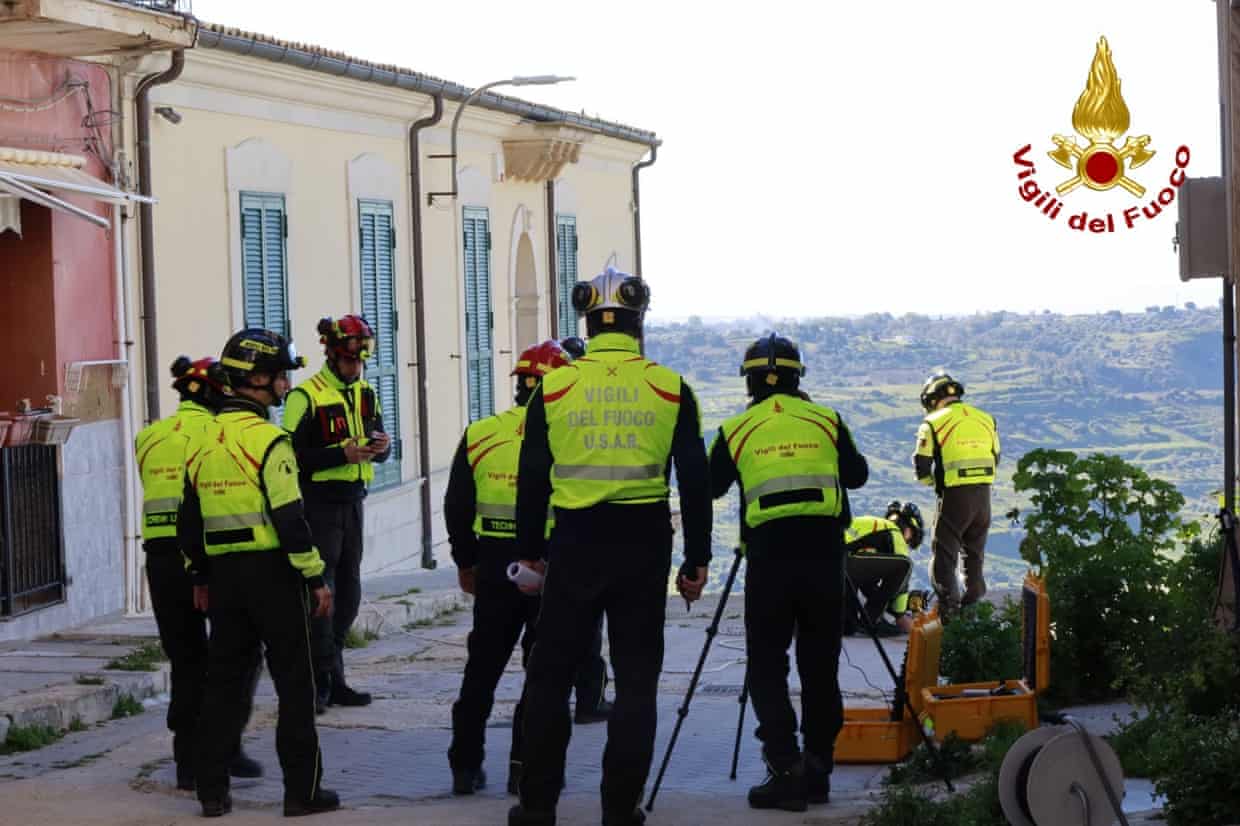
Photo: Sicilian Unit of Firefighters.
Firefighters recovered 350 volumes from a library on the edge of a cliff after a January landslide in Sicily tore away an entire slope of town and carved a chasm.

I wonder if firefighters are taught “Don’t look down.” Being a little acrophobic myself, I can hardly imagine how the book rescuers in today’s story kept from getting dizzy. People I know get dizzy just looking at their feet.

Lorenzo Tondo wrote at the Guardian about the mission.

“Firefighters in Sicily have rescued about 400 rare books from a library in Niscemi that hangs on the edge of a mudflow,” Tondo said, “after a devastating landslide in January tore away an entire slope of the town and carved a [2-mile] chasm.

“The library stands on the lip of the precipice gouged out by the landslide, with part of the building in effect hanging in mid-air. The recovery operation … was preceded by a detailed study of floor plans and interior photographs to map the position of the books.

“Firefighters drilled through the wall of a building behind the structure and, entering for minutes at a time, strapped the bookcases together and hauled them backwards to reach the books.

“The library holds about 4,000 books of literature, history and general nonfiction, including a number of rare editions dating from before 1830 on Sicilian history. Among its most precious treasures is a 16th-century book.

“ ‘It was like pulling off a bank heist,’ said Salvatore Cantale, the provincial commander of the fire brigade in Caltanissetta. ‘We had to be quick and try to take away as much as we could.’

“A drone streamed live aerial images to a monitor on the ground, while laser sensors fixed to the section teetering over the drop were used to detect the slightest movement. A separate device monitored vibrations and subtle shifts in the building’s tilt.

“The landslide began on 25 January when the ground started to shift, cracking asphalt and tearing through buildings. Some later collapsed into the void, along with a stretch of road where cars and vans had been parked. More than 1,600 people have been evacuated from the town.

“Many of the volumes remain in the basement, which is considered the most at-risk area. Officials are weighing up the use of robots, though none suitable are available in Niscemi. … Cantale said, ‘The problem is that this building is effectively a single reinforced-concrete structure. If it collapses, it will go all at once.’

“Cantale said the geologists working next to the firefighters expected the landslide’s front to retreat by another 10 to 15 metres, dragging further buildings down the slope with it, including the library.

“He said: ‘According to the geologists, rather than crumbling, the library is more likely to slide downhill as a single block. If that happens, we have already assessed that it may actually be easier to recover the remaining books once it has fallen.’ “

More at the Guardian, here.
Read Full Post »

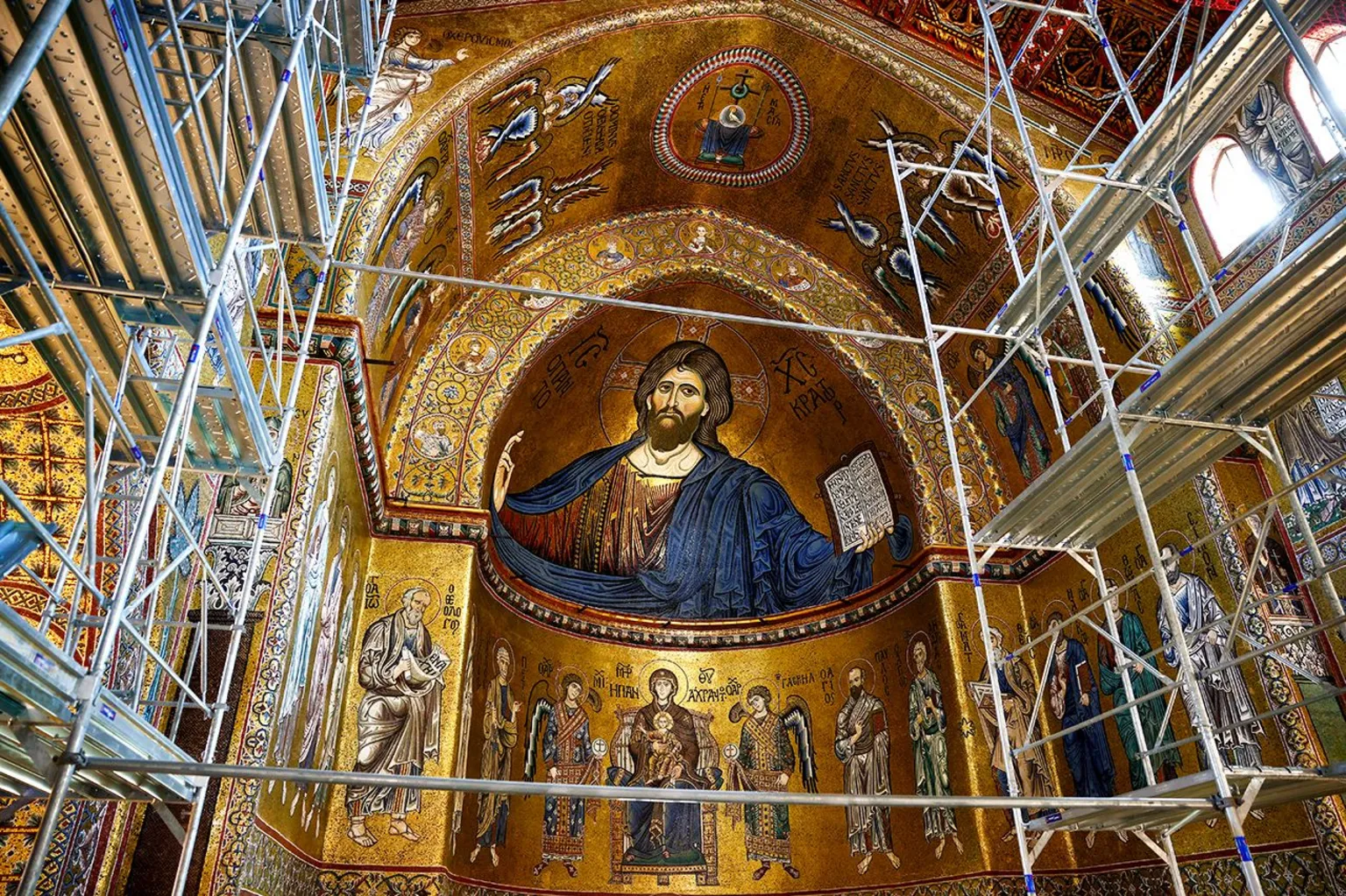
Photo: Reuters.
The Monreale cathedral was declared a Unesco World Heritage Site in 2015, and has recently undergone extensive restoration.

Some organized religions eschew signs of wealth and pomp. For others, such things emphasize the value they put on their faith. I always like hearing about the individual stonemasons who gave their heart and soul to carving small corners of the great cathedrals, but I have mixed feelings about covering churches in gold, however beautiful. I was not part of the fundraising for my church’s dome, which one member paid to gild, covering the sky-blue paint.

All to say that an extraordinary amount of gold is now drawing tourists to a cathedral in Sicily, a UNESCO World Heritage site.

The BBC’s Sara Monetta writes, “On a hill overlooking the city of Palermo, in Sicily, sits a lesser-known gem of Italian art: the cathedral of Monreale. Built in the 12th century under Norman rule, it boasts Italy’s largest Byzantine-style mosaics, second in the world only to those of Hagia Sophia in Istanbul.

“Now, this Unesco World Heritage site has undergone an extensive restoration to bring it back to its former glory. The Monreale mosaics were meant to impress, humble and inspire the visitor who walked down the central nave, following the fashion of Constantinople, the capital of the surviving Roman empire in the east.

“They span over [69,000 square feet] and contain about [4.6 pounds] of solid gold. …

“Local experts from the Italian Ministry of Culture led a series of interventions, starting with the removal of a thick layer of dust that had accumulated on the mosaics over the years. Then they repaired some of the tiles that had lost their enamel and gold leaf, making them look like black spots from down below. Finally, they intervened in the areas where the tiles were peeling off the wall and secured them.

“Working on the mosaics was a challenge and a big responsibility, says Father Nicola Gaglio. He has been a priest here for 17 years and has followed the restoration closely, not unlike an apprehensive dad.

” ‘The team approached this work almost on their tiptoes,’ he tells me. ‘At times, there were some unforeseen issues and they had to pause the operations while they found a solution. For example, when they got to the ceiling, they realized that in the past it had been covered with a layer of varnish that had turned yellowish. They had to peel it off, quite literally, like cling film.’

“The mosaics were last partly restored in 1978 , but this time the intervention had a much wider scope and it included replacing the old lighting system.

” ‘There was a very old system. The light was low, the energy costs were through the roof and in no way it made justice to the beauty of the mosaics,’ says Matteo Cundari. He’s the Country Manager of Zumtobel, the firm that was tasked with installing the new lights. …

“I ask Fr Gaglio what it was like to see the scaffolding finally come off and the mosaics shine in their new light. He laughs and shrugs.

” ‘When you see it, you’re overwhelmed with awe and you can’t really think of anything. It’s pure beauty,’ he says. ‘It’s a responsibility to be the keeper of such world heritage. This world needs beauty, because it reminds us of what’s good in humanity, of what it means to be men and women.’ “

More at the BBC, here. No firewall.

Read Full Post »

Photo: Case 1-Euro.
A small town in Sicily decided to sell decrepit houses for almost nothing to see if someone would fix them up. It’s certainly bringing in more curious visitors.

Sometimes getting something for nothing may cause a recipient to be careless with the gift, as in a story I read a few years ago about a guy who built and donated a home to a homeless woman who let it run to ruin.

Other times, wonderful things happen.

Harrison Jacobs writes at the Washington Post, “If someone said you could buy a house for a dollar, your reaction might be disbelief. That was how Rubia Andrade felt when she read a news article in 2019 about towns in Italy selling properties for one euro.

“ ‘Obviously, your first thought is that this can’t be true. I needed to see it in person,’ said Andrade, a Brazilian American who works in California’s solar industry.

“Andrade booked a flight three days later and drove to Mussomeli, Italy, a hilly town in central Sicily with about 11,000 residents that had recently launched a program selling hundreds of properties in the run-down historical center. …

“The 1-euro housing program was first proposed over a decade ago by TV personality Vittorio Sgarbi. Then the mayor of Salemi in southern Sicily, Sgarbi proposed the idea as a way to save the town’s crumbling old quarter. The idea has since caught on in 34 municipalities across Italy.

“But it was only in the past few years that it captured the global imagination when articles about towns launching similar programs on the island went viral. …

“While some houses sold through these programs are livable upon purchase, most are little more than four medieval-era walls. Roofs are caved in, and floors are torn up. Many are filled with dead pigeons or other vermin. Prospective buyers who haven’t done research are usually surprised by the conditions, said Toti Nigrelli, the deputy mayor of Mussomeli.

‘We tell people to come here first because we don’t want any surprises. We want them to know what they are getting into.’ …

“Though the official cost is 1 euro (around $1.14), fees and closing costs can typically run up to 3,500 euros (or almost $4,000). Then, you are required to renovate it within a designated time frame — typically three to five years — or forfeit a sizable deposit, usually around 5,000 euros (or $5,709). According to Nigrelli, towns use the deposit to ward off speculators and ensure buyers renovate the properties instead of letting them sit. Renovations cost anywhere from 5,000 to 100,000 euros, depending on the house’s size and condition and the renovation style. Most end up spending 20,000 euros to 40,000 euros, Nigrelli said.

“None of those complications deterred Andrade. She initially purchased a 1-euro property and returned that summer to renovate. Since then, she has bought two more and become an evangelist, returning every few months with friends, family and even Facebook acquaintances to help them with the purchasing process.

“ ‘Even with the fees and the cost of the renovation, it costs less than a timeshare in the U.S.,’ Andrade said.

“While Andrade first saw the 1-euro program as a cheap way to own a vacation home, she now has bigger plans: to help revive the town. Andrade and her son are converting their three properties into an art gallery, a wellness center and a restaurant. She plans to move to Mussomeli permanently.

“She’s far from the only one. Danny McCubbin is one of about a dozen foreigners who bought 1-euro houses in Mussomeli and now lives there full-time. McCubbin, an Australian who worked for celebrity chef Jamie Oliver for 17 years, bought a 1-euro house with the intention of converting it into a community kitchen to provide meals to vulnerable people. He crowdfunded over $30,000 last March for the project.

“Complications due to the pandemic delayed renovations, but he has since purchased an 8,000-euro house to live in and rented a storefront in Mussomeli’s piazza.

“Since launching the Good Kitchen this summer, McCubbin has become an unofficial ambassador for the 1-euro program. …

‘“The townspeople thought I was opening a restaurant. They didn’t understand the concept,’ McCubbin said. After he partnered with local charities to host picnics and baking parties for orphans and those dealing with mental health issues, locals got the idea.”

More at the Post, here.

Read Full Post »

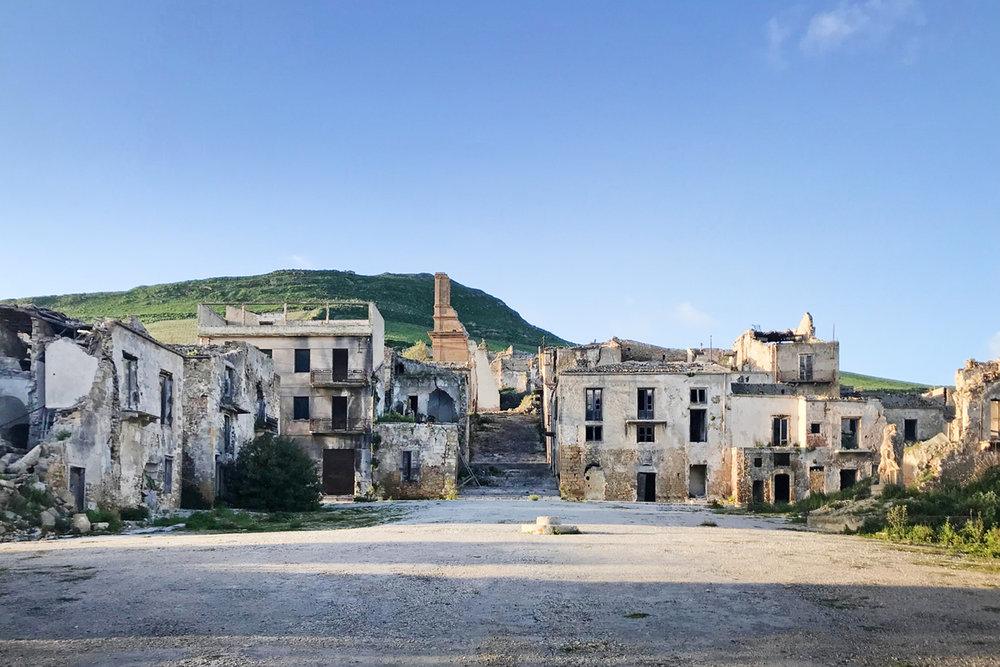
6Photo: Fondazione Manifesto
Poggioreale, Sicily, one of the towns destroyed by a 1968 earthquake. A public art project has helped to heal the region’s survivors, many of whom were still suffering from depression decades later.

I’ve blogged a lot about the healing power of various arts in various contexts, but I think this is the first post about what art can do for a traumatized region after a natural disaster. The story takes place in Sicily, where a 1968 earthquake flattened an already impoverished region.

Patricia Zohn writes at artnet news, “On a recent day this summer, I [descended] into the rural, arid Belice Valley. I was accompanied by Zeno Franchini of the Fondazione Manifesto, an advocacy group that leads tours of the region, which was devastated by the 1968 earthquake in Sicily. …

“More than the number of people who died (approximately 400), or the number rendered homeless (approximately 100,000), the earthquake exposed grave fissures in the socioeconomic and political fabric of one of Italy’s poorest regions — disparities that linger to this day.

“While thousands of earthquake victims lived outside Gibellina, an isolated agricultural community, in two shanty towns with barebones infrastructure, in 1970, the National Institute of Social Housing in Rome, determined, after numerous plans for reconstruction were abandoned, to build an entirely new city, a Gibellina ‘Nuova’ for the victims at a site 11 miles from the ruins. …

“By 1979, scant progress had been made due to government corruption, the Mafia influence, and red tape, and victims were still living in dire conditions. That’s when Gibellina’s flamboyant, powerful gay Mayor, Ludovico Corrao, invited a number of leading Italian and German artists and architects to participate in a rescue mission. …

“Though there was no budget for art or culture, Corrao had already begged and borrowed to found the Orestiadi performance festival, just outside the ruins of Gibellina, with the help of performers like John Cage and Philip Glass. Emilio Isgrò, an artist and dramatist, described a wind-chilled night of 1983

‘where artisans, sheep farmers, housewives, anti-Mafia judges and theater directors and personalities from all over Europe sat together to watch’ his performance in the festival. …

“The concrete Utopian city of Gibellina Nuova [became] an open-air laboratory for assessing the healing capabilities of public art. Today, 50 years since the earthquake struck, many look back on Corrao’s radical experiment in civic engagement, rehabilitation, and unification as a cautionary tale. But new efforts are now underway to realize a more pragmatic version of [his] utopian dream.

“ ‘The city needs to really become an Art Town,’ says Alessandro La Grassa, president of the Center for Social and Economic Research of Southern Italy, the organizational heir to the early activist efforts. He envisions it as a place ‘where artists live or stay and where empty buildings and spaces start to find a new function.’ …

“Today the region is a symbol of hope. A newly revitalized combination of social activists, municipal agencies, educational institutions, and private support is finally bringing the unique art interventions of more than five decades in the Belice Valley — and especially the city of Gibellina — to the attention of a wider public. …

“Tours of Poggioreale, Burri’s Cretto, and Gibellina Nuova are available until November 14 through fondazionemanifesto.org.” More here.

I wonder how public art might by employed to rebuild after a hurricane like Michael. Something for art leaders in Florida to think about.

Read Full Post »