Feeds:
Posts
Comments

Posts Tagged ‘Notre Dame’

Photo: AP Photo/Nicolas Garriga.
A  restoration project at Notre Dame Cathedral is uncovering evidence of daily life from centuries of Parisian history.

Today’s story is about the city of Paris deciding to put a shaded plaza in front of Notre Dame Cathedral. It’s also about the need to first uncover any artifacts that may be buried in the space, and right now a dig is focused on Roman artifacts.

(I must say, when I read phrases like, “as the Roman empire collapsed,” I wonder if the Romans refused to believe that collapse could ever happen. Maybe there’s a lesson for us.)

Thomas Adamson writes at the Associated Press, “Wilting in the summer sun, a line of tourists waits to climb Notre Dame cathedral and meet its gargoyles.

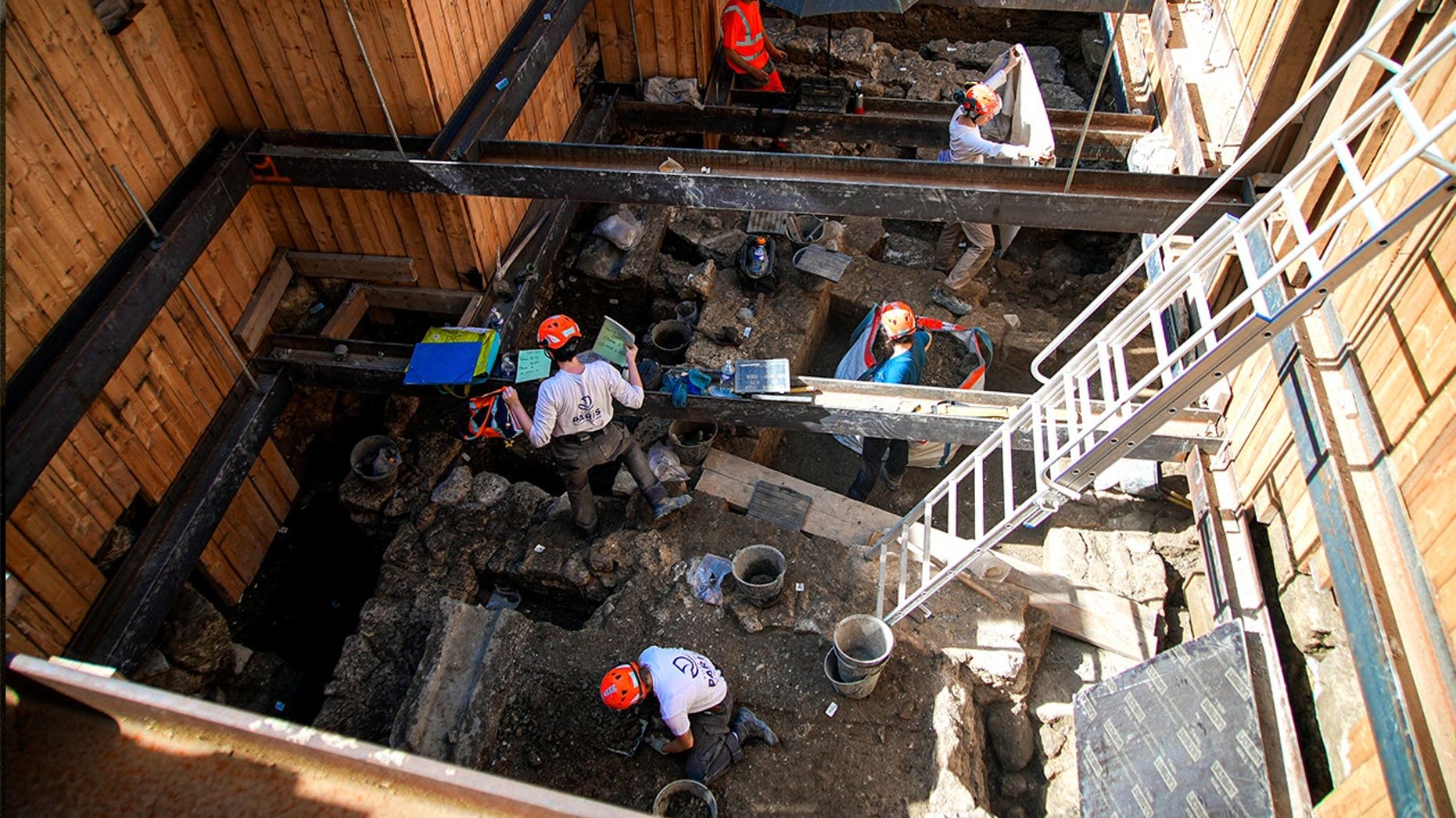
“Four meters (13 feet) beneath them, a team of archaeologists is digging the other way — straight down and back in time, to Roman Paris 2,000 years ago.

“In 2019, fire brought Notre Dame’s spire crashing down as the world watched. The cathedral was rebuilt and reopened in late 2024, and now Paris wants to soften the hot, bare square in front of it with trees and shade. But in a city this old, the soil cannot be turned until what lies beneath it is excavated, in case it is damaged during works.

“So a slice of Notre Dame’s forecourt has become an excavation site — an open pit ringed by barriers and crossed by a wooden walkway, a few steps from the line-up.

“French media have dubbed it the ‘dig of the century.’

“ ‘It’s a rare opportunity for us to work on something that’s tangibly going to make a difference to the history of Paris,’ Lucie Altenburg, a conservator with the Paris archaeology unit, told the Associated Press.

“Among the hundreds of objects already found: a fourth-century coin stamped with the face of the Emperor Constantine, and shards of medieval pottery painted on the inside with marks no expert has yet deciphered — like a modern Da Vinci Code. …

“This is the bargain in every old city: The past is not in a museum down the street — it is under the street. Cities rise. Each age builds on the rubble of the last, and the ground climbs with it; in Rome, it has risen about 9 meters (30 feet) since the empire fell in the fifth century AD. …

“At the cathedral’s birth in 1163, the entire square was packed with medieval houses, split by a single street, said Camille Colonna, the archaeologist leading the dig.

“Digging down, her team has reached their cellars — and therefore also the time in history they represent.

“Below them lie Merovingian and Carolingian grain pits, from the sixth to the 10th centuries; below those, darker and deeper still, a dense Roman quarter from the fourth and fifth centuries.

“Twenty centuries are stacked in 4 meters (13 feet) of earth. …

“The richest finds here come from the foulest place: the deep pits beneath the medieval houses, old latrines that doubled as rubbish dumps. Out of them the team keeps lifting whole jugs and cups — thrown away centuries ago, yet still intact — among the broken plates and animal bones.

“It’s ‘rare to find complete ceramics,’ said Valentine Breloux, an archaeologist with the unit. Here the soft waste cushioned them. … Then some other objects came that confounded experts. As conservators cleaned what looked like ordinary medieval pottery, they found faint reddish writing painted on the inside — the same mysterious markings on shard after shard.

“What they mean has yet to be deciphered. Of everything she has cleaned from Notre Dame, Breloux said, these are the most ‘astonishing.’

“The coins came up as black discs, eaten by rust. But under an X-ray, a face returned: it was Constantine, the Roman emperor who ruled in the early 300s AD. Such objects also ‘can be invaluable in giving us the date of the (underground) layer,’ Altenburg said.

“The Roman finds are the ones the archaeologists value most — the deepest, oldest and least understood. In Roman times, the town was called Lutetia, and its center lay across the river, on the Left Bank.

“As the Roman empire collapsed, people pulled back to the Ile de la Cite, where Notre Dame would later rise, and fortified the island with walls of stone taken from earlier buildings.

“Colonna’s team found some proof: a Roman doorstep found in the dig, taken from a much bigger building, carried over, turned upside down, and laid in a road as paving. …

“For archaeologists, the cathedral dig is a rare treat. In France, like elsewhere, they work only where building work is about to begin — a bit like how industrial quarry workers end up unearthing dinosaur remains. …

“The new square should be mostly finished by 2028: a kind of woodland clearing, with 160 new trees and a thin film of water sliding over the stone to cool it in summer — part of how Paris is bracing for ever hotter summers induced by global warming. …

“Until then, the Notre Dame team wants to go deeper still — past the Romans, toward whoever came before them, the Gauls who gave the city its first name.”

More at AP, here.

Read Full Post »

Photo: AP/Jeff Dean.
Gargoyles at the Cathedral Basilica of the Assumption in Covington, Kentucky.

What I love about gargoyles is that they sort of give permission to fantasy.

When we say that something isn’t carved in stone, we mean it isn’t necessarily going to be part of our lives, not even real for very long. But with gargoyles, people’s worst imaginary fears are in fact carved in stone. A recognition that things unseen may be very real to us.

Peter Smith at AP writes that a cathedral in Kentucky has been brushing up its gargoyles.

“Gargoyles have watched over this small Kentucky city for more than a century from their lofty perches on a cathedral known as ‘America’s Notre Dame.’ A new renovation will ensure they keep their posts for years to come on the meticulously restored facade of the towering stone sanctuary.

“Workers in recent weeks have been installing new terra cotta gargoyles as one of the final steps of a major, two-year restoration of the Cathedral Basilica of the Assumption. The Catholic cathedral’s nickname stems from how its exterior was modeled on the larger Notre Dame Cathedral in Paris — from the pointed arches and flying buttresses to the gargoyles and chimeras with their reptilian grins and piercing, canine eyes. …

“The Covington cathedral needed a rehab due to the slow deterioration of old stone, metal and terra cotta after 125 years of exposure to the elements in its Ohio River city across from Cincinnati.

“ ‘We consider ourselves blessed to be able to ensure the cathedral is taken care of for coming generations,’ said Assumption’s rector, the Very Rev. Ryan Maher.

“Workers have been painstakingly repairing and replacing tons of Indiana limestone. The new gargoyles are replicas based on meticulous scans of the 32 worn originals. … The finishing touch will be the installation of new 26 chimeras along the rooftop. These grotesque creatures, similar to gargoyles, are exact replicas of their weathered predecessors. …

“Workers have faced numerous challenges throughout the project: hoisting and fitting heavy stones into the façade while operating cranes above a busy street in the heat, cold and wind. They have been patching and fixing what they can and replacing other parts entirely.

“ ‘It’s an art and a science that’s passed down from generation to generation’ [said Brian Walter, executive vice president of Trisco Systems, the prime contractor for the restoration]. ‘Every part of it is challenging.’ …

“Over the generations, the cathedral has had several renovations and overhauls, with exterior statues added in 2019. But Maher knew a comprehensive exterior renovation was needed when, in 2018, he found a large, fallen piece of stone — evidence of a wider deterioration. This time, workers used more durable stainless steel pins and brackets to secure the stone and replace the original carbon steel, which had rusted.

“The cathedral opened in 1901, following a multiyear construction campaign by the Belgian-born Bishop Camillus Paul Maes, head of the Diocese of Covington and an adm”irer of the French Gothic style. …

“The ambition was striking, cathedral historian Stephen Enzweiler said. The city then had just over 40,000 people, similar to its population today. ‘At the time, no one had ever heard of Covington,’ Enzweiler said.

“Maes wanted a sanctuary large enough to accommodate the rapidly growing immigrant Catholic population. … The cathedral was part of a larger Gothic revival happening around the turn of the century that also saw the emergence of such landmark cathedrals as St. Patrick’s and St. John the Divine in New York.

“ ‘This is a smaller version of that revival of French Gothic in America, done at a very high level in a little town at the time, of surprisingly high quality,’ said Duncan Stroik, an architect, professor of architecture at the University of Notre Dame and author of The Church Building as a Sacred Place: Beauty, Transcendence and the Eternal.

“ ‘It shows the talent of the bishop, the architect and the craftsmen,’ he said. …

“Theories vary about the medieval intent behind the gargoyles. Were they to ward off evil spirits? Did they represent the demonic realm outside the sanctuary of the church? Were they allegorical figures for morality lessons? Or simply the imaginative fruits of medieval craftsmen?”

Permission to imagine.

More at AP, here. No firewall.

Read Full Post »

Photo: Patrick Zachmann/Magnum Photos.
The real miracle: Reconstructing the intricate wood frame of Notre Dame’s roof.

When the unthinkable happens to a beloved cultural icon, what’s next? In the days and weeks after the great fire of Notre Dame Cathedral broke hearts around the world, plans began to take shape.

Joshua Hammer writes at GQ, “Some time after six in the evening on April 15, 2019, Rémi Fromont was sitting at the Brasserie Saint-Malo, a lively café in Montparnasse, Paris, when his phone rang.

“ ‘Notre-Dame is on fire,’ ” said a friend on the other end of the line. … Fromont leapt out of his chair, got on his bike, and pedaled north toward the cathedral. …

“About an hour after his arrival, Fromont, with thousands of Parisians at the scene and millions watching around the world, looked on as the 750-ton spire, made of 1,230 oak beams, blazed, teetered, snapped like a matchstick, and crashed through the roof. Spectators broke into tears of disbelief and horror. …

“The day after the fire, French president Emmanuel Macron made a promise: Notre-Dame would rise again in the next five years.  …

“None of the many priceless paintings, sculptures, and windows that filled the church’s interior — though they were stained by smoke and singed by fire — had been wrecked beyond repair. …

“The roof frame was a different story. Known in French as the charpente, it was an ingenious assemblage of triangular-shaped trusses, each one consisting of horizontal and vertical beams and diagonal rafters designed to support the heavy roof cover and distribute the weight over the walls beneath it. Built from thousands of pieces of wood and assembled without nails, it was a singular achievement, one of the oldest surviving all-wood structures in the world. …

“During World War I, German artillery shells had reduced the cathedral in Reims, another Gothic masterpiece, to charred wood and rubble. In 1919, the architect Henri Deneux launched the restoration, reconstructing the church’s roof with reinforced concrete, a decision that was controversial at the time.

“Fromont had not warmed to Deneux’s approach. He believed that the roof’s charpente could be rebuilt exactly as the medieval carpenters had done it. The approach was not without risks — Fromont had told me, ‘Wood burns. I’m not going to say the opposite’ — but certain measures could be put into place to mitigate its vulnerability.  …

“The roof’s charpente was perhaps [Notre Dame’s medieval woodworkers’] greatest creation. Yet Fromont told me that, until recently, it had never been the subject of serious scholarly study. …

“In 2012, Fromont, then a 35-year-old scholar at Paris’s École de Chaillot, decided to address that absence. For his advanced degree, Fromont proposed spending a year surveying every inch of the charpente. When they were at last granted permission, he and his partner on the project, Cédric Trentesaux, entered the cathedral’s south transept and climbed a winding staircase into the triangular south gable. There they squeezed through an aperture and entered a medieval realm barely visited in over 800 years. …

“The two men emerged from the project with the most extensive blueprint of the 800-year-old structure that had ever been created. ‘It wasn’t a lot, but it was enough,’ Fromont said. …

“There was some skepticism that the charpente could be re-created in its original glory, but Fromont found an ally in François Calame, France’s leading apostle of traditional carpentry. In the early 1990s, as a young carpenter, Calame had visited Maramures‚ a remote region in western Romania. Isolated from a fast-changing world during Nicolae Ceausescu’s 24-year dictatorship, artisans there had kept the old ways of carpentry alive.

“Like in Romania, traditional French axmen used hand tools: the hache de grossière, a long-handled, narrow-bladed axe used to remove large amounts of wood, and the doloire, a broad-bladed, short-handled axe designed for precision chipping following the grain of the wood. It’s slow and physical work: Squaring lumber by hand can take much more time than doing it with buzz saws. For that reason, by the 20th century, axes had all but disappeared as a construction tool. Yet their proponents extol the end result: more pliable, stronger beams, and imperfections that reflect the extensive labor and love of craft. ‘This is a kind of magical work because you feel the material,’ Fromont told me. ‘You smell it and touch it.’ ”

Read what happened next in Paris. The long and fascinating article is at GQ, here. No firewall.

Read Full Post »

Photo: Sabine Glaubitz/dpa/picture alliance.
Notre Dame’s spire is visible once again following the partial removal of scaffolding.

After the Notre Dame cathedral in Paris burned, there were many suggestions for rebuilding it with lots of modern features, but tradition mostly won out. Ancient craft processes and materials were used whenever possible. People from all over pitched in.

Stefan Dege writes at DW, “The fire was still raging at the Notre Dame Cathedral on April 15, 2019, when French President Emmanuel Macron vowed to renovate and reconstruct the medieval monument within five years. Since then, work on the Gothic Episcopal church has been in full swing and is apparently on schedule.

” ‘We are meeting deadlines and budget,’ Philippe Jost, the head of reconstruction efforts, told a French Senate committee in late March. …

“The cathedral is officially scheduled to reopen on December 8, 2024. Though it will not be ready in time for the Summer Olympic in Paris, as was initially desired, visitors to the French capital can once again see Notre Dame’s towering spire following the recent removal of the surrounding scaffolding. The lead roof is also currently being installed. Fire-prevention features, such as a sprinkler system and compartmentalized sections, are also part of restoration efforts. …

“Exactly five years have passed since the fire, which partially destroyed the historic building. The Paris fire department fought for four hours before it was able to confine the fire to the wooden roof truss. The west facade with the main towers, the walls of the nave, the buttresses and large parts of the ceiling vault remained stable, along with the side aisles and choir ambulatories. Heat, smoke, soot and extinguishing water affected the church furnishings, but here, too, there was no major damage. …

“The extent of the destruction was not as great as initially feared. ‘Thank God not all the vaults collapsed,’ German cathedral expert Barbara Schock-Werner told DW at the time. Only three vaults fell in the end, and there was a hole in the choir. …

“French donors alone pledged €850 million ($915 million) to help restore the landmark. But money and expertise also came from Germany, with Schock-Werner taking over the coordination of German aid.

Cologne Cathedral’s construction lodge restored four stained glass windows that had been severely damaged by flames and heat. The four clerestory windows with abstract forms are the work of the French glass painter Jacques Le Chevallier (1896-1987), and were produced in the 1960s.

“In the glass workshop in Cologne, they were first freed from toxic lead dust in a decontamination chamber. The restorers then cleaned the window panes, glued cracks in the glass, soldered fractures in the lead mesh, renewed the edge lead and re-cemented the outer sides of the window panels. …

“As dramatic as the fire was, a discovery by French researchers at the fire site was just as sensational: iron clamps hold the stones of the structure together. Dating and metallurgical analyses revealed that these iron reinforcements date back to the first construction phase of the church in the 12th century. This may make Notre Dame the world’s oldest church building with such iron reinforcement.

“But more importantly, the mystery of why the nave was able to reach this height in the first place has also been solved. When construction began in 1163, Notre Dame — with its nave soaring to a height of more than 32 meters (about 105 feet) — was soon the tallest building of the time, thanks to a combination of architectural refinements. The five-nave floor plan, the cross-ribbed vaulting with thin struts and the open buttress arches on the outside of the nave, which transferred the load of the structure from the walls, made the enormous height possible. …

“In a stroke of luck, the cathedral’s showstoppers — the statues of the 12 apostles and four evangelists that architect Eugene Viollet-le-Duc grouped around the ridge turret he designed in the 19th century — survived the fire unscathed because they had been removed from the roof shortly beforehand for restoration.

“Some 2,000 oak trees were cut down for the reconstruction of the medieval roof truss. To work the trunks into beams, the craftsmen used special axes with the cathedral’s facade engraved on the blade. These can be seen in a special exhibition in the Paris Museum of Architecture. The show also details the painstaking work that was required to reinstall stones and wood in their original places to make the reconstruction as true to the original as possible.”

More at DW, here. No firewall.

Read Full Post »

Photo: Stephanie LeBlanc
Germany has offered to cover the costs of restoring Notre Dame’s upper windows.

Since the horrendous fire at the Notre Dame Cathedral in Paris, lots of ideas for rebuilding have been put forth and numerous groups have volunteered assistance.

This post is about two of those offers: from German glass makers and from Carpenters Without Borders. I’m glad I’m not the one who has to choose among all the ideas. People get emotional about Notre Dame.

In an article at the Art Newspaper, Catherine Hickley wrote, “A year after the devastating fire at Notre-Dame cathedral in Paris, Germany has put forward concrete proposals for its role in the reconstruction including funds from the government and donors and expertise in stained glass and cathedral restoration.

“A fund-raising campaign launched in Germany a day after the fire has raised more than [$51,000 as of April 15] according to a statement issued by Armin Laschet, the prime minister of the state of North Rhine-Westphalia, and Culture Minister Monika Grütters.

‘The reconstruction of Notre-Dame offers an opportunity to become a European symbol of hope,’ Laschet said. ‘For me this reconstruction is also a symbol of German-French friendship.’ …

“The exact scope and nature of Germany’s contribution will be determined in the coming months on the basis of studies on the ground, the statement said, adding that three glass workshops at German cathedrals have the extensive expertise and experience necessary to undertake the restoration of the clerestory windows. Germany would cover the costs of restoring the upper windows, Grütters said.” More.

Meanwhile, in a France24 article, we learn of woodworkers hoping to be allowed to use their traditional techniques in the rebuilding.

“Armed with axes and hand saws, the team of 25 craftsmen and women, who belong to a collective called Carpenters Without Borders, managed to build one of the 25 trusses that made up the wooden roof of Notre-Dame that they say is identical to the original.

” ‘It is a demonstration of traditional techniques on one of the trusses of the framework of the nave of Notre-Dame that serves to show how viable these techniques are from an economic point of view on the one hand and from a technical point of view on the other,’ researcher Frédéric Epaud told AFP.

“Known as ‘the forest’ and built out of vast oak beams, the 800-year-old intricate wooden lattice of Notre-Dame’s knave was completely destroyed in last year’s fire.

“Since then debate has raged over how it should be rebuilt. Some have argued that reconstructing the original roof is impossible as sufficiently old and large enough oak trees no longer exist in France.

“Modern alternatives, such as concrete and steel have been suggested. But Carpenters Without Borders say their work proves the roof can be rebuilt in its original form without huge expense.

” ‘We, in less than a week, with 25 professional carpenters, have entirely built one of the trusses of the nave of Notre-Dame as it was before the fire. One truss, one week,’ the group’s founder and ethnologist at France’s Ministry of Culture, François Calame, told AFP.” More.

An early concept for reconstruction, featuring a glass roof and gardens, is among the many already turned down, and the goal now is to put the cathedral back the way it was. See the Washington Post.

Read Full Post »

shutterstock_1372207001

Photo: Shutterstock
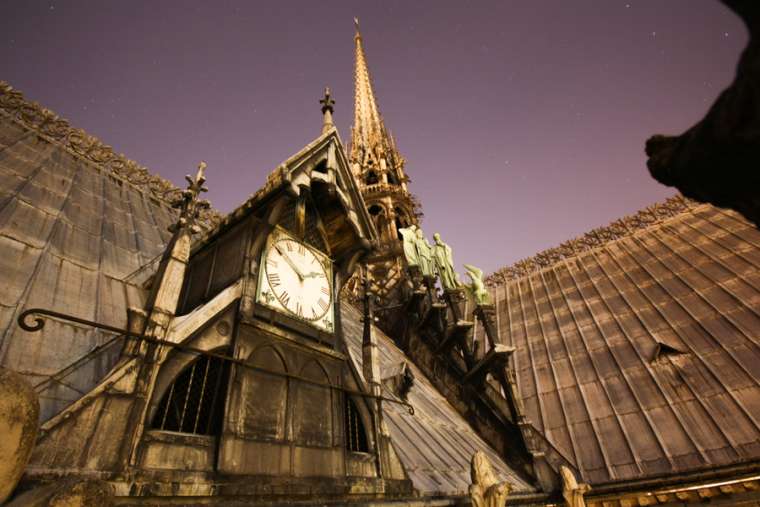
The original clock at the Cathedrale Notre-Dame de Paris was destroyed by a conflagration in April.

What is lost can often be found — or a decent replica created. That is the message of a recent story about the clock destroyed by the fire at Notre-Dame Cathedral in Paris. After I read it, I felt curious about the clock expert who realized that a different church had an almost identical clock in storage. So I looked him up. Such discoveries are not ordinarily stumbled on by people with no expertise.

The Catholic News Agency, in an item widely shared last June, reported, “A clock nearly identical to the one destroyed in the fire at Cathedrale Notre-Dame de Paris has been found in storage. The duplicate was found at the Church of the Holy Trinity in Paris, in what is being called a ‘miraculous discovery.’ …

“The original clock was located near the cathedral spire, which collapsed during the April 15 fire. It was feared there would be no way to rebuild the clock, as there were no surviving drawings of its mechanism or any digital records of how the clock was made.

“The timepiece’s near-twin was found by clockmaker Jean-Baptiste Viot, during a storage inventory at Holy Trinity. Viot called the find ‘incredible.’ …

“The Church of the Holy Trinity’s original clock was replaced by an electronic model about 50 years ago. The old clock was then put in storage, and was discovered behind a wooden board amid statues and furniture in a small storage room.”

Said Olivier Chandez, who was responsible for maintaining the clock at Notre-Dame, ” ‘If we only had the photos, we would have had to extrapolate. … But with this model, we have all the dimensions.’

“While the clocks are very similar, Chandez said that there are enough differences to prevent restorers from simply inserting Holy Trinity’s clock into the refurbished Notre-Dame.”

Here is some of the information I found on the shard-eyed Jean-Baptiste Viot [J-B Viot].

Born in 1967, he “began his training in watch repair at the Public Watch Making School of Paris in September 1983. After graduating, he went to Switzerland to continue his studies at the Technical School of the Vallée de Joux. … The federal certificate he obtained in June 1988 enabled him to pursue his training with the International Museum of Watchmaking of Chaux de Fonds … resulting, after two further years of study, in a degree in watch restoration. …

“In June 1998, J-B VIOT was hired by Breguet 7 place Vendôme, giving him the chance to return to watch restoration in Paris. Indeed, working on original Breguet movements from the historical period 1775-1840 gave him the opportunity to study this great master from the past. …

“Following the purchase of the firm by the biggest Swiss watchmaking group (Groupe Swatch), J-B decided to devote himself entirely to the restoration of antique watches and clocks.” More here.

I like to imagine how Viot felt when he saw what Trinity had at a time that all Paris was mourning the cathedral.

Read Full Post »