Feeds:
Posts
Comments

Posts Tagged ‘louisville’

Photo: Lydia Schweickart for NPR.
Madelyn Whitt (left) and Quani’e Lanier read in the school library at the Academy @ Shawnee, a magnet middle and high school in Louisville, Kentucky. Does that mean Kentucky’s phone ban is working?

I have my own gripe about cellphones in education — namely, that English language learners often let their phone’s translation app do all the work of writing — but in Kentucky, whole phones are considered enough of a problem to deserve a ban.

Sequoia Carrillo at National Public Radio (NPR) decided to investigate how well the ban was working.

“How do you get teenagers to put their phones away for hours at a time? That is the question many schools are trying to solve as bans on cellphones sweep the U.S. — more than 30 states so far now restrict their use during the school day.

“One of those states is Kentucky, where all public school classes must now be cellphone free. … To see how the policy is working, NPR visited the Academy @ Shawnee, a magnet middle and high school in Louisville.

“Before the restrictions, ‘we didn’t even know the majority of the kids were learning, because they weren’t responding [in class],’ says Hollie Smith, now in her second year as the school’s executive principal. ‘They were just doing things on their phones. … Kids know the expectations now.’

“For one thing, there’s more discourse, she says. Teachers and students feel like they are connecting. Even the cafeteria is a little bit louder — alive with conversations between students disconnected from their screens.

“Even though she finds the initial results positive and encouraging, Smith is under no illusion about what the students think: ‘I think they absolutely hate it. Their phone is their lives — it’s their world.’ …

“The big question, though, here and at thousands of schools around the country, is: Are these bans working? …

“Jefferson County’s ban echoes those in many schools, and it reflects what research points to as the best approach to restricting cellphones in schools. ‘At the end of the day,’ Smith says, ‘we have to do our kids a service. And … they have to be engaged to get the service that we’re providing.’ …

“When the ban went into effect in August, each student received a pouch with their name on it. Immediately, says [Jayden O’Neil, a senior at Shawnee], students began finding hacks to get around the system. ‘Most kids either brought a spare phone or they said they didn’t have a phone,’ she explained.’Or they broke the pouches — they cut them open.’

” ‘People had multiple extra phones,’ added Quani’e Lanier, a fellow senior. Some students brought old phones in to distribute to their friends — decoy phones, Lanier says, to put in the pouches.

“Both students are less than a semester away from graduation and looking forward to moving on. … Both say one of the big problems with the ban is that they feel like adults and should be in charge of their own possessions.

“The new policy has rules and lays out consequences for not following it, including surrendering your phone and a call to parents. But Lanier says those consequences are ‘not enough for people to care.’ …

“As we spoke with students in the library, the bell rang and students began to move between classes. Through the library windows, we could see kids walking and chatting, but a few had headphones on and one had a phone out, taking a selfie video.

“But [Joseph Jolly, a junior and a student aide in the library] said we probably would not see the same behavior in the classroom: ‘They’ve started to actually focus on work, and I think we’ve become more productive because of that.’ …

“The actual policy set forth by the school — that phones must be in their pouches — is widely disregarded, [Joseph Jolly, a junior and a student aide in the library] said. … But he adds that the new restrictions have led to an unspoken agreement: That by mutual consent, students are refraining from using their phones in class and educators are leaving well enough alone.

“Where was his phone? ‘Truth be told, it’s in my pocket right now,’ he said. ‘But … I’m not doing anything though. That’s the thing!’

“Anton Caldwell, Shawnee’s librarian for more than 20 years, says he knew right away the ban was working. The number of students visiting the library increased, and so did the number of books they’re reading. …

“While the ban may not be the sweeping, cold-turkey approach to technology that the district expected, he says it is pushing students to unplug. And there are some books he just cannot keep on the shelf.”

More at NPR, here.
Read Full Post »

Photo: Jingnan Peng/Christian Science Monitor.
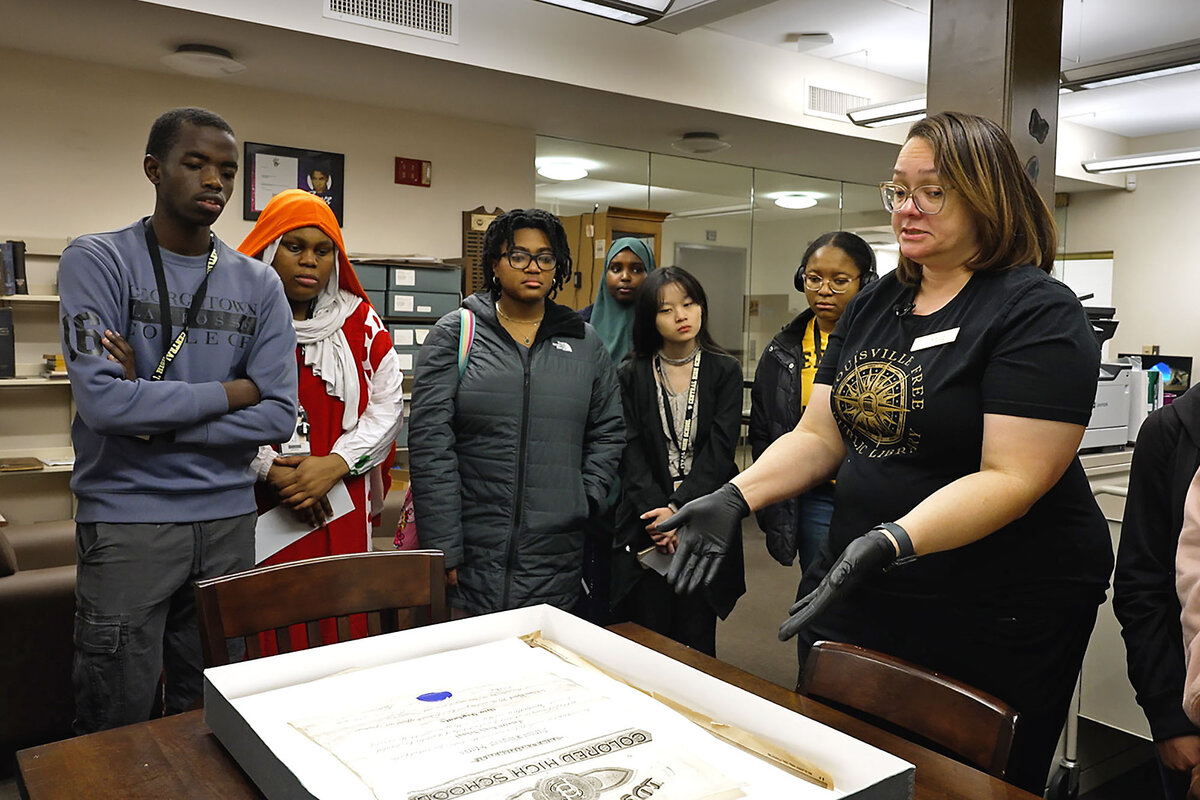
On a tour of Louisville’s Western Library, librarian Natalie Woods (right) shows a 1911 diploma of Louisville’s Central High School. Its former principal, Albert Meyzeek, helped create the oldest Black public library in the U.S. still independently run today.

It is often the case that people in a marginalized group excel in delivering badly needed services that others take for granted. Consider America’s oldest Black library and the man who started it.

Jingnan Peng writes at the Christian Science Monitor, “Thirty minutes into the library tour, Louisa Sarpee wants to work there. History is so close to her. One block away from her high school, the small library she had never set foot in laid the foundation of African American librarianship. What is more, the library was created by a former principal of her own school. Its archives even house a diploma of her school from the time the word ‘colored’ was still in the school’s name.

“ ‘Is there any way to volunteer at the library?’ the ninth grader asks Natalie Woods, the librarian giving the tour. …

“ ‘Say no more, girlfriend,’ Ms. Woods replies, beaming. ‘We’re gonna talk.’

“For Ms. Woods, the manager of Louisville’s Western Library, the gasps coming from the group of 18 students learning about its history is no surprise. She meets Louisvillians every day who know nothing about Western. The library under her care is the oldest public library in the United States independently run by and for African Americans. It was also the earliest training ground of Black librarians from around the South. It is a legacy that has changed Ms. Woods’ life, and preserving it has become her vocation. …

“The ‘Western Colored Branch’ of the Louisville Free Public Library system opened in 1905, in an era when Black communities across the South were building institutions in the wake of emancipation, says historian Tracy K’Meyer at the University of Louisville. …

“The segregated library was considered an experiment, says Ms. Woods. Its first manager, the Rev. Thomas Fountain Blue, had no formal schooling in library science – because there were no library schools open to Black people.  

“Blue not only ran a successful library … he also started the first training program for Black library workers. The course became the prototype for the first degree program in library science for African Americans, which opened in 1925 at Hampton Institute in Virginia. …

“Ms. Woods remembers Blue’s cursive handwriting. The first time she held his papers, they changed her life. She never learned about Western’s history when she grew up in Louisville. The child of a Black father and a white mother, she became a page at Louisville’s Shawnee Library. There, she would hear mentions of Western’s history.

“In 2008, while working as a library clerk and attending college at night, Ms. Woods lost the vision in her left eye due to complications from surgery. She couldn’t perceive distance properly and had to relearn basic activities, such as picking up a pencil, by repetition. It was a struggle to finish college, she says, and she gave up the idea of pursuing a master’s degree in library science.

“Then, one day, a supervisor brought Ms. Woods a folder of documents to transcribe. They were the papers of Thomas Fountain Blue. 

“On lined sheets, the cursive hand discussed circulation methods, library cards, and a library’s role in educating the public. 

“ ‘I knew of him, but I didn’t know how deep and intentional he was in everything he did,’ Ms. Woods says. ‘And it just gave me a new love and desire to go to library school.’ She obtained her library degree at Florida State University. She became Western’s manager on March 6, 2016: Blue’s 150th birthday.

“When Ms. Woods started at Western, she found that many people living near Western did not even know the library exists.

“The library’s archive, which includes Blue’s papers and a wealth of material on Black Louisville history, was disorganized. There was no indexing, and the room was not even locked down, Ms. Woods says.

“So she started giving tours of the library, which she still offers about once a week. In 2018, she obtained a $70,000 grant to index and digitize Western’s archive. 

“It is an important archive that sheds light on ‘how Black librarians, in real time, were trying to imagine what a library to serve a Black community should look like,’ says David Anderson, a professor of English at University of Louisville. …

“A child of formerly enslaved parents, Blue attended college and seminary in Virginia and ran a Louisville YMCA before starting at Western. He died in 1935, after being denied medical care for a treatable infection, says Annette Blue, his granddaughter. ‘He died from Jim Crow laws,’ she says in a Zoom interview from her home in California. …

“Ms. Woods says she does her work in honor of Blue and her parents. She tries to embody Blue’s commitment to ‘the betterment of his people.’ Her parents, who faced much opposition to their relationship as an interracial couple, taught her to ‘treat people the way you want to be treated.’ “

More at the Monitor, here. No firewall. Subscriptions are reasonable.

Read Full Post »

Photo: Frankie Steele, The (Louisville) Courier-Journal
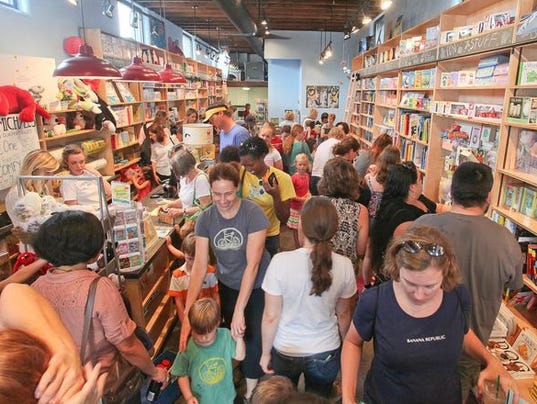
Carmichael’s Kids indie bookstore at its opening. Writer Shea Serrano recently directed his Twitter followers to the online store. The move generated more than 1,100 orders in a day.

Say what? I thought it was agreed that online shopping has killed retail. But wait! Maybe social media can save the day.

USA Today recently reposted an article by Jeffrey Lee Puckett from the Louisville Courier-Journal that highlights the possibilities. (Hat Tip: ArtsJournal.)

“Two years ago, [writer Shea Serrano] and some friends started the FOH [not translatable for family blog] ARMY and began practicing random acts of kindness such as raising money to help send a teacher to Turkey.

“Wednesday [May 17] was the group’s first FOH Indie Bookstore Day. Carmichael’s [Kids] was endorsed by Serrano after one of the store’s employees, Mark Schultz, messaged Serrano and questioned his decision to include a link to Amazon in an earlier tweet.

” ‘Some guy who works there sent me a message one day and he seemed nice so that’s why I decided to try and do the 1K in a Day thing for them,’ Serrano said in a Twitter message. …

“Serrano is best-known for his 2015 book, The Rap Year Book: The Most Important Rap Song From Every Year Since 1979, Discussed, Debated, and Deconstructed. …

‘The really cool thing is that he’s not encouraging people to buy his book. He’s encouraging people to buy any book,’ said Carol Besse, co-owner of Carmichael’s. ‘The orders have been so interesting, all across the board, all good stuff.’

“To pay back Serrano’s kindness, Carmichael’s will offer free shipping on all FOH ARMY orders, Besse said.” More here.

This twitter effort strikes me as a variation of the cash mob, which I don’t believe can be the salvation of a retail business in and of itself. Although I have to say the West Concord 5&10, which was the focus of a cash mob I described here, is still going.

The Holy Grail for retail will probably be some combination of online and bricks-and-mortar that recognizes customers like to have their purchases delivered to their homes and that also takes into account what sorts of products absolutely need to be handled before purchase.

But the article shows that it doesn’t hurt to have employees who notice Amazon references on social media and say, “Hey, what about us little guys?”

Read Full Post »