Feeds:
Posts
Comments

Posts Tagged ‘biologist’

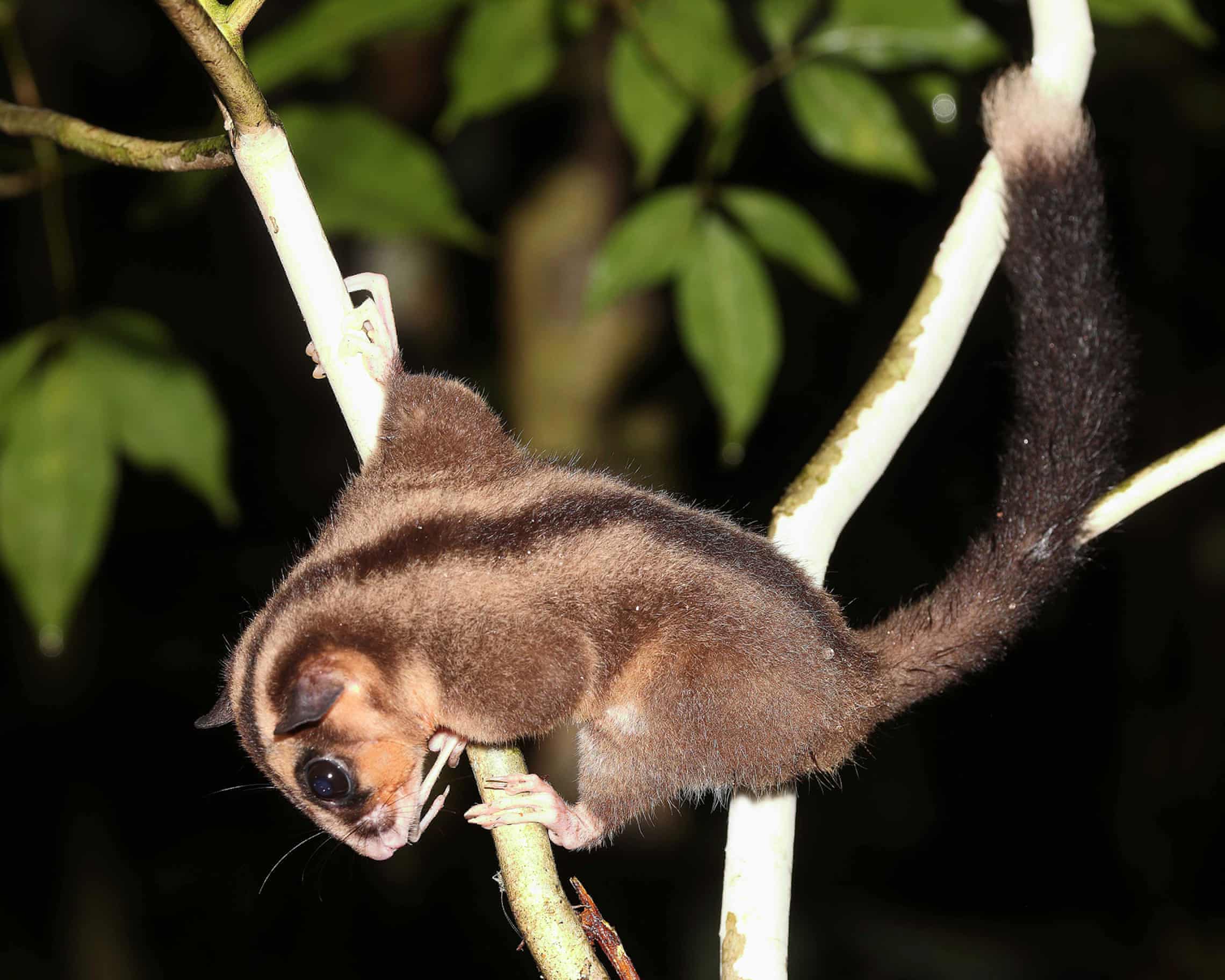
Photo: Carlos Bocos.
According to the Guardian, the pygmy long-fingered possum was last known to have lived in West Papua until about 6,000 years ago. 

It’s always good news to me when long-disappeared animals turn out not to be extinct — even if I never knew enough in the first place to be worried. I do know that many species are disappearing rapidly, so it’s comforting when scientists find that one they’d given up on is still around.

Adam Morton wrote about this at the Guardian recently. “Researchers led by the Australian scientist Tim Flannery have made a once-in-a-lifetime discovery: that two charismatic marsupial species that had been thought extinct for 6,000 years are alive in rainforest in remote West Papua.

“The pair are rare examples of ‘Lazarus taxa’ – species that disappeared from fossil records in the distant past that are later found to have survived. [Do note the choice of the word “Lazurus”!]

“One of the species is a striped possum with an extraordinarily elongated fourth digit, twice as long as the rest of its fingers, that it uses to extract and feed on wood-boring insect larvae. Fossil records had previously indicated the species, known as the pygmy long-fingered possum (Dactylonax kambuayai), lived in Australia’s central Queensland region about 300,000 years ago but seemed to have vanished during the ice age. Before the recent discovery, it was last known to have lived in West Papua until about 6,000 years ago.

“The other is a ring-tailed glider (Tous ayamaruensis), which is closely related to the Australian greater glider but with unfurred ears and a strongly prehensile tail used for gripping. It was first described by the late Australian zoologist Ken Aplin, who pieced together fossil fragments found in West Papua late last century. Flannery’s research team found the species was still living in the rainforest and identified it as part of a newly described taxonomic group, or genus, of marsupials. …

“Flannery is best known as a climate campaigner and the author of the international bestselling The Weather Makers, but he made his name in science as a mammalogist and palaeontologist working in New Guinea and Pacific islands. He says the likelihood of finding one mammal species that had been thought gone for millennia was ‘almost zero.’ The chances of finding two? ‘It’s unprecedented and groundbreaking, really, to find two Lazarus taxa,’ Flannery says.

“The 70-year-old says the identification of a new genus, in particular, felt like a ‘lifetime achievement, shared with all our many other co-authors.’ …

“Both species live in lowland mountain forests on the sparsely populated Bird’s Head peninsula, also known as the Vogelkop, in the north-west of the Indonesian-controlled part of New Guinea. Their existence was established through photographs taken by local and independent researchers, fossil fragments and, in the case of the long-fingered possum, a museum specimen that was collected in 1992 but initially misidentified. …

“The long-fingered possum was photographed in 2022 by Carlos Bocos during a trip to the area by the organization mammalwatching.com. A ring-tailed glider was captured by Arman Muharmansyah by the side of a river in a forest belonging to a palm oil company in 2015, and photographed by Ichlas AlZaqie from Orangutan Foundation Indonesia.

“The discoveries are detailed in a special edition of a peer-reviewed journal published on Friday by the Australian Museum, edited by Flannery and the museum’s former chief scientist, Kristofer Helgen. …

“They are in part a result of Flannery’s repeated trips to the Vogelkop, where he works with Indigenous elders, researchers from the University of Papua, the Global Wildlife Fund and the Minderoo Foundation to protect forests from logging and leave them in the control of traditional owners. He says the research underscored the importance of preserving the area’s unique environment.

“David Lindenmayer, an ecologist and professor at the Australian National University who was not involved in the research, says … ‘It’s fantastic to see new species still being discovered and it shows the importance of some of these rainforests in very remote parts of the world where there hasn’t been much study in the past.’ …

“The ring-tailed glider is considered sacred by some Vogelkop clans, who believe it is a manifestation of ancestors’ spirits. Rika Korain, a local Maybrat woman and a research co-author, says the species could not have been identified without the help of traditional owners. ‘This connection has been essential,’ she says.

“Flannery says the discoveries are evidence the Vogelkop was once a part of the Australian continent that had later become part of New Guinea. The link is the subject of another paper in the journal, and may have wider implications. ‘Its forests may shelter yet more hidden relics of a past Australia,’ he says.”

More at the Guardian, here.

Read Full Post »

The radio show Living on Earth (LOE) reported recently on work to restore seaweeds that are a key part of the ecosystem.

From the LOE website: “Ripped from the seafloor by strong swells, massive amounts of kelp recently washed ashore in southern California. But the uprooted algae may actually be a sign of successful kelp restoration efforts. Marine biologist Nancy Caruso discusses the fragile ecosystem and how she and a community are helping to rebuild the majestic kelp forests.”

Radio host Steve Curwood interviewed Caruso. She recounts how she began 12 years ago with a group of students and volunteers “to restore the kelp forests off of Orange County’s coast.”

After a storm, she says, big holes get ripped in the forest of kelp, often 10 feet high. Then “new life can grow from the bottom up, and so if we see this happen, which we’re seeing right now, the kelp returns immediately after this event, then we know that our restoration efforts are successful, and after 30 years of our local ecosystem not having healthy kelp forests, we can rest assured that it’s now restored.”

To Curwood’s question about how restoration is done, Caruso answers, “It was actually quite an effort because I had the help of 5,000 students from ages 11 to 18 as well as 250 skilled volunteer divers, and we planted this kelp in 15 different areas in Orange County. There’s a spot down in Dana Point. It’s the only kelp forest that was left in Orange County so we would collect the reproductive blades from those kelp plants, and I would take them into the classrooms for the students to clean them and we would actually stress them out overnight. We would leave them out of water in the refrigerator, kind covered with paper towels, and then the next morning we would put them back in the ice-cold seawater and the kelp blade would release millions of spores” that would then be raised in nurseries and returned to the ocean.

“All those animals that get washed up on the beach inside the wrangled tangled kelp become a food source for shorebirds that live along our coast.”

More from Living on Earth here. For more on the importance of seaweed, see also Derrick Z. Jackson’s article in the Boston Sunday Globe: “Eelgrass Could Save the Planet.”

Photo: NOAA’s National Ocean Service
Kelp forests can be seen along much of the west coast of North America.

Read Full Post »

Photo: Masaki Miya et al. Wikimedia Creative Commons
Anglerfish use bioluminescence to attract their prey in the darkest depths of the ocean.

When John was little, he liked a book called Fish Do the Strangest Things. Strangeness is a great focus for a nature book, because everyone likes offbeat critters.

Steve Curwood, founder of the radio show Living on Earth, recently interviewed the author of a book that focuses on the strangeness of ocean life.

CURWOOD: “In an engaging new book called The Extreme Life of the Sea, biologist Steve Palumbi and his novelist son Tony deepen our understanding of how strange sea life has managed to survive against all odds. … Why did you write this book. Why now?

PALUMBI: “Well, the real reason is that we’re trying an experiment: can you take the narrative style and approach that a novelist would use and combine it with what a scientist would do? … You don’t really care about the plot until you care about the characters, and so we wanted to write a book that made you care about the characters.

CURWOOD: “Now, you write about the extreme life of the sea, the oldest, the hottest, the shallowest, to name a few. Why did you choose this approach?

PALUMBI: “Because it was a way of getting people’s attention to the really sort of amazing things that these critters do. Organisms in the sea live in some of the hottest places, they live in some of the coldest places, and how they do that is something marine scientists have paid a lot of attention to. So it was really a way to make it more engaging, more fun, and to let us move credibly between different kinds of organisms all in the same chapter. …

CURWOOD: “You had one extreme that you called immortal.

PALUMBI: “That’s an amazing jellyfish called turritopsis, and it has the remarkable ability to age in reverse. So when the environment is bad, this animal can essentially go from its adult body form back, back, back to its larval form, and then start all over again. … It’s called transdifferentiation. It’s the only critter known to be able to do that.”

More here, where you can read the rest of the transcript and listen to the recording. It’s all pretty amazing.

Photo: Eddie Welker, Flickr Creative Commons 2.0)
Clownfish

Read Full Post »

Doubtless you know about fairy circles, also called fairy rings. According to Wikipedia, they’re a “naturally occurring ring or arc of mushrooms. The rings may grow to over 10 metres (33 ft) in diameter, and they become stable over time as the fungus grows and seeks food underground.

“They are found mainly in forested areas, but also appear in grasslands or rangelands. Fairy rings are detectable by sporocarps in rings or arcs, as well as by a necrotic zone (dead grass), or a ring of dark green grass. If these manifestations are visible a fairy fungus mycelium is likely to be present in the ring or arc underneath.

“Fairy rings also occupy a prominent place in European folklore as the location of gateways into elfin kingdoms.”

But in Africa, there is a different kind of fairy circle that doesn’t seem to have anything to do with mushrooms.

Did you catch the article by Sindya Bhanoo in the NY Times?

“The grasslands of Namibia — and to a lesser extent its neighbors Angola and South Africa — are speckled with millions of mysterious bare spots called ‘fairy circles,’ their origins unknown.

“Now, a study based on several years of satellite images describes the circles’ life span as they appear, transform over decades, and then eventually disappear.

“Writing in the journal PLoS One, Walter R. Tschinkel, the study’s author and a biologist at Florida State University, reports that the circles can last 24 to 75 years.

“The circles, which range from about 6 to 30 feet in diameter, begin as bare spots on an otherwise continuous grass carpet; after a few years, taller grass starts to grow around the circle’s perimeter.”

The reader is left with the question, Are these circles gateways to elfin kingdoms? What kind of elves are in Namibia?

I don’t understand why scientists don’t investigate matters like that.

Update July 13, 2012: Asakiyume has been tracking down stories about African fairy circles. Read this.

Update March 30, 2013: NY Times has fingered a particular species of sand termites, Psammotermes alloceru. Read this.

Photograph: Walter R. Tschinkel

Read Full Post »