Feeds:
Posts
Comments

Posts Tagged ‘discover’

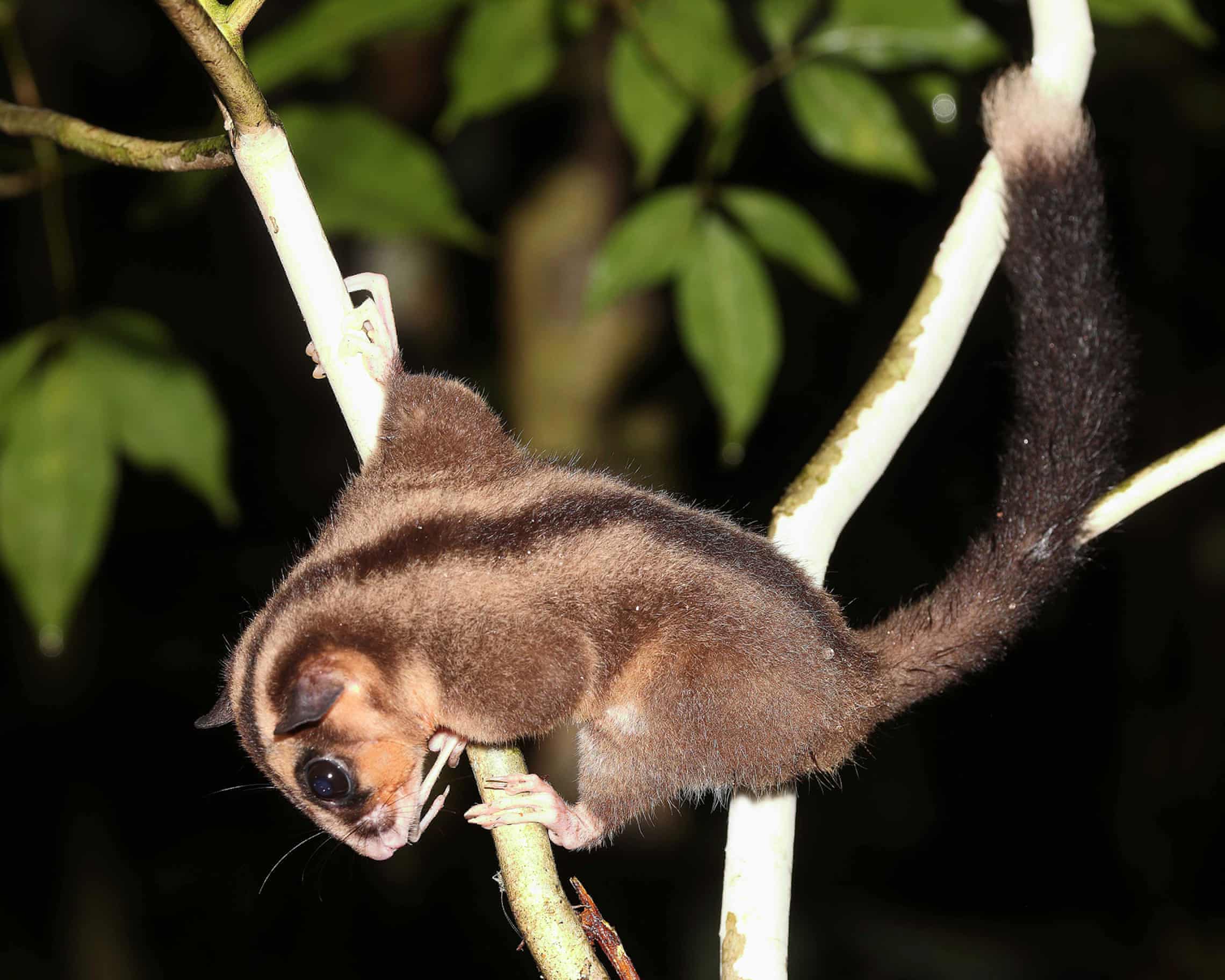
Photo: Carlos Bocos.
According to the Guardian, the pygmy long-fingered possum was last known to have lived in West Papua until about 6,000 years ago. 

It’s always good news to me when long-disappeared animals turn out not to be extinct — even if I never knew enough in the first place to be worried. I do know that many species are disappearing rapidly, so it’s comforting when scientists find that one they’d given up on is still around.

Adam Morton wrote about this at the Guardian recently. “Researchers led by the Australian scientist Tim Flannery have made a once-in-a-lifetime discovery: that two charismatic marsupial species that had been thought extinct for 6,000 years are alive in rainforest in remote West Papua.

“The pair are rare examples of ‘Lazarus taxa’ – species that disappeared from fossil records in the distant past that are later found to have survived. [Do note the choice of the word “Lazurus”!]

“One of the species is a striped possum with an extraordinarily elongated fourth digit, twice as long as the rest of its fingers, that it uses to extract and feed on wood-boring insect larvae. Fossil records had previously indicated the species, known as the pygmy long-fingered possum (Dactylonax kambuayai), lived in Australia’s central Queensland region about 300,000 years ago but seemed to have vanished during the ice age. Before the recent discovery, it was last known to have lived in West Papua until about 6,000 years ago.

“The other is a ring-tailed glider (Tous ayamaruensis), which is closely related to the Australian greater glider but with unfurred ears and a strongly prehensile tail used for gripping. It was first described by the late Australian zoologist Ken Aplin, who pieced together fossil fragments found in West Papua late last century. Flannery’s research team found the species was still living in the rainforest and identified it as part of a newly described taxonomic group, or genus, of marsupials. …

“Flannery is best known as a climate campaigner and the author of the international bestselling The Weather Makers, but he made his name in science as a mammalogist and palaeontologist working in New Guinea and Pacific islands. He says the likelihood of finding one mammal species that had been thought gone for millennia was ‘almost zero.’ The chances of finding two? ‘It’s unprecedented and groundbreaking, really, to find two Lazarus taxa,’ Flannery says.

“The 70-year-old says the identification of a new genus, in particular, felt like a ‘lifetime achievement, shared with all our many other co-authors.’ …

“Both species live in lowland mountain forests on the sparsely populated Bird’s Head peninsula, also known as the Vogelkop, in the north-west of the Indonesian-controlled part of New Guinea. Their existence was established through photographs taken by local and independent researchers, fossil fragments and, in the case of the long-fingered possum, a museum specimen that was collected in 1992 but initially misidentified. …

“The long-fingered possum was photographed in 2022 by Carlos Bocos during a trip to the area by the organization mammalwatching.com. A ring-tailed glider was captured by Arman Muharmansyah by the side of a river in a forest belonging to a palm oil company in 2015, and photographed by Ichlas AlZaqie from Orangutan Foundation Indonesia.

“The discoveries are detailed in a special edition of a peer-reviewed journal published on Friday by the Australian Museum, edited by Flannery and the museum’s former chief scientist, Kristofer Helgen. …

“They are in part a result of Flannery’s repeated trips to the Vogelkop, where he works with Indigenous elders, researchers from the University of Papua, the Global Wildlife Fund and the Minderoo Foundation to protect forests from logging and leave them in the control of traditional owners. He says the research underscored the importance of preserving the area’s unique environment.

“David Lindenmayer, an ecologist and professor at the Australian National University who was not involved in the research, says … ‘It’s fantastic to see new species still being discovered and it shows the importance of some of these rainforests in very remote parts of the world where there hasn’t been much study in the past.’ …

“The ring-tailed glider is considered sacred by some Vogelkop clans, who believe it is a manifestation of ancestors’ spirits. Rika Korain, a local Maybrat woman and a research co-author, says the species could not have been identified without the help of traditional owners. ‘This connection has been essential,’ she says.

“Flannery says the discoveries are evidence the Vogelkop was once a part of the Australian continent that had later become part of New Guinea. The link is the subject of another paper in the journal, and may have wider implications. ‘Its forests may shelter yet more hidden relics of a past Australia,’ he says.”

More at the Guardian, here.

Read Full Post »

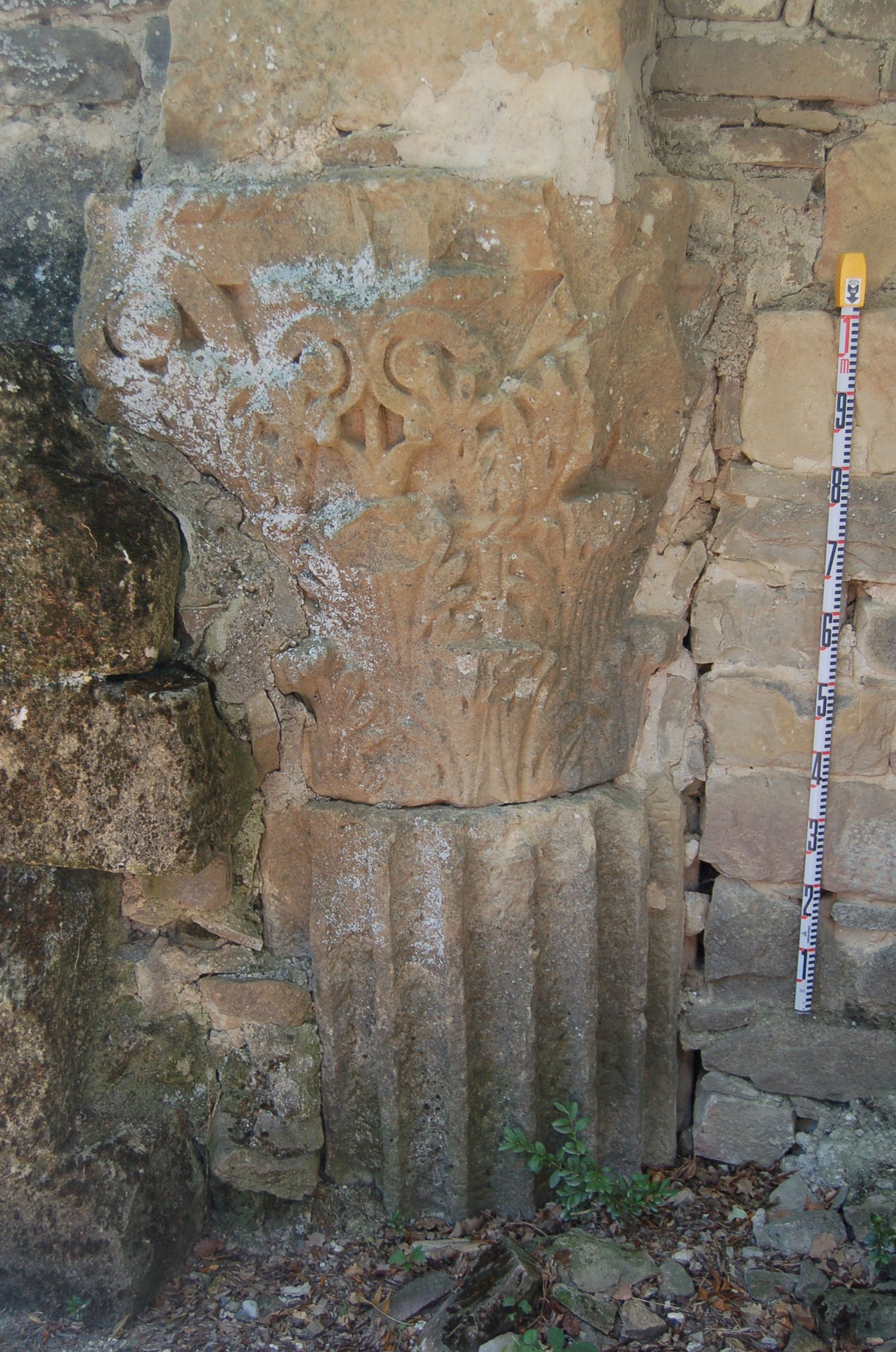
Photo: El País.
A Corinthian capital and fluted drum with a shaft located in a city discovered at the foot of the Pyrenees in 2018.

Do you ever wonder what sort of report archaeologists of a future civilization would write about your town? What if they had only the location and a few crumbled buildings to go on, no contemporary testimony? That was the plight of a group of archaeologists in Spain who investigated a “new” ancient city.

Vicente G. Olaya says at El País that archaeologists were surprised that they didn’t know the name of a recently unearthed city, but there were simply no historical documents mentioning it.

“In 2018,” he says, “the City Council of Artieda — located in northeastern Spain in the province of Zaragoza, and part of the country’s Aragon region — asked the University of Zaragoza’s Archaeology Department for help in studying some ruins located around the San Pedro hermitage, known variously as El Forau de la Tuta, Campo de la Virgen, or Campo del Royo.

“Three years later, the experts have confirmed that these sites formed a large single archaeological complex, and they detected two phases of occupation on the surface of the site: one during the imperial Roman period (the 1st to 5th centuries) and another during the early-medieval Christian era (the 9th to 13th centuries). Now, the research team has published the results in a reportEl Forau de la Tuta: A Hitherto Unknown Roman Imperial City on the Southern Slopes of the Pyrenees. …

“The report notes that based on important evidence from the ruins preserved in the hermitage, as well as artifacts held in various public and private collections and the findings at the site, the settlement was ‘of urban character — the city’s name is currently unknown — and it developed during the [Roman] imperial period. Later, the same site took on another iteration as a rural habitat during the Visigoth and early Andalusian periods.’

“The specialists have also found that, between the 9th and 13th centuries, another peasant habitat-type town or village was superimposed on top of the Roman settlement. They have identified the village as Artede, Arteda, Artieda or Arteda Ciuitate. The medieval enclave’s ruins include the apse area of the church, which was part of the San Pedro hermitage; numerous silos with circular openings, which were excavated from the subsoil and only perceptible by geo-radar; and an extensive cemetery consistent with Christian burial rites. …

“The El Forau de la Tuta site is located 1.5 kilometers from Artieda’s city center, on the fertile plain of the Aragón River. … It is possible that the site’s dimensions are even larger and that it extends to other — still unexplored — agricultural lands.

“The Roman settlement stood next to the road connecting three northern cities. … Currently known as Camino Real de Ruesta a Mianos (the High Road from Ruesta to Mianos), the road lasted through the Middle Ages as a stretch of the French Route, the Arles Way or the Via Tolosana (Tolouse Route), as part of the Way of St. James (Camino de Santiago). …

“Inside the hermitage, the study’s authors have identified two Corinthian capitals, three Italic Attic bases, a classical Attic base, several flat-edged fluted shaft drums, and a fragment of cornice. The huge dimensions and typology of the artifacts indicate that they came from several early [Roman Empire] public buildings. … 

“The study confirms that these pieces come from at least two different monuments. Their typologies indicate that they were sculpted more than half a century apart, ‘which demonstrates a prolonged period in the process of monumentalizing the city.’

“To the west of El Forau de la Tuta, next to the San Pedro ravine, ‘an impressive set of public works made of opus caementicium (the Romans’ early version of concrete) including at least four sewer outlets, a powerful massive abutment, a foundation, and a series of quadrangular structures,’ possibly supply cisterns, is also preserved. … The presence of these works is typical of urban settlements, where water drainage was a problem that had to be addressed, especially in relation to buildings, such as bath houses, that produced a large amount of water waste. …

“Archaeologists are also currently studying a sculptural fragment that is preserved in an Artieda private collection. The artifact — which was collected near the hermitage — is an incomplete, nearly life-sized left hand that holds a patera umbilicata [an offering bowl], which would have been part of a statue representing an offering figure. …

“In the first round of excavations in 2021, the archaeologists confirmed the existence of an intersection of two roads. ‘On one of the roads, possibly one of the settlement’s main streets, we documented the ruins of a sidewalk and a surface channel for draining water, which pedestrians could circumvent by means of three steppingstones.’ …

“In one of the excavations they performed, the archaeologists found ample remains of black and white mosaics made with tesserae (small cubes of stone or glass) and fragments of rudus (a layer of material placed under the tesserae). …

“Inside this structure, under a large number of slabs that fell in the building’s collapse, archaeologists found a practically complete black-and-white tessellated pavement (with some isolated red and yellow tesserae); it was extraordinarily preserved. Decorated with iconographic motifs in white on a black background, it has shells or scallops in the four corners, while the central emblem features seahorses, ridden by little Cupids, facing each other next to three representations of marine animals, a fish in the upper part and possibly two dolphins in the lower part.

“Thus, the archaeologists are certain that everything they’ve found so far ‘corresponds to a single urban complex from between the first and second centuries, and that the city had infrastructure and public monuments, including baths, a water supply system, regular urban planning, sewers, and possibly a temple.’ ” 

I can’t help thinking about the way early archaeologists (Schliemann, say, at Troy) barged in and dug at random, destroying historical records. Imagine how carefully and boringly the archaeologists in today’s story had to sift every little thing to discover the town built on top of the Roman city — and date both!

More at El País, here.

Read Full Post »

In a Washington Post story last month, described how Reddit helped in the identification of a very rare atlas.

“A reference librarian at the National Library of Norway came across an old Ottoman atlas in the collections there that seemed perfect for a Reddit board devoted to the appreciation of maps. Weeks later, he figured out that the map in question was a previously-unknown copy of one of the rarest atlases in the world: the Cedid Atlas.

“The librarian, Anders Kvernberg, otherwise known as Reddit user PisseGuri82, posted an image from the atlas to r/mapporn  … He simply identified the map — which he pieced together from scans of different pages from the atlas — as an Ottoman world map from 1803. …

“The atlas went back into the library’s collections, where it would have stayed, ignored, had Kvernberg not seen a post two weeks later from another r/mapporn user who posted an Ottoman map of Africa from the same year. …

“As Kvernberg learned more about the rare book, the Library of Congress’s page scans started to look very familiar. ‘Then I realized this was the very same atlas I had held in my hands a few weeks earlier,’ Kvernberg wrote on Reddit.

“ ‘I ran off to tell our expert on maps, Benedicte Gamborg Briså, that I had something I thought she should take a look at,’ Kvernberg told The Post. …

“Briså told The Post that the National Library of Norway’s copy of the Cedid Atlas is the 15th known surviving copy — 14 others are held by various libraries around the world.”

Read the whole saga here. Three cheers for highbrow Redditors!

Photo: Nikolaj Blegvad, The National Library of Norway

Read Full Post »