Feeds:
Posts
Comments

Posts Tagged ‘roxbury’

Photo: Jonathan Wiggs/Globe Staff.
Roxbury resident and subway operator Aaron Haynes was cleaning his house when he found his ancestor’s freedom paper, issued in the 1830s. Few of these have survived.

I found this story about a young man who discovered his ancestor’s freedom paper very moving. There are few such documents in existence because, prior to nationwide emancipation, free black men and women needed to carry papers all the time to protect themselves from unlawful arrest. It made me think of others we know of who suddenly had to start carrying their papers everywhere.

Claire Thornton reports the Boston story at the Boston Globe. “Aaron Haynes gets choked up when he thinks about what the faded piece of parchment represents: a lineage spanning centuries, and most importantly, his ancestor’s freedom from enslavement.

“Haynes, who works as a operator on the MBTA’s Green Line, began exploring his family genealogy this winter after finding an original freedom paper belonging to one of his ancestors. The documents were proof that an African American person was free in the years before slavery was abolished. Without the papers, individuals risked being kidnapped and unlawfully sold into slavery.

‘We got so excited, because we were like, “That definitely looks real.” ‘

“Haynes’s ancestor’s document, issued in 1834, was passed down through generations to his grandmother, and stored in a hutch in his mother’s Roxbury home. He stumbled across it while cleaning, as he was dusting the contents of the old cabinet.

“Issued nearly 200 years ago to 21-year-old Samuel Jones in Baltimore County, Maryland, the document identifies Jones based on his physical features.

“It was signed by a court official certifying that Jones was ‘born free,’ the document says. …

“ ‘I’m getting choked up, the fact that we have this and it’s tangible. … I feel like I’m in an ancestral plane, at arm’s length from imagining what Samuel Jones looked like, what he sounded like,’ said Haynes, 34.

“In the early 1800s, African Americans — including many like Jones who were born free — carried their freedom papers on their person to protect against being captured and sold into slavery, according to historians. Original freedom documents are exceedingly rare, experts said.

” ‘I’ve never held an original freedom paper in my hand before — I‘ve only seen them digitized,’ said Lindsay Fulton, chief research officer at American Ancestors, a family history nonprofit in the Back Bay.

“Archives at the University of Virginia in Charlottesville and an exhibit at the Senator John Heinz History Center in Pittsburgh house two of the largest collections of freedom papers, Fulton said. The National Museum of African American History and Culture in Washington, D.C., also has freedom papers on display.

“Samuel Jones would have stored his freedom paper somewhere safe after receiving it in 1834, Fulton said. When it was passed down to Haynes’s mother, it was in a smaller leather folder, and it’s been remarkably well-preserved.

“ ‘The reason these documents were so critical, and in many cases saved and passed down through generations, was because they are the key to avoiding enslavement or re-enslavement right after freedom,’ said Kendra Field, chief historian of American Ancestors’ 10 Million Names project cataloguing identities of people enslaved in the US.

“At first, Haynes said, he didn’t know where he could take the document to learn more about it. … In January, Haynes saw the American Ancestors building when he was on Newbury Street. When he showed researchers there the document, they immediately knew it was an stunning piece of history.

“ ‘We got so excited, because we were like, “That definitely looks real,” ‘ Fulton said.

“Field said the document is what historians call a certificate of freedom, because it was issued by a court. … Samuel Jones’s certificate of freedom says he was 5 feet, 7 inches tall, he had a ‘light complexion’ and ‘a small scar on his left hand.’

“A Baltimore County Court wax seal dating from 1817 was stamped on the bottom left corner. The document isn’t made of paper, but rather parchment, which is more durable. The document says Jones was ‘born free’ in Anne Arundel County, which includes state capital Annapolis.

“Because the document was issued in Baltimore County, it’s possible Jones got his freedom papers after moving away from his hometown to seek work at age 21, Fulton said. It’s also possible Jones sought the document because he was in a new place with fewer relatives and connections, she said.

“Haynes and other family members are researching their ancestry further after the discovery, tracing their lineage south of the Mason-Dixon line, which they didn’t know much about before.

“ ‘I’m proud that my son didn’t worry about what he might learn,’ said Haynes’s mother, Michelle Kendrick. ‘Every family has a history, and he stepped into wanting to know his history and that’s a big step for anyone to take.’

“Kendrick, 58, has lived in Roxbury her whole life, she said. The home of her grandmother, also in Roxbury, caught fire when Kendrick was a child and many family heirlooms were destroyed, she said. Jones’s certificate of freedom was salvaged.”

More at the Globe, here.
Read Full Post »

haleyhouse_video_still_final

Photo: Bank of America
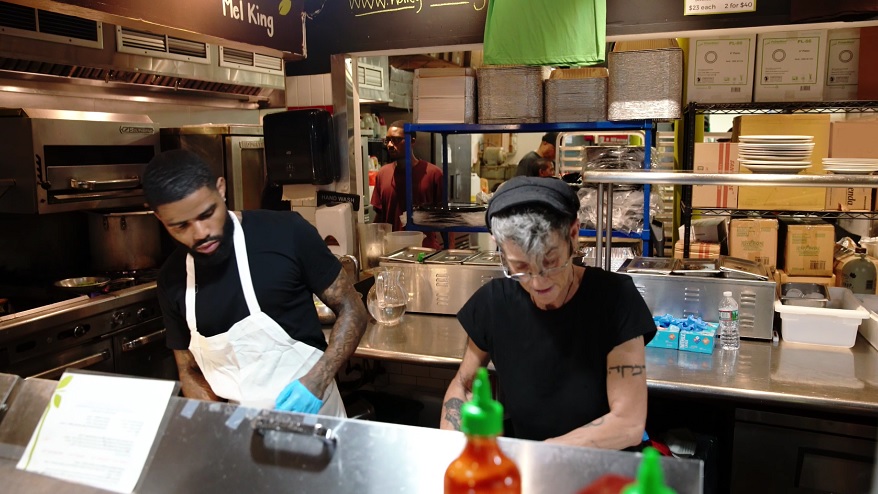
Nonprofit Haley House uses food and community ties to provide job training and to revitalize neighborhoods. When it was closed 11 months for reflection, it was sorely missed in Dudley Square, now Nubian Square.

There’s a nonprofit gathering place in Boston’s Roxbury section where food and mission come together. But when persistent financial losses seemed to threaten its future, fans far and wide worried.

In December, Kay Lazar reported at the Boston Globe, “The little bakery that could is making a comeback.

“When Haley House Bakery Cafe in Roxbury, a bustling eatery and beloved community gathering place, closed its doors in January [2019], its executive director vowed it wasn’t goodbye. It was a timeout to figure out how to make the grand social experiment in Dudley Square financially sustainable. Since its opening in 2005, it never broke even.

“Now the cafe, known for providing job training for former prisoners and hosting community discussions, poetry slams, live music, and community dinners, is planning to reopen in mid-December. It will feature a new menu with an international flair (and some reimagined old favorites). …

“Pivotal to its sustainability, says Bing Broderick, the cafe’s executive director, is its new open-book approach. The restaurant’s financial information is being shared with workers, everyone from the cashier to the dishwasher, and each is being trained to be an efficiency expert. They’ll learn how seemingly little things, such as food waste or showing up late for work, affect the entire operation. Employees will have a say in menu pricing and taste-testing new dishes.

‘It’s very empowering if everyone understands how they can help the success of the business and lead to a better organization overall,’ Broderick said. …

“All food assembly will be moved to the kitchen to free up more space for its legendary live performances, as well as for private events, such as wedding receptions and corporate meetings that Broderick hopes will help them bridge the financial gap. …

“The meals will be bowl-based, with customers choosing a base of grits, home fries, mixed salad greens, or rice, with a pick of protein options — including vegetarian offerings — and a sauce topping. The new recipes will reflect the culturally diverse Dudley Square [now Nubian Square] area, including the bakery’s workers, with African- and Caribbean-influenced sauces and spices. …

“The process of redesigning the menu has featured some fascinating in-house discussions among the bakery’s international staff, [new general manager Misha Thomas] said.

“ ‘It’s been cool to get their thoughts,’ she said. ‘Everyone has an idea of how spicy things are supposed to be.’ …

“One thing that will not be changing is Haley House’s social mission. Founded in 1966 as a provider of food and shelter for the homeless in the South End, Haley House, the bakery’s nonprofit parent company, uses food and community ties to provide job training and help revitalize neighborhoods. … The meal and training programs went on hiatus after the bakery closed last winter, but Broderick said they will be bringing them back.

“Also returning will be cultural events in the evening, from jazz and history to poetry and movies, all offering a beacon in a community that has weathered some tough times and frustrating one-step-forward-two-steps-back revitalization efforts.

“ ‘The arts and cultural programming at the cafe was very much its identity and community ownership, too,’ Broderick said.”

More here.

Read Full Post »


I had an awfully nice lunch yesterday, and I’d like to tell you about it. It involved two nonprofits — the mostly Caucasian conservation group Trustees of Reservations and the mostly African American community-outreach enterprise called Haley House.

The trustees had a really great idea recently to do meaningful art installations on a couple of their properties and chose one next to the Old Manse in Concord. The Old Manse is most often associated with 19th Century novelist Nathaniel Hawthorne, but the grandfather of Ralph Waldo Emerson was also a resident and saw the historic events unfold at the North Bridge on April 19, 1775.

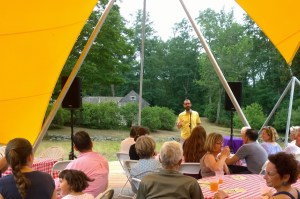
Artist Sam Durant wanted to draw attention to the presence of slaves in the early days of Concord and launch a discussion, so he constructed a kind of big-tent meeting house, with a floor made of the kinds of materials that might have been in slave buildings.

The Trustees conferred with him on a series of “lyceums” that might bring races together at the site. They decided that at the first one, they would encourage races to break bread together and talk about food traditions.

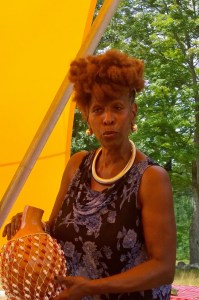
From Haley House in Roxbury, they brought in a chef, a beautiful meal, and singer/educator/retired-nurse Fulani Haynes.

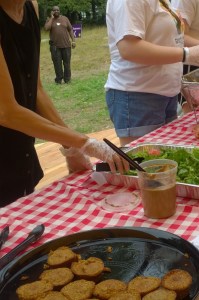
I ate a vegan burger, sweet-potato mash, very spicey collard greens and wonderful corn muffins. Also available were salad and chicken.

Haynes sang a bit and talked about the origins of Haley House, how it helps low-income people and ex-offenders and local children, teaching cooking and nutrition and gardening, among other things. She invited attendees to tell food stories from their early years, and several brave spirits stood up.

That participatory aspect of the activities helped to reduce the impression that African Americans were making entertainments for a mostly white audience (art, food, music entertainments).

I loved the whole thing and learned a lot. (For example, Grandpa Emerson had slaves living upstairs, and “the embattled farmers” who “fired the shot heard ’round the world” were able to go marching off because slaves were working the farms. I really didn’t know.)

African American artifacts are on display next door at the Old Manse. The art installation will be up until the end of October 2016.

More here.

Photos: Artist Sam Durant offers the crowd a new lens on history. The chef from Haley House keeps an eye on the African American cuisine. Fulani Haynes demonstrates how a food can become an instrument.

081316-artist-Sam-Durant-at-installation-picnic

081316-Fulani-Haynes-sings-in-Old-Manse-field


081316-Haley-House-chef-and-corn-muffins

Read Full Post »

Babson College in Wellesley, Mass., is well known as a hub for entrepreneurship. So the school was the logical place to help start-ups offering farmers distribution services, marketing, and the like learn how to grow their business. A training was held at Babson at the end of December, and the New York Times covered it.

Stephanie Strom writes, “In spite of the surging demand for locally and regionally grown foods over the last few years, there is a chasm separating small and midsize farmers from their local markets.

“But a growing number of small businesses are springing up to provide local farmers and their customers with marketing, transportation, logistics and other services, like the Fresh Connection, a trucking business providing services to help farms around New York City make deliveries. …

“The Fair Food Network, a nonprofit organized to improve access to better food, recently held a second ‘business boot camp’ in Wellesley, Mass., for tiny companies working to increase ties between communities and local farmers, which culminated in a contest to win some $10,000. …

“For farmers selling products to a number of customers, there are so-called food hubs like Red Tomato, which connects its network of farms to existing wholesale distribution systems to make deliveries of locally grown fruits and vegetables to groceries, produce distributors, restaurants and schools in the Northeast. …

“Not all ways of improving consumer access to local and regional farm production involve distribution, however. Blue Ox Malthouse, for instance, is making malt from barley grown in Maine as a cover crop. Normally, farmers plow barley under or sell it cheaply for animal feed.  Blue Ox has given them a new and more lucrative market, though, buying up barley and turning it into malt in hopes of selling it to Maine’s thriving craft beer businesses. …

“It’s good for the farmers, who get a better price for a product they often just plowed under, and it’s good for the craft beer business, where brewers are always looking for points of distinction,” [founder Joel] Alex said.”

Read about some other great services for small farms here.

Photo: Michael Appleton for The New York Times
Mark Jaffe of the Fresh Connection picks up fresh eggs from a farmer’s stand in Union Square, Manhattan. He will make deliveries to restaurants and groceries.

Read Full Post »

Unless you are going to the Danforth Museum of Art, I do not recommend ever going to Framingham (traffic issues, strip mall issues).

But I am very glad I finally made it to the Danforth today because it is a lovely museum with a community outreach effort that I admire.

The exhibit I went to see was described in the Boston Globe by by Sebastian Smee.

“One of the things you notice first in ‘Eternal Presence,’ a terrific career survey of John Wilson at the Danforth Museum of Art, is how attentive Wilson is to the faces of children. From his earliest days sketching his brother to his most recent large-scale drawings in charcoal, the impulse has remained the same: It is an impulse toward clarity, toward truth. He doesn’t sentimentalize or caricature children. …

“What you notice later is the high number of pictures showing children in the arms of adult men and women. … Wilson is after something elemental and profound. But the resulting image is not just another mother and child, or dad with young kid. There is instead, each time, something tender and hard-won about what you are looking at. A hope, a promise, a lament all in one.

“Wilson, 90, is one of Boston’s most esteemed and accomplished artists. He was born in Roxbury, the son of parents from British Guiana (now the nation of Guyana), was admitted to the School of the Museum of Fine Arts in 1939 after developing a natural aptitude for art at the Roxbury Boys Club, where he attended classes taught by SMFA students.”

Smee goes on to describe Wilson’s long career, including a stint in France, his interest in the Mexican muralists, and his sculptures of Martin Luther King Jr. (one is in the Capitol rotunda).

Amazing that the artist is around and will be giving a talk at the museum. Try to go. The show is up until March 24. And you may enjoy as much as I did the African American sculptures by Meta Vaux Warrick Fuller from the permanent collection and the joyful Harlem watercolors of Richard Yarde.

More at the Globe.

Lithograph by John Wilson

Read Full Post »