Feeds:
Posts
Comments

merlin_171401421_7bd14fe0-6988-4520-9c7d-acf5ead55b88-superjumbo

Photo: Erin Schaff/New York Times
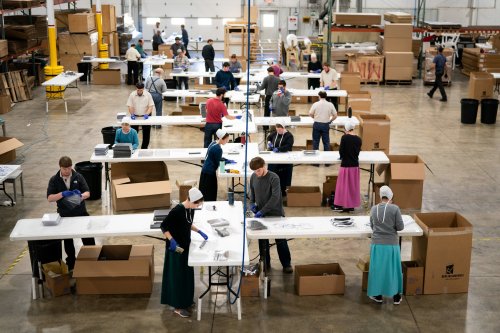
Workers assembling face shields at Berlin Gardens’ warehouse, Millersburg, Ohio, early this month. T
he Amish community is stepping up to fight coronavirus.

I know very little about the Plain People, and as is often the case when we know little about a group, we make assumptions. Amish communities are said to keep to themselves mostly, so perhaps I assumed that they would deal with coronavirus among themselves and not participate with wider efforts to tackle it. Wrong again, Suzanne’s Mom!

Elizabeth Williamson, reporting from Sugarcreek, Ohio, writes this for the New York Times: “On April 1, John Miller, a manufacturer here with deep connections to the close-knit Amish community of Central Ohio, got a call from Cleveland Clinic. The hospital system was struggling to find protective face masks for its 55,000 employees, plus visitors. Could his team sew 12,000 masks in two days?

“He appealed to Abe Troyer with Keim, a local lumber mill and home goods business and a leader in the Amish community:

‘Abe, make a sewing frolic.’ A frolic, Mr. Miller explained, ‘is a colloquial term here that means, “Get a bunch of people. Throw a bunch of people at this.” ‘

“A day later, Mr. Troyer had signed up 60 Amish home seamstresses, and the Cleveland Clinic sewing frolic was on.

“For centuries, the Amish community has been famously isolated from the hustle of the outside world. Homes still lack telephones or computers. Travel is by horse and buggy. Home-sewn clothing remains the norm. And even now, as the coronavirus rages in the country at large, there is resistance from people sustained by communal life to the dictates of social distancing that have brought the economy to a halt — in Amish country as everywhere else.

“But as the virus creeps ever closer, the Amish community is joining the fight.

“ ‘If there is a need, people just show up,’ said Mr. Troyer, a man in his 40s with a gray-streaked beard and a mild German accent. …

“The pandemic has idled hundreds of Amish seamstresses, craftsmen and artisans, and Amish people do not apply for federal unemployment benefits.

“ ‘It conflicts with our faith and our commitment to the government,’ said Atlee Raber, who founded Berlin Gardens, an area garden furniture maker that now makes protective face shields.

“Almost overnight, a group of local industry, community and church leaders has mobilized to sustain Amish households by pivoting to work crafting thousands of face masks and shields, surgical gowns and protective garments from medical-grade materials. When those run scarce, they switch to using gaily printed quilting fabric and waterproof Tyvek house wrap.

“ ‘We consider this a privilege that we can come in here and do something for somebody else who’s in need and do it right at home here, and do it safely,’ Mr. Raber said, instead of ‘taking handouts.’

“Mr. Miller, who is president of both Superb Industries, a manufacturer in Sugarcreek with medical, automotive and commercial clients, and Stitches USA, a commercial sewing operation, calls March 16 ‘Black Monday.’ That’s when social distancing guidelines laid waste to Holmes County’s economy. … Member businesses employ about 6,000 people, the majority of them Amish. Three days later, Mr. Miller created ‘Operation Stop Covid-19.’ …

“With area businesses, he set up a website and enlisted emergency workers from Sugarcreek Fire & Rescue to model prototypes of N95 mask covers, fluid-resistant gowns sewn of tarp material from Zinck’s Fabric Outlet in Sugarcreek, and boot covers made of Tyvek from Keim, in nearby Charm, Ohio.

“Keim’s Amish millworkers built hardwood dividers for field hospitals in New York, the meticulous workmanship belying their temporary purpose. Berlin Gardens, which normally makes garden furniture from recycled plastic milk jugs, completed their first order of 20,000 plastic face shields for Yale New Haven Hospital last month.

“ ‘We’re close to 100,000 a day,’ Sam Yoder, the current owner of Berlin Gardens, said last Friday. ‘It almost covers our payroll. Not quite.’ …

” ‘Cleveland Clinic has been here for us,’ Mr. Miller said. ‘They saved my mom’s life many times.’ ”

More here. The part about Covid-19 challenges to the communal way of life among the Amish is interesting. Like the rest of us, everyone is having to rethink how things get done.

Deb at https://abearsthimble2.wordpress.com/, I know you are not Amish, but you know a lot more about their way of life than I do, so if a comment on this post comes to mind, send it to suzannesmom@lunaandstella.com and I will post it. That way we can work around the Comments glitch.
04062020_muralartists_105054-1020x574-1

Photo: Ramon Dompor
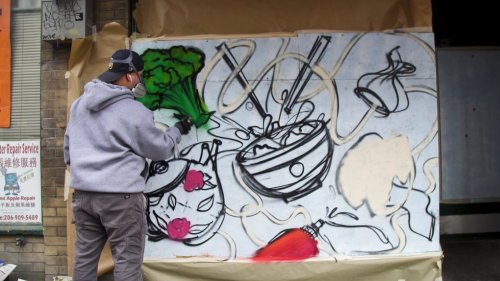
Artist Carlos Ruiz works on his mural to cover the boards on the Jade Garden Restaurant. Ruiz and other local artists donated their time and paint to help several restaurants in Seattle.

As we all know, Washington State had the first cluster of coronavirus cases in the US, and it is still struggling. That’s why the Seattle Times decided to solicit stories for a Stepping Up series meant to bring residents some encouragement.

In one example, Chris Talbott reported on artists beautifying boarded-up storefronts.

“Plywood is going up all over town. It’s not pretty. Give Seattle’s art community a little time, though, and it will catch up. Already artists are out and about, painting  murals to combat the growing blight as the novel coronavirus pandemic forces continued closures of local businesses and restaurants.

” ‘I have been homebound mostly like everybody else and trying to think of ways that I can help my community,’ artist Amanda Bishop said.

‘I’ve been feeling a little bit helpless because I’m not on the front lines. I’m not a nurse, I’m not a doctor. I don’t have a ton of money and my husband and I both lost work because of the virus. So when this opportunity came up, I was like, “This is a way that I can use my skills because this is my full-time thing.” ‘

“Working with permission from owners through the group Overall Creative, Bishop has started painting murals. She spent Sunday at the corner of Pike Street and 10th Avenue working in front of the Comet Tavern and Lost Lake Café along with other artists, each presenting their own vision. …

“Bishop said, ‘I actually did have a lot of people come up and say thank you. And I’ve done a ton of murals over the last eight years of doing this professionally and I haven’t had that as much as I had the last two days.’

“Plywood started going up [in March] after vandals began smashing windows of closed businesses. That led to more plywood from store owners who feared they might be next. Things were starting to look bleak all over town.

“The folks at Venue in Ballard realized this immediately. The shop sells the work of local artists and features a row of large picture windows. There was no question the windows needed to be covered up, but plywood seemed so … blah. So owners decided to hire a painter to beautify the plywood with a forest scene. …

“Venue owner Diane Macrae said, ‘Knowing artists are struggling as well with canceled shows and lack of sales, we figured it was a chance to provide some additional work for them. Our store is all about supporting local artists, so it made sense to continue to do this during this time in any way we can.’

“A similar effort has been under way in the International District and Little Saigon areas after vandals took out the windows of several restaurants nearly two weeks ago. …

“Ivy Chan and her family, which has run Jade Garden for 17 years, aren’t sure if the vandals were trying to break in or were just out to cause damage. But she feels the opportunity arose because the streets are virtually empty thanks to the stay-at-home order.

“ ‘Those people, they like to take advantage of the fact that there’s less people now because they’re all trying to do their diligent part to stay home,’ Chan said. “And then other people are like, ’Oh, it’s easier for me to go out there and do stuff. There’s less police patrolling, there’s less eyes to watch.’ …

“Keoke Silvano, a local photographer, … organized a group of artists who proceeded to paint the colorful mural at Jade Garden. He hopes it’s just the start, and that painters who might be out of work or looking for a way to contribute will continue the effort for businesses forced into fortress mode. …

“ ‘It seems to me that some of these businesses might’ve been targeted because they are Asian businesses,’ Silvano said. … He decided to fight back and put out word to the art community. He ended up with a half dozen or so painters who decorated the front of Jade Garden in a variety of colorful styles. They used mostly spray paint to craft scenes that included a meal of noodles, vegetables and tea with a fortune cookie, and a Seattle skyline framed by jacaranda blossoms.”

More here.

Isn’t that the way things go? First something bad like vandalism happens, then individuals in the community basically say, “I’m not on that team” — and join forces.

iu6gz4ze2zbl5godytm4y5pgqu

Photo: Jim Davis/Globe Staff
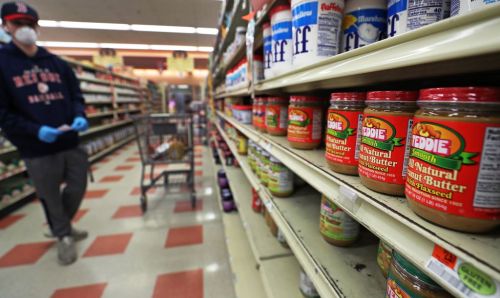
Jars of Teddie Peanut Butter on the shelves in Market Basket, Nashua, New Hampshire. Teddie is increasing production to meet new demand.

But wait! There’s more. More, that is, on civic-minded businesses pivoting to meet the pandemic challenge. Whether it’s companies like Teddie Peanut Butter increasing production to prevent shortages (here), or the companies that are suddenly making something new, it’s all good.

Here’s a nice story by Leanne Italie at the Associated Press that was broadcast on WEARTV about a small sail company.

“On the coast of Maine, Eric Baldwin and his staff of two usually spend their days selling, repairing and washing sails for boats. They transform their surplus sailcloth into tote bags to bring in extra money.

“But when the coronavirus outbreak slowed business, they turned their industrial sewing machines to a new task: making cotton masks for caregivers and others who need protection from the disease.

‘We wanted to do something to give back,’ Baldwin said from his North Sails workshop in the small village of South Freeport, about 20 miles north of Portland. ‘Doing something like this just makes you feel good.’

“The 53-year-old Baldwin, who has operated his shop, known as a loft, for about 25 years, got the idea from employee Karen Haley. They went to work immediately and are now shipping to recipients as far away as Arizona after word spread on social media that masks were available. …

“Haley’s mother is a quilter. She raided her mom’s stash of cotton remnants to turn into double-ply rectangles called for by a mask pattern they found on a hospital website. Baldwin’s former wife got a Jo-Ann fabric store to provide elastic at a discount.

“Although they still have orders to fill for totes and sails, a portion of each day is dedicated to masks. Baldwin’s other worker, Alan Platner, volunteered to sew masks at home as well. …

” ‘I have every intention of keeping both of these people employed, and we’re not at a point yet where that’s even close to being in jeopardy, but I do think in terms of the tote business. I would be shocked if that picks up. We’re essentially missing the tourist season,’ Baldwin said. …

” ‘The response from the people has been overwhelming,’ Haley said. ‘They’ve been so appreciative of what we’re doing. The recipients include a woman who works for the Department of Homeland Security whose husband is an EMT. Others are nurses and nursing assistants. One is a social worker who makes home visits.’ …

“There’s been a run on elastic so when their stash is gone they might have to quit. He’s scrounging for more.

“Even if he’s no longer able to produce the masks in Maine, the effort is likely to continue elsewhere. Baldwin put out the word to other North Sails lofts around the country, letting them know what he was doing. Four have already offered to begin making masks, including shops in San Diego, Chicago and Annapolis, Maryland.” More.

Meanwhile in Rhode Island, as @angusdav noted on Twitter recently, “Kinder Industries shifted production today from boat canvas to PPE face shields at our industrial park in my hometown Bristol, RI. 3M raw material truckload arrived today; manufacturing begins Monday. 1st 8,000 to R.I. hospitals. Ready to supply others.”

Please give a shout-out to other companies stepping up during the pandemic. We need to remember them down the road.

Photo: AP/Robert F. Bukaty
In this Monday, March 23, 2020, photo, Eric Baldwin examines the stitching on a cotton mask, one of hundreds he and the employees at his sail-maintenance business are making for coronavirus caregivers at North Sails in Freeport, Maine.

46d3cefa-d589-4653-af04-8942d0234ca2-medium16x9_ap20083809763998

040520-Melvin-Memorial-ConcordMA

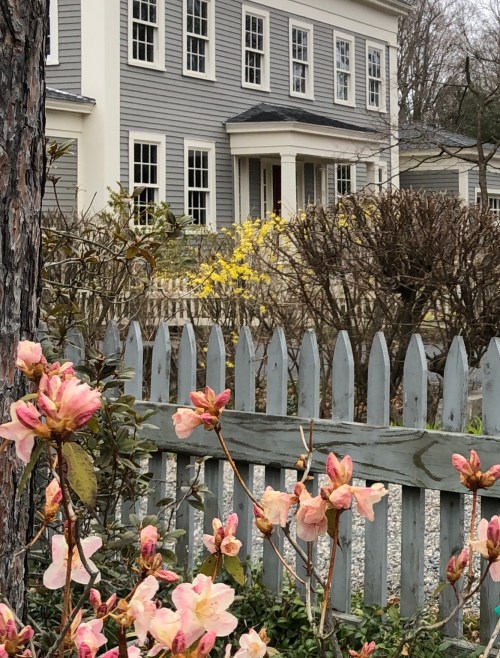
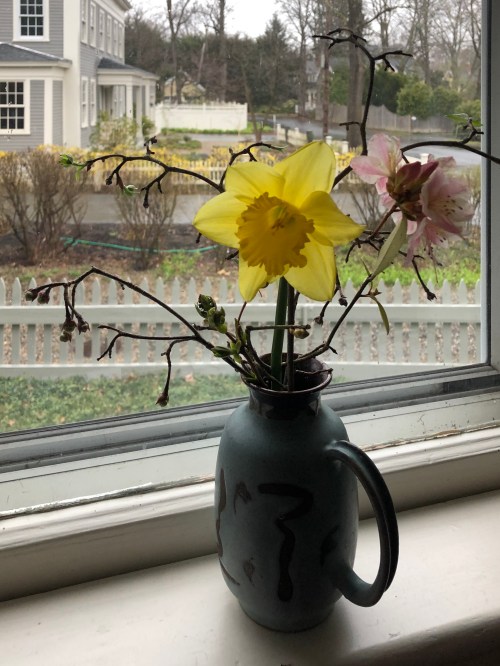
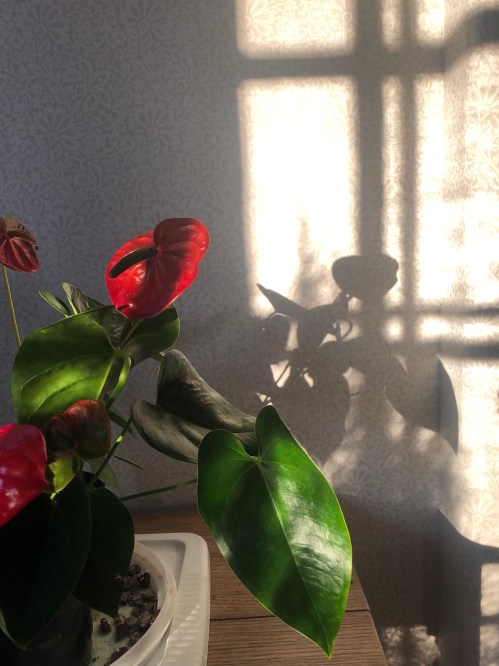
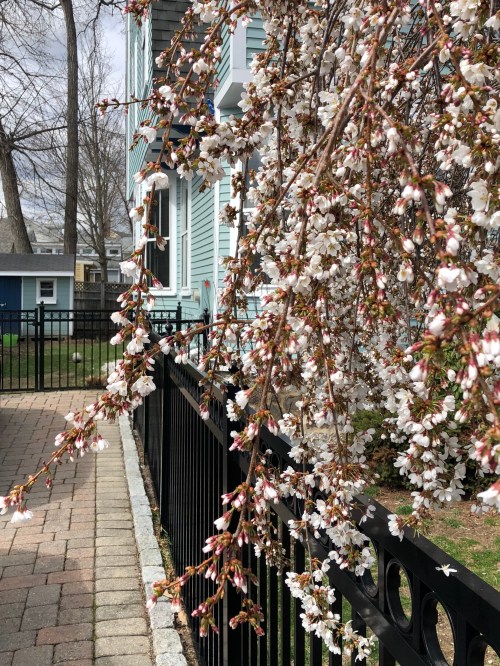
Time for a few more photos sent to me by family or gathered on a walk. What would I do without the outlet of walks?

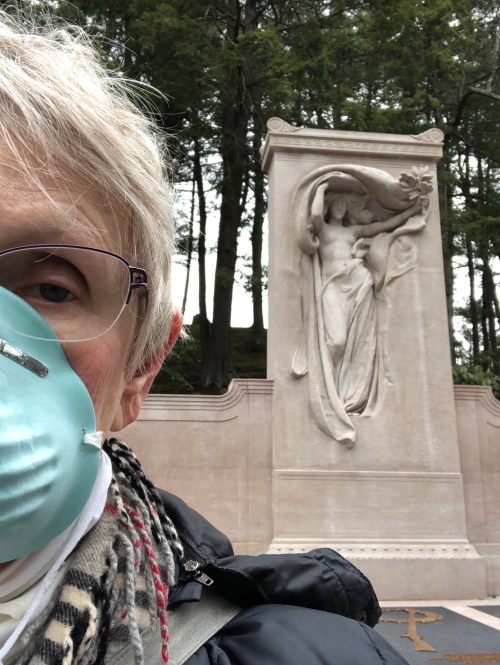
Above I am bundled up in front of the Melvin Memorial at Concord’s Sleepy Hollow cemetery. It commemorates another bad time in US history, the Civil War. A heartbroken man whose three brothers never came home commissioned the famous Concord sculptor Daniel Chester French (who created the statue of Lincoln at the Lincoln Memorial in DC) to make this lovely recognition of his brothers’ service.

French, by the way, is buried not too far from this, near authors Henry David Thoreau, Nathaniel Hawthorne, and Louisa May Alcott.

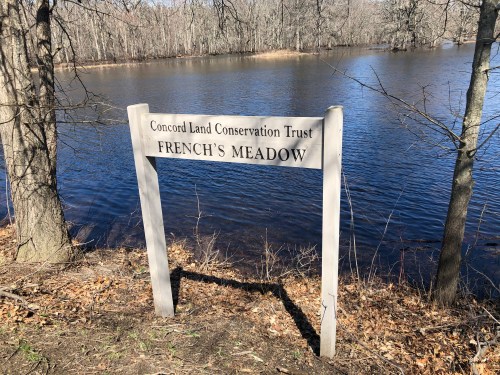
In the next picture, I’m photographing John’s adventurous neighbors from the bridge over the Sudbury River as one of them photographs me. The bridge is near the next scene, a meadow that the river floods every spring.

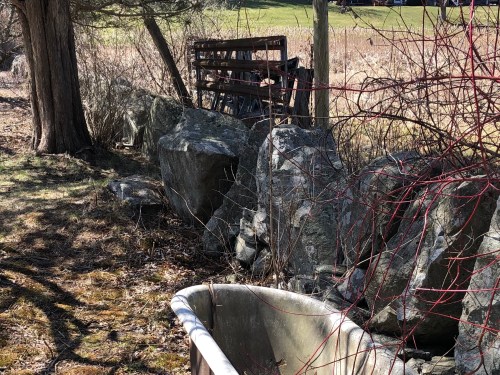
A walk on conservation land can turn up a fox if I’m lucky. Or maybe a bathtub.

What to make of the bear? I did read somewhere that folks in another town were putting teddy bears in windows to make a safe scavenger hunt for neighborhood children, but this was the only bear I encountered on my walk. He looks like he is being held for ransom.

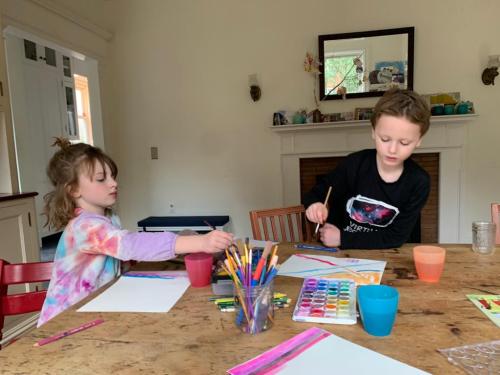
In the last picture my Rhode Island grandchildren are making flags of countries they have invented where there is no coronavirus. According to Suzanne, my grandson’s country is “a mountainous island off of Norway [and my granddaughter’s] is filled with rainbows, unicorns, and — LOL — dolls.”

Laurie, I know you’d like a country with unicorns.

032820-me-filming-the-Teel-St-gang

033120-underwater-meadow

033120-outdoor-tub

033120-shadows-on-grass-straight-view

040220-flowering-bushes

040820-are-there-bears-in-the-woods?

400820-bouquet

040620-red-green-shadows

040820-flowering-cherry-at-neighbor

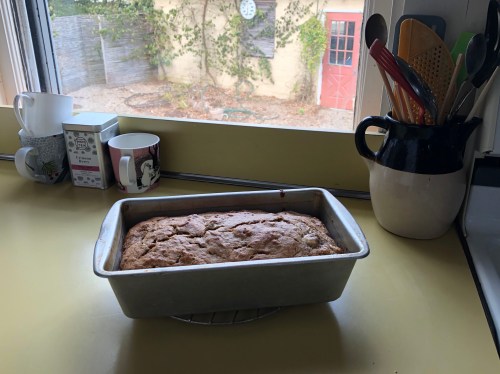
040120-banana-bread-in the-plague-year

2020-04-01-making flags-of-country-with-no-coronavirus


gerbil-museum-2-1080x607-1

Photo: Filippo and Marianna
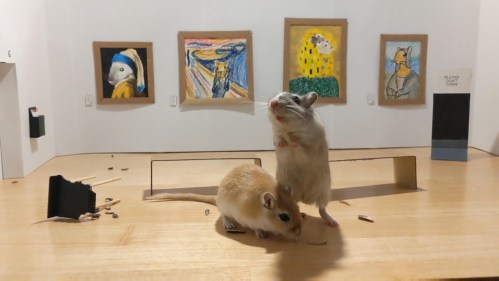
Nine-month old gerbils Pandoro and Tiramisù survey London’s newest art institution, the Gerbil Museum.

This cute story from London about two imaginative shut-ins and their pets makes me think of Beatrix Potter books. But which one in particular? Maybe The Tale of Two Bad Mice? What do you think?

Hrag Vartanian reports for Hyperallergic, “Pandoro and Tiramisù are not your ordinary gerbils. The London-based pair got a special surprise when their owners, Filippo and Marianna, created a miniature museum  just for them during the current COVID-19 quarantine. …

“Both Filippo and Marianna are art lovers, with one working in a local museum and the other as an artist and writer. The gerbils declined to comment.

“Hyperallergic: Tell us about your gerbils!

“Filippo and Marianna: They are 9-month-old brothers and their names are Pandoro and Tiramisù. Pandoro is tawny while Tiramisù is the taupe one.

“H: Have they demonstrated a love of art before?

“F&M: Not really, this was their first time in a museum. They much enjoyed the display and paid close attention to the quality of the gallery’s props. They can’t read, so the sign to advise the visitors to not chew [on the furniture] went completely unnoticed. Overall, it seemed to be a satisfying and engaging experience.

“H: How did you choose the paintings?

“F: Initially we wanted to select less famous paintings but in the end we thought it would have been funnier and more engaging to choose some of the best known works in art history. … Marianna is very good at painting and I couldn’t help but wonder how ‘The Kiss’ and “’Girl with a Pearl Earring’ could have looked with a gerbil twist. …

“H:  Did Pandoro and Tiramisù enjoy the opening of their private museum?

“F&M: Initially they explored the gallery space looking for clues about the rather eclectic selection of artworks. After a while, boredom and a certain love for disruptive gestures grew to a point they managed to start a performance by chewing the empty gallery assistant’s stool — an act that we were lucky enough to film. …

“H: Is this a complicated ploy to write off your gerbils on your taxes?

“F&M: Maybe yes, although they are not very expensive. As long as we have seeds and mini gallery assistants’ stools we are good.”

The blogger Bereaved Single Dad, also in England, frequently mentions gerbils. This is from 2019: “A couple of days back we set off for the pet shop to get a gerbil. A couple of hours later we had fallen for the story of the three inseparable brothers who they didn’t want to split up. … Happy Son. Confused Dad.

“Meet our three new faces. Cupid, Jeff and Hendrix. Unbelievably the house is already covered in wood chippings. Suspect I will need a bigger Hoover.”

The video of the museum-going gerbils is at Hyperallergic, here.

As the New Yorker magazine used to say in a bottom-of-the-column feature: “There’ll always be an England.”

salad-850x478large

Photos: Off Their Plate
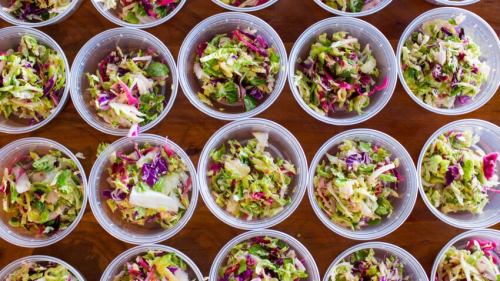
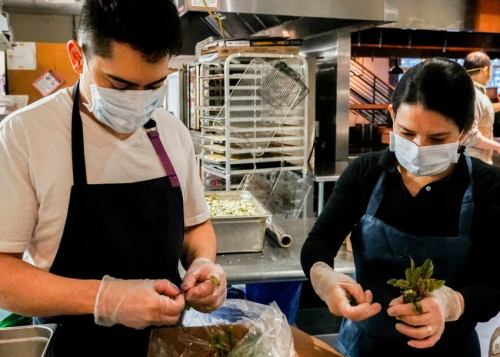
Off Their Plate cooks and delivers healthful meals to healthcare workers.

Amid government failures, can individual efforts ever be enough in a catastrophe like today’s?  I think they can be because feeling good about doing something concrete feeds on itself and simultaneously inspires others. You are probably doing things yourself, like donating to a food bank or calling friends you don’t normally call who are at home alone.

Suzanne, for example, has signed up on Twitter to promote a desperate call from Rhode Island emergency doctors for masks and other personal protection equipment (PPE). Please write in Comments what you are up to. No matter how small, I am interested.

Devra First has a nice story at the Boston Globe, “With restaurants closed for dine-in business, the industry is suffering, and many people have lost their jobs. At the same time, workers on the front lines of the coronavirus don’t have time to prepare nutritious meals to help keep them going. A new organization, Off Their Plate, is working to address both problems.

“It began when Natalie Guo, a medical student at Harvard who previously worked in business, reached out to local chefs Ken Oringer (Little Donkey, Toro, and more) and Tracy Chang (Pagu). The idea: Raise money to provide meals to health care workers, and pay cooks now out of work to make them.

‘In 10 days, we raised something like $80,000,’ Guo says, and the effort has expanded to New York, Pittsburgh, San Francisco, and Los Angeles.

“By [March 26], its fifth day of operation in Boston, Off Their Plate had served close to 1,000 meals in the area — to Massachusetts General Hospital, Brigham and Women’s, Faulkner, Boston Medical Center, and Beth Israel Deaconess, with more coming soon, including Carney Hospital, Boston Health Care for the Homeless, and other federally qualified health centers. Meals go to everyone from nurses to hazmat teams to the people working the front desk. ‘It’s a massive effort here,’ Guo says. ‘It’s not just MDs. Very soon this is going to consume the entire health force.’

One hundred percent of donations go to wages and meal costs. According to a ticker on the website [March 27], Off Their Plate has so far raised enough to cover 6,500 meals, more than 2,000 work hours, and $32,500 in wages. A $100 donation covers the cost of providing 10 meals.

“ ‘It’s been really fortuitous to be able to get a lot of the people who are not able to collect unemployment or people we decided to reach out to … and be able to help them earn some money,’ Oringer says. ‘A lot of them have been with us for more than 10 years. We are trying to take care of our family and our community. We’re getting food from purveyors, from fishermen, who are getting really, really hurt by all of this.’ …

“They are creating recipes and safety protocols that can be passed along to partner chefs in other cities, so they too can join the effort. ‘We want to make sure we are taking the utmost precaution in the health and safety of our own employees and the people they are feeding. The last thing we want to do is be part of the problem,’ Chang says.” More here.

Erin Kuschner has another take on the story at Boston.com, which is separate but related to the Boston Globe. She adds, “Guo, who was doing her clinical rotation at Massachusetts General Hospital before she launched Off Their Plate, is amazed by the charitable actions of everyone involved.

“ ‘Our goal is to serve Boston as well as we can, which means getting to volunteer for the homeless and getting to areas where healthcare workers are really in need,’ she said.”  The unemployed restaurant workers get paid, but not the others involved. Of them Guo says, ‘Not a single person has asked for a single dollar of service, and that’s just really incredible.’ ”

Off Their Plate meals being prepared before delivery.

roberto-andrea-herbs-by-tclarge

2019-Malcolm-Greenaway-Voices-from-Village

Photos: Malcolm Greenaway

April is National Poetry Month. I know quite a few poets, and I truly value the way they capture feelings obliquely and more deeply than common speech. In fact, at my sister’s memorial service in January, I read my friend Ronnie Hess‘s poem called “What We Scarcely Know,” from her collection Ribbon of Sand about a childhood on Fire Island. The theme of sand repeatedly washing away and returning in a new form really spoke to me. What poems speak to you?

ronnie_hess_writer-poet

Photo: Wisconsin poet Ronnie Hess

Rhode Island poet Nancy Greenaway has been bringing a love of poetry to her community and to students on Block Island for decades. Recently she told me, “For National Poetry Month, I usually organize a reading of favorite poems by community members who are not poets: a ferry captain, a police chief, a teacher, a real estate broker, a minister, a doctor, a guitar-playing student, a gift shop owner, a first warden [something like a mayor], a manager of the power company, for example.

“We had scheduled the Voices from the Village reading for April 24, but cancelled because of COVID 19. Instead, we are asking community members to email favorite poems to their friends during the month of April. I’ve received two so far:
Wendell Berry’s ‘The Peace of Wild Things‘ and Kitty O’Meara’s ‘And the people stayed home.’ ”

Nancy’s email inspired me to search online for articles about past Voices from the Village events. This is from the Block Island Times, May 2018: “The annual community poetry reading known as Voices from the Village featured a wide range of voices reading the works of many different poets:

“Here is the poem by [former first warden] Edie Blane’s sister, Eileen Lee, titled ‘Block Island Spring,’ from Jan. 31, 1962.

miss20edie20blane

Photo: Malcolm Greenaway

“Spring doesn’t come to our bleak island home

“With whispering air and fragrant smell of earth.

“Ours is a different world —

“Grey, cold and harsh,

“And April days are angry with us still.

“The equinox comes in with windy roar;

“Pale dune grass dips and rises in its path.

“Seas crash

“White crested and dark shining green.

“The sun is bright but gives no pleasant warmth.

“And yet we have a portent, old as time,

“Though cold winds rule us yet, with icy breath;

“A day of quiet comes —

“The Sound grows still, a pale and milky blue

“The smallest waves lap gently on the shore.

“In the great echoing stillness on the sea

“The sweet slow tolling of the buoy rolls in.

“At last, this is the long awaited time,

“First sign of island spring.”

See all the Malcolm Greenaway photos of the 2018 readers here. And for inspiration from Nature, check the photographer’s website, here.

I’m wondering if a group poetry reading could be done virtually, the way these singers handled the old-time spiritual “Down to the River.” Looks complicated.

200331092911-02-wild-goats-wales-coronavirus-exlarge-169

Photo: Carl Triggs
Wild Kashmiri goats pay a visit to a newly empty Welsh town. “The goats live on the hill overlooking the town. They stay up there, very rarely venturing into the street,” a resident told CNN.

They say that Nature abhors a vacuum, but I doubt anyone was thinking of this. In a Welsh town under quarantine, wild Kashmiri goats decided it was safe to check things out.

Aleesha Khaliq writes at CNN, “A coastal town in north Wales has found a whole new meaning to the phrase herd immunity, after goats were spotted roaming its quiet streets.

“It comes just days after British Prime Minister Boris Johnson introduced tighter restrictions around social movement last week in a bid to limit the spread of coronavirus.

“Residents spotted herds of goats strolling around Llandudno on Friday and over [last] weekend, after more than a dozen of the animals ventured down from the Great Orme headland and roamed the streets of the coastal town. …

“They are referred to as Great Orme Kashmiri goats, whose ancestors originated from northern India, according to the town’s official website.

“Town resident, Carl Triggs, was returning home after delivering personal protective equipment masks when he saw the goats. ‘The goats live on the hill overlooking the town. They stay up there, very rarely venturing into the street,’ he told CNN. …

“Mark Richards, from hotel Lansdowne House, told CNN: ‘They sometimes come to the foot of the Great Orme in March but this year they are all wandering the streets in town as there are no cars or people.’ …

“Local councilor Penny Andow told CNN she has lived in the area for 33 years and has never seen the goats venture from the Great Orme down into the town. …

“However, the [police] force said it was ‘not that unusual in Llandudno. … They usually make their own way back.’ ” More here.

The town’s website has lots more: “The first intimation of Llandudno Goat – Latin name, Capra Markhor, is the rank odour. It is strong, musty and compelling (a bit stinky). … The creatures eat with discrimination. Delicately nibbling the juiciest berries, whilst carefully avoiding the thorns. …

“All goats have their own peculiarities, and it is possible to identify individuals. One billy, in particular, is easily recognisable. He is smaller than the others, and has a longer, shaggier coat. This goat is an outsider. He is one of three goats introduced into the herd from Whipsnade Zoo.

“It was not a very successful experiment. The first goat died within weeks of arrival. The second decided that he was probably not a goat, but a sheep. He mixed quite happily with the flock, until, unfortunately, he fell off a cliff and was killed. This is very unusual, as goats are extremely sure footed. The third goat survived, and eventually became accepted by the herd.”

You know what I would like to see walking through town: a moose. I have always wanted to see a moose that wasn’t just in a zoo. What would you like to see? Mythological beasts permissible.

produce_carrot

Photo: Brett Forsyth, Flickr, CC BY 2.0
Much of US food is wasted because of aesthetics, but more people are realizing that twisty carrots are as good as ordinary carrots — “perfect imperfections.”

I like how the radio show Living on Earth manages to find the environmental angle for whatever is in the news.

A recent episode addressed how “social distancing and staying at home is whetting consumers’ appetite for grocery delivery” and how some companies that deliver “aim not only for convenience but for reducing food waste.” Host Steve Curwood introduces Bobby Bascomb’s interview with Abhi Ramesh, CEO of Misfits Market.

“STEVE CURWOOD: Companies including Hungry Harvest, Imperfect Produce, and Misfits Market work with farmers to collect produce that isn’t quite good enough for supermarket shelves but is still perfectly edible. They’ll pack them up and deliver weekly straight to your door. …

“BOBBY BASCOMB: Please explain your business model to us. …

“ABHI RAMESH: We essentially rescue a lot of different types of products that would otherwise go to waste in our food system. And we ship it directly to households. And the idea is that you can save money and also help combat the global food waste problem. …

“We make it a priority of ours to work with non-commercial farms. … We figure out what is consumable for human consumption, and we repurpose it and ship it directly to people.

“BASCOMB: And why would it otherwise be going to waste?

“RAMESH: [We see] three big buckets. The first one is an aesthetic reason. … The second big bucket is size constraints. So we’ll have products that are either too small or too large to sort of fit into the size restrictions that regular buyers would want. So we see some of that. And the third bucket, which I think a lot of people don’t necessarily think about, is simply excess. So you know, nature operates in interesting ways and isn’t necessarily always predictable. And buying patterns from large supermarkets and grocery chains are also not super, super in line with what growers are producing. So the food system produces a lot of excesses accidentally, and we’re able to purchase that and sell it to our subscribers at a big discount.

“BASCOMB: And where would these imperfect and excess fruit and vegetables go if not for services like yours? …

“RAMESH: If a grower is not able to sell stuff, they’ll either toss it or they’ll end up leaving it in the ground. So we, a lot of times we’ll see farms that choose not to harvest something that they’ve grown just because they think there’s not a market for it. …

“BASCOMB: Surely it could end up in a food pantry or something like that, though? …

“RAMESH: There’s a very, very, very small number of them that actually have the infrastructure today to go and ship items consistently to food banks and food pantries. … At Misfits Market, we sort of see ourselves as building that kind of pipeline and that infrastructure where it didn’t exist already. So we’re aggregating food from a lot of different growers. We sell what we can to folks that want to save food, want to eat more affordably. And then we actually donate a pretty large chunk of it to food banks and food pantries. …

“BASCOMB: Now, how do you know that the produce in a Misfits Market box would actually have gone to waste? I mean, an ugly carrot, for example, can still be shredded, or a bruised tomato can be made into sauce or something, right? …

“RAMESH: Yeah. So you know, in theory, [but] for every one grower that has access to, you know, a carrot shredder, there are twenty other carrot growers that do not. …

BASCOMB: Looking down the road, what do you see for the future of Misfits Market and this idea of avoiding food waste more generally? …

“Our goal over the next couple of years is to really grow Misfits Market to be a national brand that sort of embodies a lot of things we want to embody around the affordability of food and sustainability and food waste. … And also in the process, educate households and consumers on what they can do on their end to sort of tackle that food waste problem.

More at Living on Earth, here.

merlin_171027342_b2073294-9cfa-462a-ab1d-2b4acc7952b7-jumbo

Photo: C.J. Chivers
Andrade’s Catch has been buying clams from a rotating group of fisherman to keep revenue flowing to quahoggers.

My friends in Minnesota and Wisconsin have perhaps not been asking themselves, “How are the quahoggers doing these days?” but on the coast, a few journalists are checking in on the folks who provide our seafood.

C. J. Chivers (a New York Times writer who sells clams but has no connection to the shop in this story) reports about a lifeline for clam diggers.

“Lou Frattarelli eased his flatbed truck into the loading zone at Andrade’s Catch, a small seafood shop in [Bristol] on Narragansett Bay. … He had four sacks of quahogs to sell, raked on the still-running tide from the bottom of the bay.

“Davy Andrade, one of the shop owners, met him at the door. Mr. Andrade was buying, one of the few shellfish dealers in the state still employing clammers and bringing a local seafood staple to residents.

“ ‘What do you want me doing tomorrow?’ Mr. Frattarelli asked, hoping for one more day’s pay.

“ ‘Another 500, if you can,’ Mr. Andrade answered.

“Five hundred littlenecks is far fewer clams than an experienced quahogger can rake in a day from the rich waters around Prudence Island, where Mr. Frattarelli had been working. But in the age of the coronavirus, it amounted to a boon.

“Many fishing ports across the United States, long imperiled and struggling under strict regulations and the declines of valuable fish and shellfish stocks, have fallen even quieter in the pandemic. …

“Until two weeks ago, much of the East Coast’s daily harvest of wild clams was channeled through wholesale buyers to restaurants and raw bars, many of them in New York City. When bars and restaurants were closed, wholesalers stopped buying.

“In Rhode Island, where state regulations forbid quahoggers from selling clams directly to consumers, the result is that the fleet has all but stopped working — even though catches were high and people, wary of going into crowded and picked-over grocery stores, are eager for healthy meals. …

“Andrade’s Catch has managed to support quahog sales, at least at a small scale. While the shop does a robust wholesale business, it also runs a retail shop out front. By shifting operations almost entirely to retail, it has kept a few boats on the water.

“ ‘I’ve got about six guys I am buying from,’ Mr. Andrade said, and he rotates their days. ‘We want to keep the guys going.’ …

“Said David Andrade, Davy’s father and a co-founder of the shop with his wife, ‘I’ve been telling the diggers, take it easy, wait for the restaurants to come back, [but in] all reality, you’ve got to make $200 a day to pay for the boat.’ …

“A town resident donated $600 to provide free clams to Andrade’s Catch customers. The donation became the impetus for a retail special: Anyone spending $24 or more on seafood this week received 24 free clams. …

“Mr. Andrade’s fiancée, Victoria Young, [encourages] shoppers to place orders by phone and to collect purchases curbside — reducing traffic in the store and potential dangers to the customers and staff.

“Between customers, Ms. Young sprays and wipes anything they might touch — the counters, the A.T.M. and the frame, glass and handles of the front door. …

“ ‘We were supposed to get married next week,’ she said, looking at Davy. ‘We’ve postponed it.’ ”

Read what some Rhode Island quahoggers are saying about the future, here.


lot_daughters_1200

Lot and His Daughters, about 1622, Orazio Gentileschi, at the J. Paul Getty Museum. Recreation on Twitter by Qie Zhang, Erik Carlsson, and their daughters with sheet and yellow dress.

Oh, my goodness! How I loved reading about this yesterday! The J. Paul Getty Museum in California invited fans on social media to use everyday objects from around the house to replicate pieces of art in the museum’s collection. I’m posting a couple of the results, but you really have to go to the site and enjoy everything that the museum has shared.

Sarah Waldorf and Annelisa Stephan wrote at the Getty blog, “On [March 25] we issued a playful challenge on Twitter, Facebook, and Instagram to re-create your favorite art using just three objects lying around home. And wow, did you respond! Thousands and thousands of re-creations later, we’re in awe of your creative powers and sense of humor.

“The challenge was inspired by the Rijksmuseum in Amsterdam and a brilliant Instagram account called Between Art and Quarantine, but adapted with the invitation to use digitized and downloadable artworks from Getty’s online collection. …

“You’ve re-created Jeff Koons using a pile of socks, restaged Jacques-Louis David with a fleece blanket and duct tape, and MacGyvered costumes out of towels, pillows, scarves, shower caps, coffee filters, bubble wrap, and — of course — toilet paper and toilet rolls.

Cézanne and Vermeer have been a popular source of inspiration, especially Still Life with Apples (done to perfection with household pottery and gin) and Girl with a Pearl Earring (restaged with selfies and grandma, pug, or lab). Grant Wood’s American Gothic seems to capture the current socially distant mood, while Munch’s The Scream is appropriate for all ages and apparently tastes good on toast. …

“Christian Martinez’s 6-year-old daughter Bella has a love of nature that drew her immediately to this page from a Renaissance manuscript. Encountering the challenge over breakfast, the family let their imaginations run wild. …

“ ‘Pasta being life for a 6-year-old, it was first selected, followed by the boiled eggs, which happened to be cooling off to the side,’ Christian told us. Next came a brown paper bag as the canvas, and a basil stem from last night’s dinner. …

“[An] early 20th-century Scandinavian interior spoke to Tracy McKaskle ‘because we are all confined to home,’ she said. … For her re-creation, she stood on a chair and carefully placed some pins to hold the little picture, moved her dining room furniture out of the way, then perfectly placed an easel with a blank canvas. …

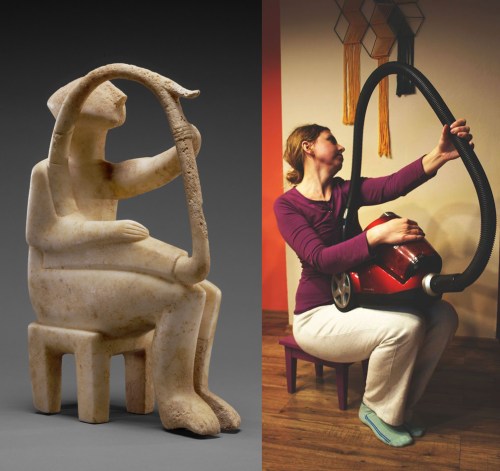
“Transforming into an ancient harp player with a vacuum cleaner ‘was the first thing that came to mind when I was looking at your collection,’ says Irena Irena Ochódzka, who posed herself into this amazing sculptural recreation. …

“[A] Baroque masterpiece ‘was the first painting that stood out to me [in the Getty collections] and I thought we could do it pretty easily,’ said Qie Zhang of this family project. Her two girls fought over the yellow dress, she told us, but you can’t tell from the delightful end result.

“Her husband’s pose also made us laugh with its allusion to parental exhaustion.”

More here. Don’t miss the Van Gogh made of Play Doh, carrot slices, and wooden beads! And tell me your favorite.

Male Harp Player of the Early Spedos Type, 2700–2300 B.C., Cycladic. Marble. Recreation via Facebook DM by Irena Ochódzka with canister vacuum.

irena_harpist_1008

Bonus Post

040420-poet-NWG-picks-BI-daffodils

Photo: Malcolm Greenaway

Nancy Greenaway sent me a couple of her lovely poems today, and they put me in the spring spirit. Thought I’d share them with you.

To Arms

After dull, damp, mud months,
tender green blades
duel to freedom
from the weather underground
where the fight for life
somehow survives
gray death’s dominion
over the frozen, surface world.

Just when we’ve thrown
gloved hands skyward
in surrender to whips
of winter wind,
daffodils shoot up blazing
captivating us with promises
of an armistice
called spring.


April

A great golden wall of forsythia
defines my neighbor’s property lines.

It glows through fog, competes
with daffodils to steal the show.

040120-daffodil

dmypsrrs3vbi3pxqmjh4gzszda

Photo: Suzanne Kreiter/Globe staff
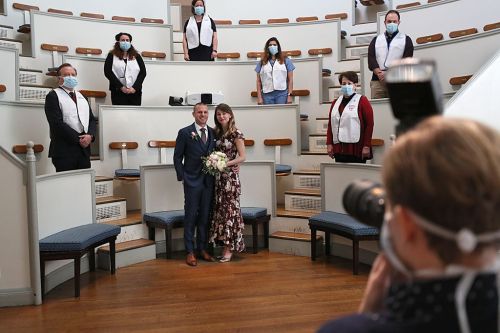
Jen Andonian and Matt Shearer, both epidemiologists, recently got married at Massachusetts General Hospital.

Where there’s a will, there’s a way. Many group events are being put off because of the war against coronavirus, but recently I’ve been learning how weddings, Passover feasts, funerals, conferences, and the like are probably managed in other kinds of war.

Here are two wedding stories from the Boston Globe.

Liz Kowalczyk reports on Jen Andonian and Matt Shearer, who “had it all planned: her burgundy floral dress, his matching checked tie. They live in Cambridge, but chose Ann Arbor, Mich., where they met as graduate students, for their simple courthouse wedding ceremony in March with immediate family. A reception for 75 guests would follow the next day at her parents’ lakeside restaurant.

“Then the fast-moving coronavirus began spreading through the world — and the United States. Andonian and Shearer, both epidemiologists on the frontlines of COVID-19 — she at Massachusetts General Hospital, he at Johns Hopkins Center for Health Security — knew they could not ignore the risk of a large celebration. …

“When she told her coworkers at the MGH Center for Disaster Medicine the next day, a colleague joked: What about just getting married at the hospital? Her co-workers turned the offhand remark into an actual plan, executed in the midst of exhausting 12-hour workdays.

During quick breaks from setting up coronavirus testing sites and expanding intensive-care units, team members ordered flowers and vanilla cupcakes and devised a music playlist. Nurse Eileen Searle applied for a one-day state certificate to perform a marriage ceremony. …

“On Friday, Andonian, 30, and Shearer, 36, were married before a small group of disaster medicine colleagues, all wearing surgical masks and sitting six feet apart to prevent the spread of germs, as the sun streamed in from the windows high in the light-blue dome. It was a welcome but brief break amid the relentless arrival of patients ill with a relentless virus; the number of patients sick enough with COVID-19 to be admitted to Mass. General had more than doubled over the course of the week, to 61 on [March 27] alone.

” ‘This may not have been the wedding you wanted, but it is clearly the wedding MGH needed,’ began Searle, whose job includes training nurses to properly put on protective gear. ‘Thank you.’ …

“When they told their families about the plan to marry at the hospital, Andonian said they had mixed feelings. ‘Everyone was sad, but after seven years, they were ready for us to get married,” she said. …

“The couple arrived about 15 minutes before the ceremony was scheduled to begin at 11 a.m., walking past a long table outside the Ether Dome set with cupcakes to share, a cake for them to take home, tiny colorful containers of bubbles, and a gift bag hiding a bottle of champagne. ..

“As Andonian waited in the hallway, Shearer stood between a white plaster statue of Apollo and a glass case containing an Egyptian mummy, part of a small collection of artifacts [in the MGH museum].

” ‘You ready?’ Searle asked.

” ‘Let’s do it,’ he said.” More.

Another Globe story detailed how a photographer that a couple had never met was determined to put together all the traditional pieces so that a soldier could “elope.”

Megan Johnson writes of bride Victoria Pass, “ ‘If you still want to get married, I definitely want to get married,’ said Victoria. ‘We gotta figure this out.’

“The couple decided they’d wed at Chicopee City Hall. But with none of their family and friends in the area, Victoria wanted to have a photographer capture the moment. They started making phone calls, and stumbled upon Dani Klein-Williams, a Northampton-based photographer.

‘They said they were just planning a very quick, no-frills elopement at Chicopee City Hall,’ said Klein-Williams. ‘I was like, “Okay, can you give me two hours? I’m gonna put something even more spectacular together for you.” ‘

“Klein-Williams called Blantyre, the Tudor-style Relais & Châteaux property in Lenox, Mass. … Within two hours, she got approval from Blantyre, which was already shut down for their annual winter closure. …

“Next, Klein-Williams called her favorite wedding planner, Tara Consolati, who also happens to be ordained. Though she had never performed a ceremony before, she was on board to officiate. Carolyn Valenti, a Berkshires-based florist, offered up a blend of snapdragons, hyacinth, and other blooms. ‘She said, “I have all these gorgeous flowers and they’re just going to rot and die,” ‘ said Klein-Williams.

By the end of the conversation, she discovered that Valenti had a house guest who could bake. Without her baking equipment on hand, however, they dumped the contents of an oversize can of tomatoes, sterilized the can, and used that as a frame for a small wedding cake, topped with berries and flowers.

“[Klein-Williams next] … reached out to Mike Murray of Summer Wind Wedding Films, who volunteered to live stream the event, so Victoria and Jerrod’s family and friends could follow along.” More.

Oh, the kindness of strangers!

Photo: Dani Klein-Williams
Victoria and Jarrod Pass eloped in the Berkshires after having to cancel their 60-guest wedding in Las Vegas. A photographer they hadn’t met, Dani Klein-Williams, was determined the couple should have all the traditional features of a wedding.

bfvwmxbidfgbhiapa6gtzpsksi

90-year-old grandma moves like Mick Jagger.

Don’t you feel that, among all their reports of gloom and doom, journalists are also trying to find ways to cheer us up? I sure am seeing a lot of articles about people helping  other people. Here is one about ways you can connect to online dance opportunities and performances, mostly for free.

Boston Globe dance critic Karen Campbell writes, “Dance, by its very nature, is an intensely personal endeavor, involving the body, as well as intellect and emotion. But dancing is seldom solitary. The sense of connecting with other bodies, other sources of energy, and the momentum generated by bodies moving together and in opposition can fuel a palpable electric charge. In this time of social distancing, those of us who regularly dance are missing not just the visceral thrill of movement, but the joy of dancing together.

“Meghan Riling, dancer/marketing director of Haitian contemporary dance company Jean Appolon Expressions, says, ‘There are so many people who refer to attending [Jean’s] Saturday class as “going to church.” With so [much] devastating news and a lack of physical connection, we really need to be there for our community as much as we can.’ The organization is now hosting online classes and tutorials. …

“Teachers and performers, many of them freelancers in the gig-based economy, are losing much-needed income. …

But Greater Boston’s dance community isn’t taking it lying down.

“Even as organizations such as Boston Dance Alliance, the Boston Artist Relief Fund, Dance/USA, MassCreative, Americans for the Arts, and the Massachusetts Cultural Council seek ways to provide a glimmer of hope for some financial assistance, dance studios and independent teachers are finding ways to keep classes going.

“Using Zoom, Instagram Live, Facebook Live, Google Hangout, even Skype, they are live streaming from their living rooms and basements, with only a computer, tablet, or phone. The stylistic range of offerings is remarkable — from contemporary (Project31dance.org) to jazz (MassMotion.com) and flamenco (LSFlamenco.com), from country western line dancing (JKDance.com) to Dance With Parkinson’s (Urbanitydance.org), to a range of ballet, hip-hop, tap, and somatic practices. Some, like MiniMoversStudio.com and BallroominBoston.com’s Facebook page, have offerings tailored for young children. …

New England’s busiest multi-genre facility, The Dance Complex in Cambridge, is offering its teachers the opportunity to live stream classes via the organization’s Instagram channel (Instagram.com/thedancecomplex), boosting visibility and access. Cambridge Community Center for the Arts (cccaonline.org) is jump-starting its interactive online video/remote learning and teaching platform to allow ‘students to attend remotely, and faculty members to teach from wherever they are comfortable,’ says president and executive artistic director Dan Yonah Marshall. The organization is offering its A/V online streaming setup to the greater dance community, too.

“Other studios are following suit, and in some cases increasing the range of offerings. “

Find many great links in the Globe article, here. Plus, you can check out free Alvin Ailey dance theater performances here.

Photo: Handout
Laura Sánchez, a dance instructor in Cambridge, teaches an online flamenco class. I know a five-year-old who should take this class.

bibypnxonzhk7fei5zdwlv7rkm

el-jefes-taqueria-850x478large

Photo: Suzanne Kreiter/Globe Staff
El Jefe’s Taqueria is among the restaurants Cambridge is paying to serve hot and cold meals to homeless shelters.

One of the many interesting aspects of the Situation has been the way leaders in states and municipalities have taken matters into their own hands.

We know that individuals and both for-profit and nonprofit organizations are stepping up, but some government entities are, too. Across-the-board federal efforts would be better, especially if we don’t want to see New York suing Rhode Island and other such anomalies, but we’ll take what we can get.

Here’s a story about Cambridge, Mass., a city that some have called Moscow on the Charles mainly because it tries to help the poor.

Erin Kuschner, writes at the Globe‘s Boston.com, “With restaurants facing a sudden loss of revenue due to Gov. Baker’s mandated dine-in ban, and homeless shelters seeing a drop in volunteers helping to deliver and prepare food, the City of Cambridge came up with a solution to benefit both parties: Paying restaurants to make and deliver food to homeless shelters.

“The program launched Monday after the city reached out to both the Harvard Square Business Association and the Central Square Business Improvement District to help organize the initiative, with a goal of distributing roughly 1,800 to 2,000 meals to various shelters by the end of the week. …

“Denise Jillson, executive director of the Harvard Square Business Association, said that it has already brought roughly 15 restaurants on board to make meals for local shelters like the Harvard Square Homeless Shelter and Y2Y, a youth homeless shelter that has seen many of its student volunteers leave following Harvard’s closure.

“ ‘It just made so much sense,’ Jillson said. ‘We were on board immediately.’ …

“Among the restaurants serving Harvard Square’s homeless shelters are Black Sheep Bagel, Cardullo’s, El Jefe’s Taqueria, Orinoco, Subway, and Veggie Grill. Jillson said that they have tried to provide a range of healthy meal options for breakfast, lunch, and dinner.

“The Central Square Business Improvement District partnered with PAGU to deliver meals to Bay Cove Human Services and the Cambridge YMCA.

‘We made our first delivery [Monday],’ said Michael Monestime, executive director at the Central Square Business Improvement District. ‘It was pretty humbling and sad at the same time. It’s hard enough being homeless on any given day, and then under these circumstances it’s even more difficult.’ …

“In addition to providing hot and cold meals to those experiencing homelessness, the city has set up a Cambridge Community Food Line, available to any resident who is a high risk for food insecurity.

“The delivery service provides a weekly bag of produce and shelf-stable food items to individuals and families who have experienced the following: The food pantry or meal program you used has closed until further notice; you have lost your job or part of your income and cannot afford groceries at this time; you are homebound due to illness, disability, or quarantine and do not have friends or family that can bring you food; you are at high risk for COVID-19 (coronavirus) and do not have access to a regular food source.”

More at the Boston Globe, here. Local readers, try to remember these restaurants and thank them with your business when we come out of the tunnel to the other side of this plague.