Feeds:
Posts
Comments

Posts Tagged ‘100 years’

Photo: Graeme Sloan for the Washington Post.
Wild ponies swim across the Assateague Channel in a 100-year-old tradition. Remember Misty of Chincoteague?

Today’s story reminds me of a book series I loved as a child, one that I have learned is too slow for today’s kids, who love slam-bang spy adventures.

Remember Misty of Chincoteague and the annual swim? Hau Chu at the Washington Post wrote about the 100th real-life swim.

“By sunrise at 6:03 a.m. on Wednesday, hundreds of people already had their legs smeared with mud and their brows filled with sweat as their eyes gazed across the Assateague Channel along Virginia’s Eastern Shore.

“They trudged through the marsh to stake out a spot of shoreline. Some woke up as early as 3 or 4 a.m. Others planned more than a year ago from their homes in Massachusetts, Texas and beyond to be in this exact spot.

“These people wrestled with all these things to see wild ponies [at] Pony Swim Lane.

“ ‘Let me tell y’all, you guys are hardcore,’ Chincoteague Mayor Denise Bowden said to the crowd, nearly two hours later, while standing on a pier overlooking the water. … ‘That mud will wash off, but your memories are gonna last forever.’

“The annual wild pony swim at Chincoteague brings thousands of visitors and locals to the town every summer. This year marked the 100th year of the event. Ponies are corralled by the volunteer fire company on neighboring Assateague Island and swim over at slack tide, when the current is still. Officials say they do this to manage the population of ponies that inhabit the land: The festivities culminate in an auction of some of the foals that provides money for the company and veterinary care. …

“Andrea Lucchesi of Southampton, Massachusetts, knew plenty about it. Like some others, she had long dreamed of attending because of her fondness for Misty of Chincoteague, a 1947 children’s novel by Marguerite Henry.

“The book, and subsequent 1961 film, were inspired by a real pony, who is memorialized with a statue along the town’s Main Street. Business signs, restaurant menu specials and residential decorations throughout Chincoteague incorporate the wild creatures. Visitors and locals alike are clad for days in apparel with pony imagery or the Saltwater Cowboys, the group of firefighters responsible for managing the ponies.

“Those cowboys brought the ponies to the edge of Assateague Island at about 8:06 a.m. …

“And off they went. Dozens of ponies’ heads stayed above water and inched closer to the shore within minutes. All made it over to a pen on Pony Swim Lane. …

“Some have criticized the swim over concerns about the horses’ welfare and the desire to tame wild animals. Scott Rhoads, 69, was standing along a fence of the pony pen after the swim. He went back and forth on how he felt about it.

“ ‘You just wonder, these ponies, what they’re thinking,’ Rhoads, a retired small-animal veterinarian, said before taking a second to pause. ‘I worry,’ he paused again, ‘how it affects them, but I’m sure they get over it quickly.’ …

“People like Ashley Le embraced the summer beach town atmosphere and the novelty and spectacle of the event. Le, 28, had been to Chincoteague a few times before but never during pony swim time, she said. She lives in the Logan Circle neighborhood of Northwest Washington but was born and raised in Ho Chi Minh City, Vietnam.

“ ‘It’s a very American thing, but it’s not like a military American thing; it’s a small-town American thing,’ Le said. ‘I feel like a lot of unique American things you think of is like July 4 or like fireworks and that kind of stuff. But this isn’t it; this is so outside of that zone. … I think just being here makes me feel like taking a breath of fresh air away from everything that’s happening in America. And the ponies are just so cute.’

“By sunset at 8:12 p.m., hundreds of people were cleaned up at the Chincoteague Carnival Grounds on Main Street. …

“Bowden, 56, was sitting in a chair inside the information booth at the carnival entrance. She was born and raised in Chincoteague. She’s a Saltwater Cowboy, and her family’s participation in the event goes back to her grandfather. But Bowden was injured in an April roundup of the ponies. The wild horses started charging and fighting and threw her off her horse. The distal femur in her right leg was crushed, she said. Still, this was all worth it.

“ ‘If they had to drag me down there on a stretcher … if they had to helicopter me in, it didn’t matter,’ Bowden said. ‘I wouldn’t miss this for anything.’ ”

More at the Post, here. Have you ever been to that part of Virginia? I was there once but didn’t see the ponies. The main thing I recall is eating my first oyster fritters.

Read Full Post »

Photo: Cincinnati & Hamilton County Public Library.
This copy of
Wild West was returned more than 35,000 days after its due date of Nov. 23, 1926.

Here’s a fun story for all of us who love libraries. Looking at you, Laurie.

Tana Weingartner writes, “Librarians at the Westwood and Price Hill branches of the Cincinnati & Hamilton County Public Library got quite a surprise late last year. A copy of Wild West, by Bertrand W. Sinclair, was returned after 98 years.

” ‘I’ve been here a while, and I’ve seen books come back that were due in the ’80s and the ’90s and even the ’70s, but this is the first time I’ve come across a book that was almost a century overdue,’ Christopher Smith, genealogy and research services reference librarian, tells WVXU.

“According to the date slip in the back of the book, it was checked out from the Price Hill branch sometime in 1926 and due back on Nov. 23, 1926. …

“The book was discovered by family members cleaning out the home of an elderly loved one who had died. It was found on a bookshelf with other books, though Smith says it’s unclear to whom the book belonged.

” ‘We assume it’s the person who checked it out, but we don’t know that,’ he says, noting the library does have some old records, but it would take a lot of digging to see if it still has lending records going back that far. …

“It was returned to the Westwood branch about five miles away — and more than 35,000 days late. The library no longer charges fines, but it if did, he calculates the fine would have been roughly $730. The average cost of a hardback novel in 1926, he points out, was $2.

” ‘The way I look at it is someone either loved this book — and I think they did — or they just forgot about it,’ says Smith. ‘I assume this person just loved the book and decided, “Nope, I’m going to keep that.” ‘

“After about two years, he notes, the library likely — though he can’t say for certain — sent someone out to look for the book. He says library policy at the time would have been to go after the borrower, so their borrowing privileges would also likely have been affected. …

“The book was clearly well cared for, despite its age. Smith reports it is in decent shape. The library did purchase another copy of the book two or three years after the original went missing, and it remains in circulation. …

” ‘Normally, for a book this old that’s fiction, we wouldn’t necessarily keep a second copy,’ he tells WVXU. ‘But in this case, I felt it deserved a place on the shelf, so I had it re-cataloged — because it had fallen out of our system decades and decades ago — and it’s back on the shelf and can be checked out.’

“A lot of times, library books head to a used book sale or the Friends of the Public Library after they reach their useful lifetime in circulation. Smith says it’s clear this wasn’t a case of someone picking the book up used.

” ‘[There] would have been a stamp that clearly said “discarded material,” and those are clearly visible,’ he notes. ‘But there is nothing in this book to indicate that it was not meant to come back, and there’s nothing in the book to indicate that the library got rid of it.’

“There is a stamp indicating the book was added to the library’s collection on May 14, 1926.

” ‘I just found it fascinating. The fact that it came back in decent shape, considering it’s an almost a 100-year-old book — that’s crazy,’ Smith says. ‘The fact that it made it back to us, and didn’t just make it into the garbage or recycling or getting ground up for paper pulp? It’s just amazing that a book like that made it back to us.’

“As the name suggests, Wild West is a Western-genre work of fiction. Smith notes it was very popular, and Westerns were a big deal at the time.

” ‘It was the books that would lead into the TV programs that were all the rage in the 1950s,’ he adds.

“Here’s the liner description from the library’s catalog: ‘Rustlers had long been stealing from Montana cattle outfits when Robin Tyler, rep for the Bar M during the Block S roundup, saw Mark Steele, the Block S ramrod, hazing cows into a hidden canyon, and learned that Steele was the secret owner of the T Bar S iron, whose cows showed a miraculous increase each year. Trying to catch Steele red-handed, Robin tipped his hand. And Steele, a gunman, trapped Robin, who had never owned a gun, in a line cabin and decided to kill him. Robin pulled through that ruckus and went on the dodge. But he came back-this time with a smoking Colt-to start a wholesale cleanup on the Montana rangeland!’ “

Did you ever keep a book you weren’t supposed to keep? As I child, I kept a story collection from my elementary school and used it for years to teach dolls in my little “school” on the third floor.

More at WVXU, here.

Read Full Post »

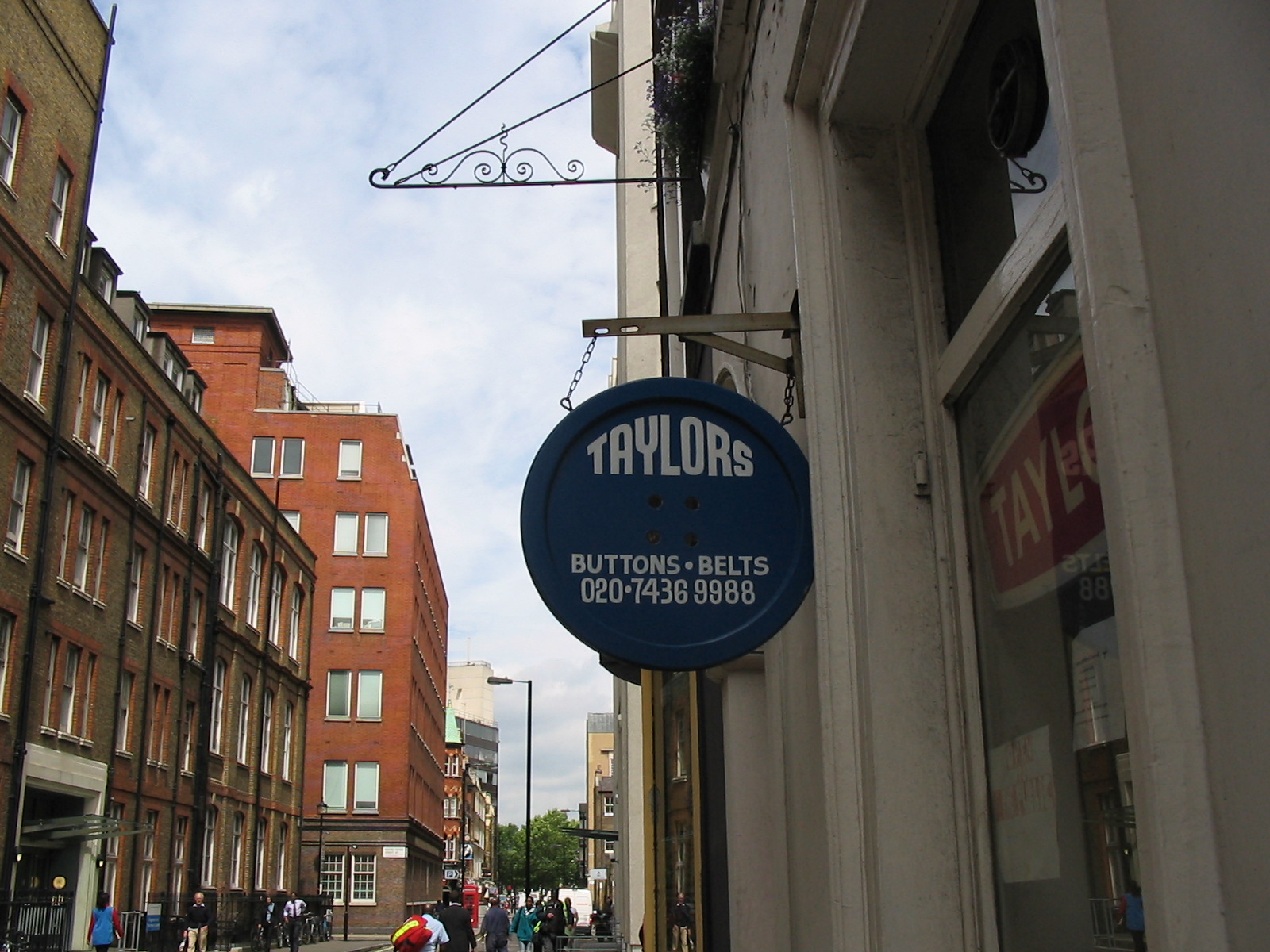
Photo: Taylors Buttons.
The Taylors Button Shop has been established in London over 100 years.

A long time ago, a parent family at the Elwanger-Barry Nursery School in Rochester, New York, closed down their button business and donated a lifetime supply of buttons to the school. Poured into an indoor sandbox, the buttons became one of the two favorite play centers of three-year-old Suzanne. The fuzzy box and the button box.

That’s one reason I’m interested in button stories. And when an editor from last year’s Ukraine social-media project (see this post) wrote on Facebook about a 100-year-old button store in London she visited, I had to learn more.

The Gentle Author at Spitalfields Life interviewed Maureen Rose of Taylors Buttons for a bookshop’s blog:

“Taylors Buttons is the only independent button shop in the West End. It’s more than 100 years old and it’s only been owned by two families in that time. It was founded by the original Mr Taylor; then there was Mr Taylor’s son, who retired in his late eighties when he sold it to my husband,” Maureen Rose said.

“I was a war baby. My mother was from Whitechapel and she opened her own millinery business in Fulham at nineteen. She got married when she was twenty-one and ran her business all through the war. As a child, I used to sit in the corner and watch her make hats, but I didn’t take up millinery – something I regret now, as she was very talented and she could have taught me.

“I helped my mother for a while: I did a lot of buying for her in Great Marlborough Street, where there were many millinery wholesalers. There was a big fashion industry in the West End: I used to go to see the collections from houses like Hardy Amies and Norman Hartnell. It was so glamorous. Now it’s all gone.

“My late husband, Leon Rose, first involved me in this business. He started his career in a button factory learning how to make buttons. Then his uncle, who had a factory in Birmingham, got in touch to say, ‘There’s a gentleman in town who’s retiring and you should think about taking over his business.’ So he did.

“My mother went in to help when he needed someone for a couple of hours a day, and then – of course – there was me! I’ve been working here for more than 40 years now and since my husband died in 2007 it has been a one-woman show.

“Every button tells a story and I have no idea how many there are in the shop. Some are more than 100 years old, but most I make to order. You send me the fabric – velvet, leather or whatever – and I’ll make you whatever you want. We used to do only small orders for tailors: two fronts and eight cuff buttons for a suit. Nowadays I do them by the hundred. I don’t think Leon ever believed that was possible.

“Anybody can walk into my shop and order buttons, but I get a lot of orders for theatre, television, film, fashion houses and weddings. I get gentlemen who buy expensive suits that come with cheap buttons: they come here to buy proper horn buttons to replace them.

“My friends ask me why I have not retired, but I enjoy working here. What would I do at home? I’ve seen what happens to my friends who have retired: they lose the plot. I meet nice people in the shop and it’s interesting. I’ll keep going for as long as I can.”

Interview originally published on the Spitalfields Life blog by The Gentle Author. 

More here. And there’s detailed button information at the Taylors Buttons website, here, where you can also learn that Dickens lived in the building once. Hat tip: Ro.

Read Full Post »

Photo: Aaron Ufumeli/EPA.
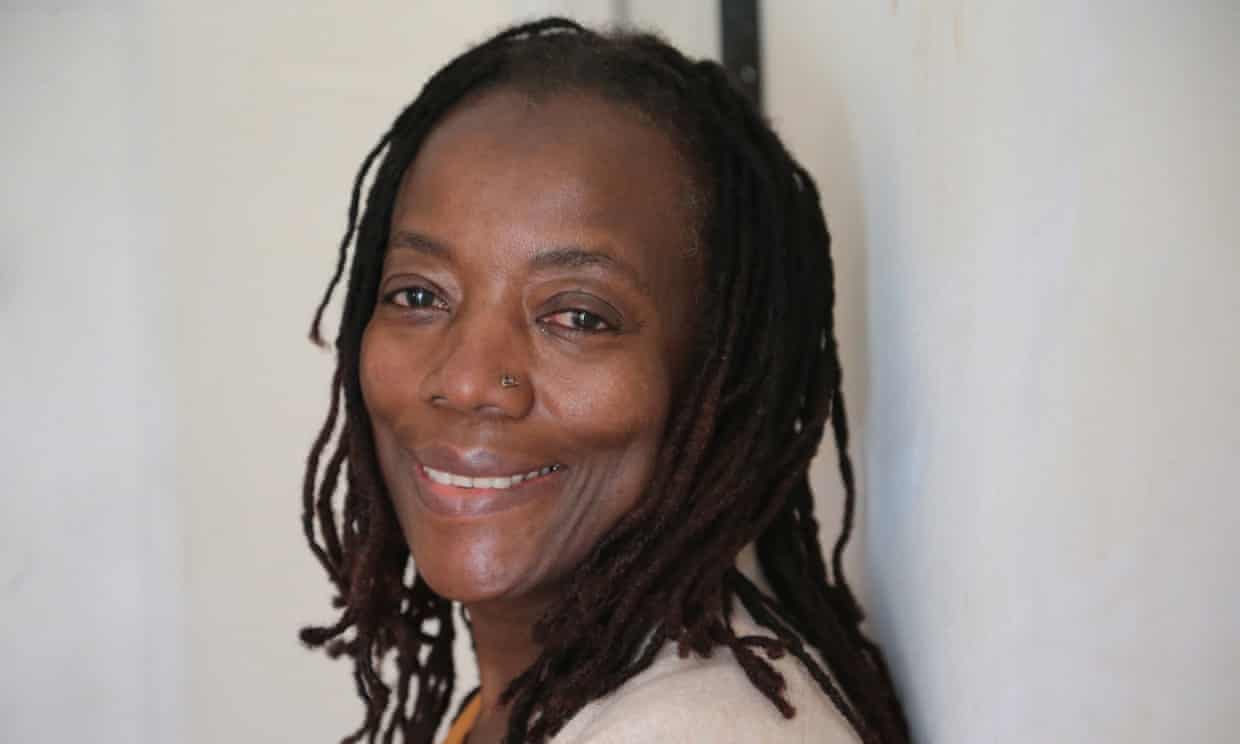
Author Tsitsi Dangarembga has joined the Future Library, offering a work that won’t be read for 100 years. 

There are many ways artists can highlight how global warming is hurting the planet. Katie Paterson, for example, once created an installation that allowed people to listen in on the sound of glaciers melting. Now she has come up with the idea of a Future Library in hopes that it will still exist in 100 years so that people can read the works of the celebrated authors who have joined the project.

Alison Flood reports on one such author at the Guardian. “Tsitsi Dangarembga made the Booker shortlist for her most recent novel, This Mournable Body, the story of a girl trying to make a life in post-colonial Zimbabwe which was praised as ‘magnificent’ and ‘sublime.’ Her next work, however, is likely to receive fewer accolades: it will not be revealed to the world until 2114.

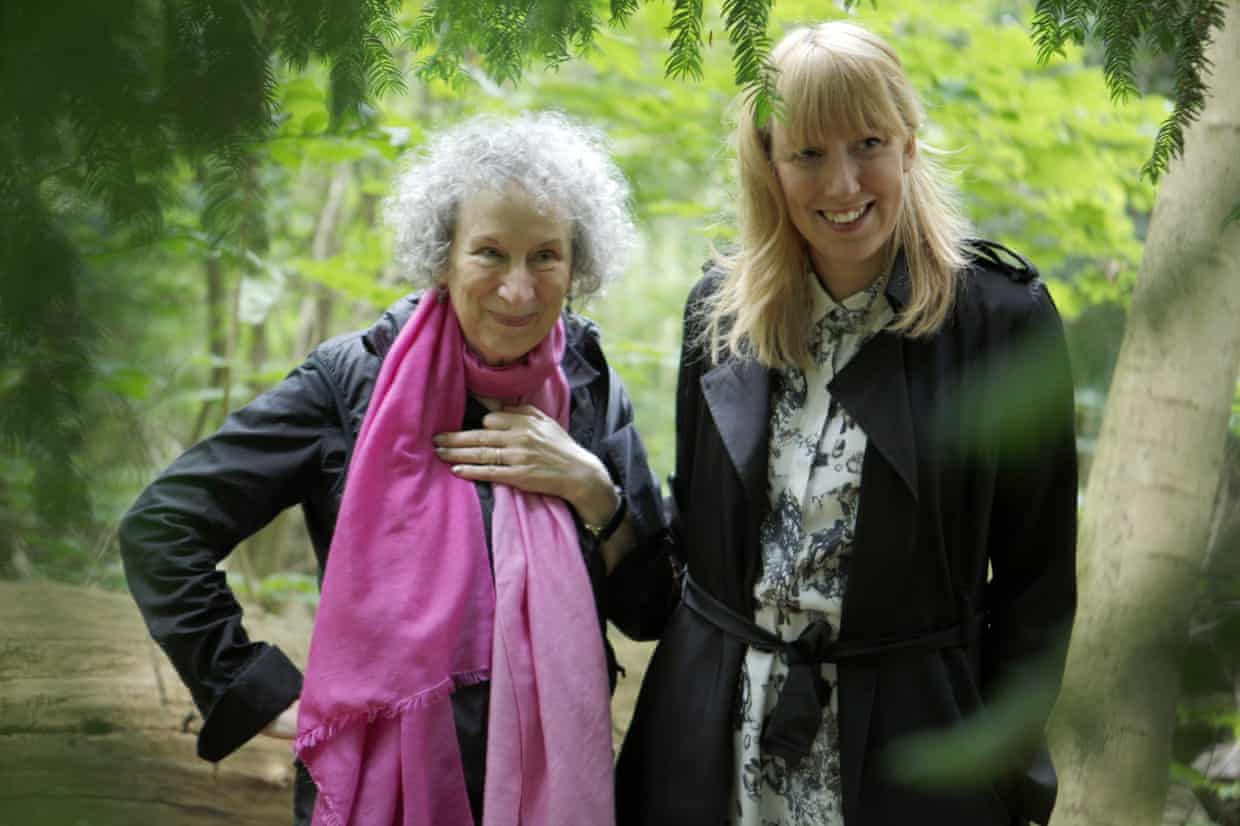
“The Zimbabwean writer is the eighth author selected for the Future Library project, an organic artwork dreamed up by the Scottish artist Katie Paterson. It began in 2014 with the planting of 1,000 Norwegian spruces in a patch of forest outside Oslo. Paterson is asking one writer a year to contribute a manuscript to the project – ‘the length of the piece is entirely for the author to decide’ – with Margaret Atwood, Ocean Vuong and Karl Ove Knausgård already signed up. The works, unseen by anyone but the writers themselves, will be kept in a room lined with wood from the forest in the Deichman library in Oslo. One hundred years after Future Library was launched, in 2114, the trees will be felled, and the manuscripts printed for the first time.

“The artwork ‘perfectly expresses my yearning for a human culture that centres the earth’s sustainability,’ said Dangarembga. ‘I share with many other dwellers of our beautiful planet a deep sense of concern for our home’s wellbeing.’ …

“The author, whose acclaimed debut Nervous Conditions (1988) was the first novel written in English by a black woman from Zimbabwe, said she was already “settling on the story” she would tell. She was not worried about the fact that she will never know how her writing is received.

‘I’m always my first audience. … A lot of my life has been writing into the void. So I’m used to writing into the void.’

“Paterson said that Future Library was ‘honoured’ to include Dangarembga. … ‘Tsitsi Dangarembga’s words have shaped the world. Praised for her ability to capture and communicate vital truths, the Zimbabwean novelist is admired worldwide as a voice of hope,’ said Paterson. ‘She examines oppression, discrimination, and systemic racism, through writing that is brave and unforgettable.’ …

” ‘I don’t think of myself in those terms,’ Dangarembga said. ‘So it’s really a great honour, I’m very pleased about it.’

Nervous Conditions, to which This Mournable Body is a sequel, was named by the BBC as one of the 100 books that shaped the world. Currently in Harare, the Zimbabwean author is working on a piece of non-fiction, and a speculative young adult novel. She is also awaiting a trial date after she was arrested during anti-corruption protests in Harare last year, and charged with intention to incite public violence. Authors and free speech organisations have called for the charges to be dropped, describing them as an outrage.”

More at the Guardian, here.

Photo: Giorgia Polizzi.
Novelist Margaret Atwood with artist Katie Paterson at the inauguration of the Future Library forest in Norway. 

Read Full Post »

Photo: Oklahoma City Public Schools
Drawings and script on 1917 school chalkboards were recently uncovered in Oklahoma.

In June 2015, student drawings and script from 1917 were uncovered on Oklahoma blackboards.

Elahe Izadi wrote at the Washington Post, “Teachers and students scribbled the lessons — multiplication tables, pilgrim history, how to be clean —  nearly 100 years ago. And they haven’t been touched since. …

“Contractors removing old chalkboards at Emerson High School in Oklahoma City made a startling discovery: Underneath them rested another set of chalkboards, untouched since 1917.

“ ‘The penmanship blows me away, because you don’t see a lot of that anymore,’ Emerson High School Principal Sherry Kishore told the Oklahoman. ‘Some of the handwriting in some of these rooms is beautiful.’ …

“A spokeswoman said the district is working with the city to ‘preserve the “chalk” work of the teachers that has been captured in time.’

“A wheel that apparently was used to teach multiplication tables appears on one board. ‘I have never seen that technique in my life,’ Kishore told the Oklahoman.

“The boards carry not just teachers’ work, but also that of students, and every room has a lesson on pilgrims, according to the district.” More here.

The principal’s comment on the penmanship was interesting to me because just a few weeks ago, my husband unearthed his mother’s student chapbooks from around the same period. All she did was copy Chaucer. Not only was there no analysis, there was nothing about whether she even liked what she read. Not required.

I’d like to think that today’s loss of elegant penmanship signifies that teachers are spending time on more important learning.

Read Full Post »